










































COVID-19 Vaccine Hesitancy Worldwide: A Concise Systematic Review of Vaccine Acceptance Rates
The University of Jordan and Jordan University Hospital
"[V]accine hesitancy can be the major hindrance of the control efforts to lessen the negative consequences of COVID-19 pandemic, at least in certain countries/regions."
Previous research has revealed that vaccine hesitancy is a common phenomenon globally, with variability in the cited reasons behind refusal of vaccine acceptance. Common reasons included: perceived risks vs. benefits, certain religious beliefs, and lack of knowledge and awareness. These reasons can be applied to COVID-19 vaccine hesitancy, as various studies have shown. This systematic review aimed to assess the acceptance rates for COVID-19 vaccine(s) in different countries worldwide, which can provide an initial step to study the factors implicated in regional and cultural differences behind COVID-19 vaccine hesitancy. The goal is to help guide interventions to increase awareness and assure people about the safety and benefits of vaccines to the end of tackling this threat to global efforts to combat the pandemic.
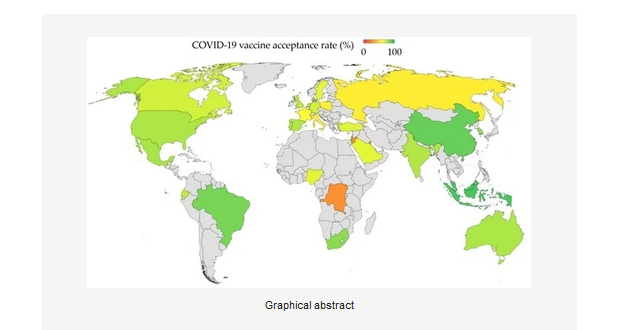
The researcher conducted a systematic search of the peer-reviewed English survey literature indexed in PubMed on December 25 2020. Results from 31 peer-reviewed published studies met the inclusion criteria and formed the basis for the final COVID-19 vaccine acceptance estimates. Survey studies on COVID-19 vaccine acceptance rates were found from 33 different countries.
In the majority of survey studies among the general public stratified per country (29/47, 62%), the acceptance of COVID-19 vaccination showed a level of 70% or higher. The highest COVID-19 vaccine acceptance rates were found in Ecuador (97.0%), Malaysia (94.3%), Indonesia (93.3%), and China (91.3%). The lowest COVID-19 vaccine acceptance rates were found in Kuwait (23.6%), Jordan (28.4%), Italy (53.7), Russia (54.9%), Poland (56.3%), the United States, or US (56.9%), and France (58.9%). Studies found that males were more inclined to accept COVID-19 vaccines, which "can be related to their higher perception of COVID-19 dangers and lower belief in conspiratorial claims surrounding the disease".
Eight surveys among healthcare workers (doctors and nurses) indicated vaccine acceptance rates ranging from 27.7% in the Democratic Republic of the Congo (DRC) to 78.1% in Israel. For the 3 studies conducted among parents/guardians, the vaccine acceptance rates were more than 70%. For the 2 studies among University students, the vaccine acceptance rate was 57.3% in Malta (excluding university staff) and 86.1% in Italy.
In countries with multiple surveys over time, various changes in COVID-19 vaccine acceptance rates were observed. Two examples include: In Italy, the vaccine acceptance rate was 77.3% in April 2020, 70.8% in June 2020, and 53.7% in September 2020. For the US, the vaccine acceptance rate was 56.9% in April 2020, and rates ranged from 67.0 to 75.0% in May 2020, reaching 75.4% in June.
Overall, the findings indicate that the acceptance rates among the general public were relatively high in East and South East Asia. One study cited here attributed the relatively high rates of vaccine acceptance in the region to strong trust in governments. These rates might also be related to stronger confidence in vaccine safety and effectiveness, as reported previously in Asia.
Aside from Israel, the Middle East was among the regions with the lowest COVID-19 vaccine acceptance rates globally. "Such low rates can be related to the widespread embrace of conspiratorial beliefs in the region, with its subsequent negative attitude towards vaccination..."
Only 2 surveys among the general public in African countries reported acceptance rates: 81.6% in South Africa and 65.2% in Nigeria. An early knowledge, attitudes, and practices (KAP) survey from North-Central Nigeria reported an acceptance rate of COVID-19 vaccine of 29.0%, which highlights the need for more studies for an accurate depiction of COVID-19 vaccine hesitancy in Africa due to possible large regional and sub-regional variations. "Besides Africa, more studies are needed from Central Asia, Eastern Europe, Central and South America to reach reliable conclusions about the scope of COVID-19 vaccine hesitancy around the globe."
In conclusion: "The widespread prevalence of COVID-19 vaccine hesitancy mandates collaborative efforts of governments, health policy makers, and media sources, including social media companies. It is recommended to build COVID-19 vaccination trust among the general public, via the spread of timely and clear messages through trusted channels advocating the safety and efficacy of currently available COVID-19 vaccines."
Vaccines 2021, 9, 160. https://doi.org/10.3390/vaccines9020160.
- Log in to post comments