

























Development action with informed and engaged societies

After nearly 28 years, The Communication Initiative (The CI) Global is entering a new chapter. 

Following a period of transition, the global website has been transferred to the University of the Witwatersrand (Wits) in South Africa, where it will be administered by the Social and Behaviour Change Communication Division. Wits' commitment to social change and justice makes it a trusted steward for The CI's legacy and future. 

On the transfer, co-founder Victoria Martin expressed her pleasure to see this work continue under Wits' leadership, knowing that co-founder Warren Feek (1953–2024) would have felt deep pride in The CI Global's Africa-led direction. 

As Wits, we honour the team and partners who sustained The CI for decades and look forward building from that strong base. This includes co-founders Warren Feek (1953-2024) and Victoria Martin as well as La Iniciativa de Comunicación (CILA), which continues independently at lainiciativadecomunicacion.com with links to The CI Global site. We are also eager to forge new partnerships and entertain new ideas as we consider how best to contribute to social and behaviour change in our rapidly evolving environment.

If you are joining the International Social and Behaviour Change Communication (SBCC) Summit in Panama, please join Wits and CILA on Monday, 22 June, to share your thoughts and suggestion for the relaunch of the Communication Initiative. We will be in Pacifica 5 from 12-1:25 for the Refuel, Reflect, and Renew Lunch Series: The Communication Initiative: celebrating a driving force for Communication for Social Change and the way forward. We will reflect on the legacy of Warren Feek and family in creating the Communication Initiative, consider the contributions of CI over the years and then turn our attention towards the future in this dynamic session. 

If you are unable to join us in Panama, we still want to hear from you. Please contribute your thoughts by following this link: https://redcap.link/CommunicationInitiative2026 or reaching out to ci_surveys@commint.com

You can also follow the QR Code:

 https://redcap.link/CommunicationInitiative2026

Time to read
less than
1 minute
Read so far

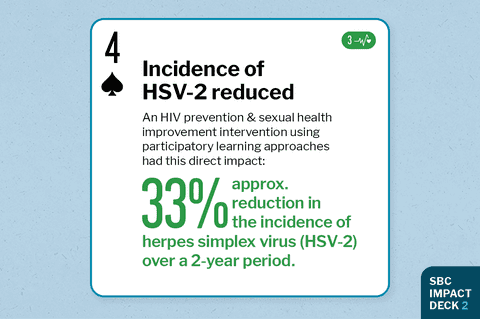
Participatory Learning - 33% Reduction in the Incidence of HSV-2
1 comment

Strategy researched

HIV prevention and sexual health improvement intervention using participatory learning approaches to build knowledge, risk awareness, and communication skills and to stimulate critical reflection

Impact achieved

Stepping Stones was associated with a reduction of about 33% in the incidence of herpes simplex virus (HSV-2) (adjusted incidence rate ratio 0.67, 95% confidence interval (CI) 0.46-0.97; P=0.036) - that is, it reduced the number of new HSV-2 infections over a 2-year period by 34.9 (95% CI 1.6-68.2) per 1,000 people exposed. However, there was no evidence that Stepping Stones lowered the incidence of HIV (adjusted incidence rate ratio 0.95, 95% CI 0.67-1.35).

Country of study

South Africa

Research methodology

RCT

Journal

BMJ: British Medical Journal; 2008

Journal paper title and link

Impact of stepping stones on incidence of HIV and HSV-2 and sexual behaviour in rural South Africa: cluster randomised controlled trial

Excerpt from Abstract

"Stepping Stones did not reduce incidence of HIV but had an impact on several risk factors for HIV - notably, HSV-2 and perpetration of intimate partner violence."

Summary at this link


Comments

Submitted by tturk on Thu, 05/18/2023 - 00:26 Permalink

This card may benefit by elaborating on what significant behavioural impacts were achieved in relation to the several risk factors for HIV - notably, HSV-2 and perpetration of intimate partner violence, rather than acknowledging no impact on the key indicator of HIV incidence. The argument being that the other behaviors are determinants of the later achievement of reduced levels of HIV infection.