










































COVID-19 Snapshot MOnitoring (COSMO Standard): Monitoring Knowledge, Risk Perceptions, Preventive Behaviours, and Public Trust in the Current Coronavirus Outbreak - WHO Standard Protocol
"For crisis response measures to affect public behaviours, they need to be perceived as consistent, competent, fair, objective, empathetic or sincere. They also need to be easily understood and communicated through trusted people and accessible channels."
In a crisis such as the 2020 outbreak of the novel coronavirus, monitoring public perceptions of risk, protective and preparedness behaviours, public trust, and knowledge and misinformation can enable government spokespeople, the media, and health organisations to implement adequate responses. The purpose of this standard protocol for national serial cross-sectional studies in the World Health Organization (WHO) European Region is to allow rapid and adaptive monitoring of these variables over time and to assess the relations between risk perceptions, knowledge, and misinformation to preparedness and protective behaviour regarding COVID-19.
Intended to enable rapid, flexible, and cost-effective monitoring, the approach to national studies on public perceptions and behaviours was developed based on a monitoring framework initiated in Germany on March 3 2020: the "COVID-19 Snapshot Monitoring" (COSMO). The researchers and authorities who are collaborating on COSMO - Universität Erfurt, Robert Koch Institut, Leibniz Institute for Psychology Information, Bernhard Nocht Institute for Tropical Medicine, Science Media Center, and Yale Institute for Global Health - have made this framework available, and the protocol and questionnaire have been adapted for regional use.
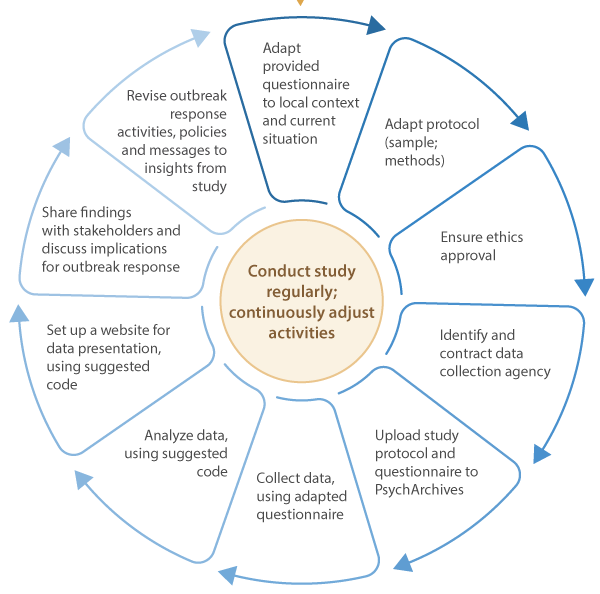
Any country interested may use the questionnaire to conduct a serial, cross-sectional study regarding the public's COVID-19-related risk perceptions, behaviours, trust, knowledge, and other variables. (Variables can be adapted to different countries, groups, cultural contexts, and to the evolving situation and epidemiology over time.) A national research group or private company can be engaged to collect the data via online panels. Using a set of codes, the findings are automatically transferred to a protected website, which allows national pandemic response groups to assess changes over time and assess misinformation or possible stigma as they emerge. National teams using the tool are urged to work in partner coalitions to discuss insights gained and implications for outbreak response interventions, policies, and messages. Results can be made available to the media to support high-quality and responsible reporting.
WHO advises including a broad range of stakeholders in this process, and engaging them in all steps.
The guidance document includes:
- details about the recommended process and steps;
- a sample study protocol;
- advice for obtaining ethical clearance;
- a suggested sample questionnaire; and
- codes for data analysis and concurrent establishing of a website for rapid online presentation of the data.
WHO Europe's Insights Unit and Health Emergencies Programme are offering support to countries for implementation and are asking all users of the tool to let them know so they can coordinate and share (see Network Contact, above). As of this writing, a few countries have rapidly instigated studies to gain such insights, and more countries are urged to prioritise such efforts to inform and support other response measures.
Publishers
49 (guidance document)
WHO Regional Office for Europe website, March 25 2020.
- Log in to post comments