










































Building Disaster Resilient Communities: Evaluating the Impact of the BBC WST's Radio Programme New Home New Life on Disaster Risk Reduction and Related Messages
BBC World Service Trust
This 20-page report outlines the key findings from a qualitative study of the Afghan radio soap opera New Home New Life (NHNL), which is created by the media-for-development project for Afghans run by Afghans, Afghan Education Projects (AEP). This research, carried out in July 2009 by the Research & Learning Group (R&L) of the British Broadcasting Corporation (BBC) World Service Trust (WST) with funding from the European Commission's Humanitarian Aid Office (ECHO), sought to assess knowledge, attitudes, and practices (KAP) with regard to disaster preparedness/management among NHNL audiences.
Broadcast in Dari and Pashto on the BBC World Service since 1994, NHNL communicates educational messages on key developmental themes such as health, gender equity, good governance, and sustainable rural livelihoods. Major subjects covered have included mine awareness, repatriation, nutrition and malnutrition, drinking water, livestock management, issues related to poppy cultivation, and basic hygiene. Weekly radio educational feature programmes provide back-up information on the health (Health and Life), rural (Village Voice), urban (City Voice), and governance issues (People Talk) that arise from the drama.
R&L conducted focus group discussions and in-depth interviews among NHNL listeners. To get a comparative perspective of the impact on regular listeners, two focus groups were also conducted among non-listeners. In total, 10 investigators (male and female) were trained in 8 villages across 4 provinces - Kandahar, Khost, Nangarhar, and Laghman - provinces chosen because of their proneness to natural disasters like floods, droughts, and earthquakes. The Research and Learning Group developed discussion guides (for listeners and non-listeners) in consultation with the AEP creative and drama production team in Kabul. The guides were translated in Dari and Pashto, and fine-tuned after pre-testing for audience comprehension and discussion flow.
Selected findings:
- People mentioned learning various things from NHNL, such as sending their daughters to school, saving young people from drug addiction, learning to be self-sufficient, and taking care of their environment. "But the most common message echoed in almost all the focus groups was the message of solving day-to-day problems amicably with the help of elders and the Jirga (local council) and not with guns..."
- Most respondents who had listened to NHNL were aware of the important messages related to earthquakes (e.g., important documents, first aid, etc. should be kept safely in a place from where they can be retrieved easily when disaster strikes). "By contrast, those who had not listened to New Home New Life did not have knowledge about specific issues related to earthquakes. While some respondents gave general answers in response to specific questions on disaster preparedness and management, most did not exhibit correct knowledge on disaster preparedness and risk reduction."
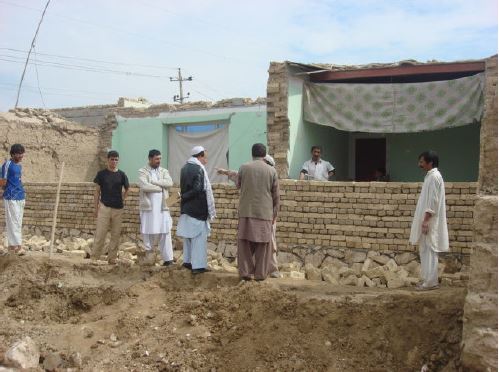
- Most respondents who had listened to NHNL were aware of important messages related to floods (e.g., people should use boiled water to prevent waterborne infections like cholera and diarrhoea after the floods, and should use preventive measures like mosquito nets to prevent incidences of malaria caused by mosquitoes breeding in stagnant water). When asked about the precautions taken by inhabitants of the Di-Payan village, the respondents mentioned that the people from the lower village decided to build a stone wall to prevent damage from floods to their agricultural land. [In the words of a male listener from Village Bahramkhil, Khost Province: "The villagers do not have money to build the wall but we should decide that every villager can work and take part."] By contrast, those who had not listened to New Home New Life blamed the Government and the municipal authorities for not taking adequate measures to prevent floods.
The authors conclude that "There is clear evidence from the focus group discussions and in-depth interviews that the audiences of New Home New Life not only recalled the characters and the storyline of the episodes related to disaster preparedness and management, they also played back the messages related to disaster risk reduction very clearly, narrating specific instances from the programme episodes. Both male and female listeners across provinces could recall the messages very clearly. Also encouraging is the fact that some of them even reported taking actions inspired by the drama to prepare for disasters in their respective villages and families....By contrast, the non-listeners...gave very general and vague responses to specific issues related to preparedness for and management of disasters. The responses ranged from lack of awareness to myths and misconceptions about the causes of disasters and mitigation of the impact of disasters. While the listeners sounded motivated and prepared to deal with natural disasters, the non-listeners sounded despondent blaming the Government for not taking adequate steps for disaster prevention and mitigation."
It is recommended that NHNL continue the broadcast of messages related to disaster risk reduction - perhaps including messages/storylines on natural disasters other than floods, earthquakes, and droughts (like avalanches, landslides, mudflows, blizzards, and cyclonic storms). The authors elaborate: "It may be useful to include more messages related to governmental and non-governmental organizations (NGOs) working in the area of disaster risk reduction - so that people can approach these organizations and work with them to reduce disaster risk....It is further recommended that messages related to disaster risk reduction be woven within the regular drama story lines - such as those dealing with issues related to agriculture, women, health, education etc. These issues are of immediate relevance to the audiences attracting them to listen to the programmes regularly. This way even those who could not listen to the disaster related episodes for some reason will continue to get the messages with regular episodes. And for those who did, it will continue to serve as a reminder so that communities don't become complacent about disaster preparedness in normal times."
Email from Emily LeRoux-Rutledge to The Communication Initiative on November 4 2009.
- Log in to post comments