










































Who Gets Vaccinated in a Measles-Rubella Campaign in Nepal?: Results from a Post-Campaign Coverage Survey
World Health Organization, or WHO (Danovaro-Holliday, Bose); Biostat Global Consulting (Rhoda, Prier); Country Office Nepal, WHO (Lacoul, Bose); Government of Nepal (Gautam, Pokhrel); Center for Molecular Dynamics, or CMDN (Dixit, Rajbhandari)
"Nepali caregivers utilize child health services that they know about."
Measles outbreaks often follow natural disasters like Nepal's 2015 earthquake. The national immunisation programme (NIP) of Nepal promptly responded with a preventive supplementary immunisation activity (SIA) including measles-rubella (MR) and oral polio vaccines. This paper reports campaign coverage and explores correlations of programmatic interventions with vaccination uptake. It also discusses how these survey results vindicate the strategies undertaken by the NIP for the MR-polio vaccine campaign conducted in Nepal in 2020.
As the paper outlines, the planning for each of the 4 SIA phases was done at national and district levels. Nepal's network of female community health volunteers (FCHVs) and opinion leaders at national and sub-national levels undertook communication and social mobilisation. Nepal has an institutionalised mechanism of community ownership and engagement of opinion leaders through Immunization Coordination Committees at successive subnational levels; members include elected representatives (mayors, chairpersons of municipalities, municipal ward members, etc.) and members of civil society organisations. Health workers and independent monitors were deployed for house-to-house visits to identify missed children. Key elements added to SIA planning for the SIA in earthquake-affected areas included: a) microplanning to accommodate displaced populations, with additional session sites planned in makeshift camps where affected population were residing; b) revamping of the cold chain; and c) alternate arrangements with porters in places where vaccine transportation was an added challenge after the earthquake.
A household survey using stratified multi-stage probability sampling was conducted from February to June 2017; 11,253 households with 4,870 eligible children provided information on vaccination during the 2015-2016 MR SIA. The surveyor teams included local enumerators who could fluently speak the local language and who could translate questions in the field. Logistic regression was used to identify factors related to vaccine uptake.
Overall coverage of MR vaccine was 84.7% (95% confidence interval (CI): 82.0-87.0); coverage in rural areas was higher at 85.6% (CI: 81.9, 88.8) than in urban areas at 79.0% (CI: 75.5, 82.1). Of the 4,870 caregivers surveyed, 83.3% (95% CI: 79.8-86.3) reported having been informed about the campaign, with a higher proportion informed in rural (87.8%; 95% CI: 84.1-90.8) compared to urban areas (81.6%; 95% CI: 77.4-85.2). Of 4,223 caregivers who also stated the source of this prior information, 64.2% identified the FCHV as the source. The second most common source of information was local health workers (LHWs), at 21.4%. For rural residents, FCHVs or LHWs were the primary sources of prior information for 82.2% and 16.8% caregivers, respectively; for urban residents, these proportions were 57.2% and 23.2%, respectively. Some received the information from more than one source.
Among the 759 (15.3%) caregivers of children not vaccinated during the campaign, the most common reason for non-vaccination was reported as lack of information by 93.1%, while 29.1% reported some form of obstacles to reach vaccination session sites, and 19.9% did not feel the need to get their children vaccinated or had some fear of adverse reactions (the question allowed multiple responses).
In the survey, a limited number of socio-economic and geographic characteristics were explored, and none was found to be significantly associated with SIA immunisation status except residence by ecological zone, where the mountain districts had the highest coverage of 96.1% (95% CI: 89.3, 98.6), and the Terai districts had lowest coverage of 80.0% (74.4, 84.7). What did matter was whether the caregiver was informed in advance about the SIA: "Having information about the campaign ahead of time was almost perfectly predictive of whether the child received the MR dose. A child whose caregiver knew about the campaign beforehand was 53.6 times more likely to be vaccinated than one whose caregiver did not."
Specifically, of the 4,223 children whose caregivers knew about the SIA, 96.5% received the MR dose; of the 647 children whose caregivers had not heard about the campaign, only 1.8% received the MR dose. The odds ratio for that variable is 1,477; "the p-value is infinitesimal".
"The strong recommendation that comes through in these analyses is to let caregivers know about the time and place of vaccination campaigns and most will avail themselves of the service. Reaching out to caregivers with information about SIA through interpersonal communication is a program intervention that can be implemented by program managers with the right strategy and resources."
To that end, enhanced efforts on social mobilisation for vaccination have been used in Nepal since this survey, notably for the 2020 MR SIA. For example, the 2020 campaign strategically planned to distribute invitation cards to caregivers through house visits by FCHVs and LHWs before the campaign, as well as SIA cards to caregivers as a record of SIA vaccination, and undertook other mass communication strategies.
In conclusion: "As Nepal rolls out COVID-19 vaccination programme in 2021, these results should inform decisions regarding interpersonal communications through FCHV or local HW to harness community demand for COVID-19 vaccination....Using survey data to identify one or more specific actionable programme intervention(s), like better communication in this case,...can be pursued by immunization programmes and considered as part of a global best practice package."
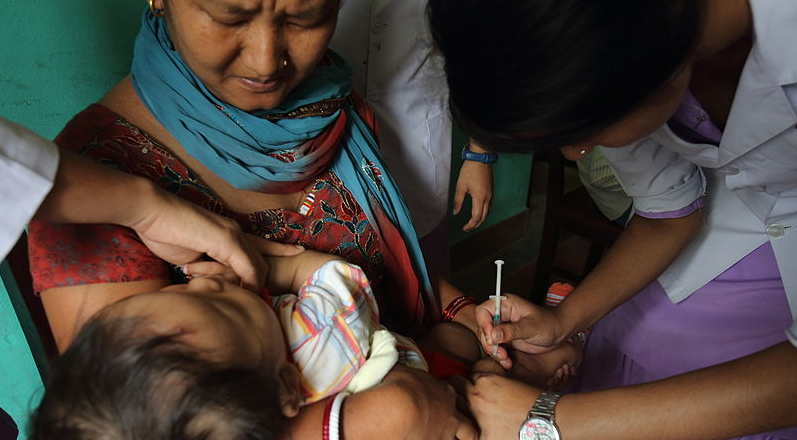
BMC Public Health (2022) 22:221. https://doi.org/10.1186/s12889‑021‑12475‑0. Image credit: Jim Holmes/AusAID via Wikimedia (CC BY 2.0)
- Log in to post comments