










































Voice and Accountability Tool
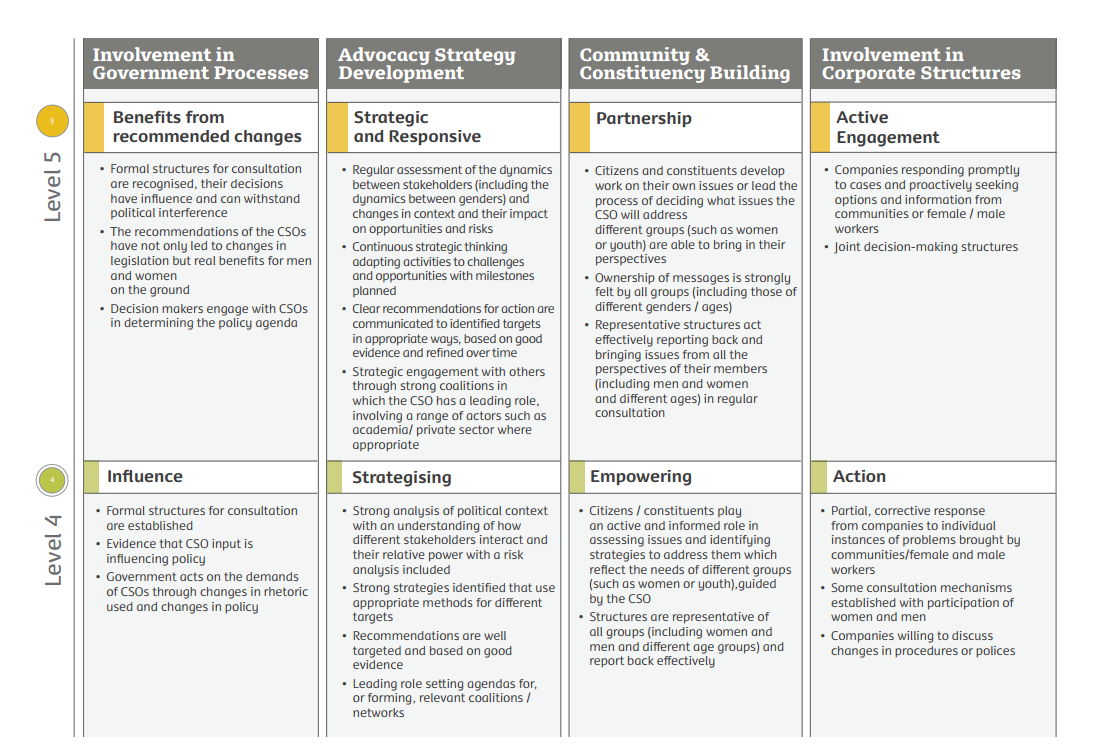
This tool is designed to support groups in evaluating their capacity to conduct advocacy programmes and improve their performance. It was produced by the Catholic Agency for Overseas Development (CAFOD), which is the official aid agency of the Catholic Church in England and Wales, and also part of Caritas International, a group of over 160 Catholic agencies from around the world.
Focusing on 4 key areas of advocacy capacity - Involvement in Government Processes, Advocacy Strategy Development, Community & Constituency Building, and Involvement in Corporate Structures - the tool allows the user to assess the readiness to conduct advocacy based on a 5-level scale. For example, one indicator in Level 4 of Community & Constituency Building is: "Citizens / constituents play an active and informed role in assessing issues and identifying strategies to address them which reflect the needs of different groups (such as women or youth), guided by the CSO [civil society organisation]." The levels are cumulative, and require partner organisations (e.g., CSOs CAFOD works with) to think through the reasons why they might be classed at one level or another by providing anecdotal evidence in each case. The tool does not prescribe which elements to emphasise in any given level.
Presented in a grid-type layout, such tools can help visualise the sorts of impacts people may be looking for, offering a sense of positioning and progression. The tool can also provide some evidence-based milestones that allow people to gauge development over time (and balancing qualitative and quantitative measures).
3
Contribution by Robin Vincent to the Pelican Initiative: Platform for Evidence-based Learning & Communication for Social Change on September 7 2016; and BetterEvaluation website and CAFOD website - both accessed on September 7 2016.
- Log in to post comments