










































Citizen Voice and State Accountability: Towards Theories of Change that Embrace Contextual Dynamics
Overseas Development Institute (ODI)
"The development industry is increasingly pushing practitioners to achieve results, and to do better in demonstrating what works, what does not, and explaining why."
This paper uses a critical analysis of citizen voice and accountability (CV&A) cases to examine how CV&A happens in different governance contexts. According to author Fletcher Tembo, CV&A project interventions produce and reproduce diverse outcomes that are not amenable to linear models of theories of change (ToCs), which are "starting to be viewed as...a key part of what constitutes 'rigour' in impact evaluations." The analytical framework used in this paper draws on the tools of outcome mapping (OM) and political economy analysis (PEA).
The paper shares the experiences of ODI's Mwananchi Governance and Transparency Fund (GTF) programme, a funding mechanism created by the United Kingdom (UK) Department for International Development (DFID) in Ethiopia, Ghana, Malawi, Sierra Leone, Uganda, and Zambia. Mwananchi is a 5-year programme working to strengthen ordinary citizens' voices and improve state accountability and responsiveness. (Click here to learn more about Mwananchi, or follow it on Twitter).
As Tembo explains, evaluations of CV&A projects consider the understanding of context to be one of the core building blocks of success. To that end, he provides several examples of social accountability tools that can be used to hone in on the particular incentives and interests of the actors involved, and how they shape citizen-state negotiations and outcomes. For example, the Masindi District Education Network (MADEN) in Uganda uses suggestion boxes to mobilise children's voices for discussions and lobbying with local education institutions and the Ministry of Education. And in Malawi, radio listening clubs (RLCs) provide communities and service providers with an interface mechanism across a generic range of public services (e.g. schools, health clinics, and water). "Speaking through recorded messages before actual face-to-face meetings with government authorities enables many of the 'would have been silent' community members to have a say, and helps the authorities to hear them."
Tembo notes that one key factor in the success or failure of CV&A initiatives is finding the right incentives to mobilise and aggregate citizens' voice while also generating incentives for engaging state institutions. He cites the Basic Needs project in Ghana, which "succeeded in influencing the Mental Health Bill by using research-based evidence presented in a photo book that documented the everyday lives of people with mental health issues, and possible actions to help them."
Next, the paper explores "modes of interlocution". Tembo explains that the pathway of change that enables economically poor citizens to hold their governments to account depends on the availability of specific mechanisms, spaces, and incentives; figure 1 on page 3 shows this process in a visual way. "The model draws on PEA to understand the contextual dynamics, and on OM to develop the results chain. It is expected that the model will help CV&A programmes develop and deepen their ToCs." In brief, the process involves:
- Exploring the wider dynamics at the national and sub-regional levels that are relevant to the CV&A interventions. This is where the foundational governance factors and the rules in use are captured (e.g., a country's constitution and how it shapes relations).
- Describing local organisations' and citizens' stories of how various outcomes come about in that context (e.g., narratives about the allocation of national budget to various sectors).
- Drawing out which actors have the potential to be game changers on a specific governance issue (known as 'interlocutors').
- Exploring engagement dynamics in an attempt to map out the behaviour of interlocutors of change who might influence strategic actors to change the rules of the game in a particular policy orientation or sector. Most social accountability processes use tools such as citizen report cards (CRCs) to focus on the behaviour of public office holders as well as citizens. OM can help to sharpen the use of these tools by helping to articulate interlocutor behaviours (relationships and activities) that are expected to be in place for desired outcomes to be achieved.
- Exploring institutional patterns and decision logics, which involves establishing (over time) which institutional patterns are effective and which ones are not. The results of this analysis need to be reviewed in the light of the foundational governance factors, described during the first step of analysis.
Key points:
- Enabling citizens to influence government accountability is a complex process involving political dynamics at the citizens' interface with state institutions.
- Developing explicit ToCs from the start of programme planning helps planners delve into complex citizen-state dynamics.
- Fusing political economy analysis and outcome mapping tools can help develop a deeper understanding of these dynamics to generate more effective ways to achieve outcomes.
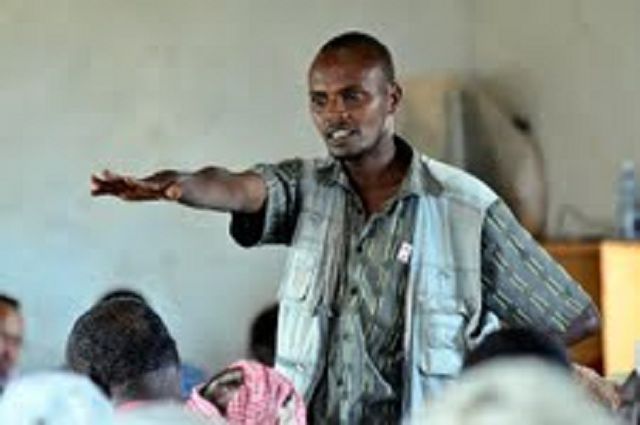
ODI website, July 12 2012; and email from Jessica Sinclair Taylor to The Communication Initiative on July 19 2012. Image credit: Neil Palmer (CIAT). A village meeting in Dirib Gombo
- Log in to post comments