










































Using a Responsive Feedback Approach to Develop and Pilot a Counseling Chatbot to Strengthen Child Nutrition in Rural India
Dimagi India (Tomar, Srikrishnan); Dimagi USA (Lesh); Dimagi South Africa (DeRenzi)
"This work demonstrates how chatbots could create multiple interaction touchpoints between caregivers and health care workers to increase caregivers' access to age-appropriate nutrition counseling and information."
The fact that routine household behaviours (e.g., diet and hygiene practices) influence the nutritional status of children emphasises the need for continuous, age-appropriate counseling as a vehicle for driving behavioural change. In 2018, India launched POSHAN Abhiyaan, the National Nutrition Mission, as a centrally sponsored scheme focused on alleviating the country's malnutrition challenges. The Integrated Child Development Services-Common Application Software (ICDS-CAS) was designed to equip community health workers, including Anganwadi workers (AWWs), with smartphones to strengthen service delivery and improve nutrition outcomes in the POSHAN Abhiyaan programme. There is an opportunity to augment AWWs' impact by engaging directly with beneficiaries to create additional touchpoints with the health system. Thus, Dimagi iteratively built and tested a chatbot to facilitate direct-to-client engagement that aims to support improved parent awareness and knowledge of nutrition-related information. This article describes the development and piloting of the counseling chatbot to improve nutrition outcomes for children aged 0-12 months.
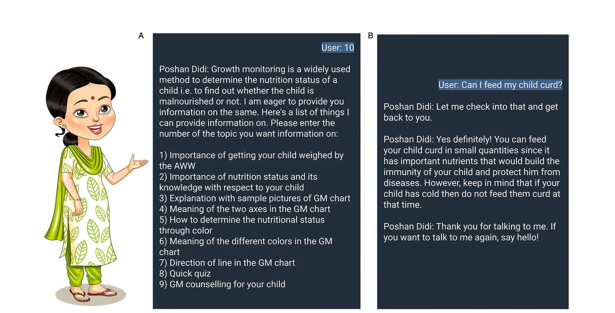
A chatbot is a computer programme that can talk to people through voice or text prompts similar to a human conversation and allows people to find information or access online services. Dimiagi developed the Poshan Didi ("nutrition sister" in Hindi) chatbot using a responsive feedback (RF) approach that draws on a theory of change, continuous testing, and active engagement with key stakeholders.
Specifically, initial site visits during the course of the ICDS-CAS programme and a desk review of existing programmes found that an unmet need existed for additional contact points and follow-ups between health systems and their clients beyond what the understaffed health workforce could provide during in-person sessions. Based on the formative work done, a theory of change (see Figure 3 in the paper) was developed that included an intervention that provides nutrition-related information directly to beneficiaries.
An initial version of Poshan Didi's persona was developed for feedback. Through a collaborative exercise during conversations with mothers, the research team further refined the persona to better embody the cultural context of the community being addressed and the channel being used to introduce the tool (i.e., through existing AWWs). Some of the characteristics chosen for the Poshan Didi persona included being less authoritative than the AWWs, friendly and familiar (represented by similar clothing worn by women in the community), about the same age range as mothers being enrolled from the community, knowledgeable about positive health behaviours and practices, and a proponent of the counseling messages delivered by AWWs and government officials.
Messages were developed and delivered specifically for the mothers/primary caregivers with children within 2 age groups: 0-6 months and 6-12 months. Modules on kangaroo mother care and exclusive breastfeeding were available only to mothers in the 0-6 months group; modules on complementary breastfeeding, complementary feeding, and complementary feeding recipes were available only to mothers in the 6-12 months group. All mothers received content from modules on sanitation, commonly occurring diseases in infants and young children, feeding techniques, lactating mother nutrition, and feedback on AWW services by the mothers. Content was adapted from publicly available incremental learning modules, which were used during initial AWW training. This was done to reinforce existing health messaging and ensure alignment between the information that users received from different sources. The initial script was adapted in real time by the project staff based on the responses received from the users, allowing content to be continually refined.
The chatbot was piloted in Katni district from February 2019 to October 2019 in 2 phases to investigate acceptability and feasibility (Phase 1, n=10 mothers) and to assess whether users would engage with both the automated content as well as through free-form questions (Phase 2, n=100 mothers). The initial manual testing in Phase 1 was done on WhatsApp, with 1 member of the project team directly messaging caregivers, simulating the experience of interacting with an automated chatbot system. Later, in Phase 2, the automated prototype was developed and intentionally created to be platform agnostic. In line with the RF approach, the establishment of feedback loops and communication channels with key stakeholders, who included users, staff who observed the users, AWWs who interacted with the users, and district-level government officers, allowed for course correction and sequential development. User feedback - both quantitative and qualitative data - were collected in focus group discussions (FGDs) with healthcare workers and mothers (n=4) and interviews with mothers (n=26).
Mothers who tested the chatbot were receptive to it, appreciated the fast response time, and found the information they received useful. They appreciated having a private channel to discuss sensitive topics and referred to Poshan Didi's persona as being knowledgeable. Eighty percent of users replied at least once to a chatbot-generated message. Sixty-four percent engaged beyond the standard chatbot content by discussing at least 1 issue with a nurse who responded to escalated messages. Multiple mothers reported during in-person interviews that they had engaged with Poshan Didi, despite their interactions not appearing in the usage logs - suggesting they may have engaged in mediated usage, in which another person used the Poshan Didi system on their behalf.
The mothers reported different barriers preventing their usage of the chatbot but most frequently cited a lack of time due to competing household responsibilities. Women who were registered on their household phones also did not have continuous access to phones. However, the mothers appreciated the always-on availability and immediate response available at a time of need.
Responses during FGDs with the health workers suggested that the tool would help reduce their workload and refocus their efforts on areas where more of their involvement was needed.
Noting that the chatbot aligned with the same language and messaging used by AWWs to deliver nutrition-related information to families, the research team says: "This familiarity with the chatbot information that was shared and the chatbot's endorsement by AWWs, who have a close relationship with the community members, helped ensure the relevance and acceptance of the tool by users and enabled higher levels of usage."
Selected recommendations for developing locally appropriate digital solutions include:
- Facilitate collaborative decision-making, rapid prototyping, and user acceptance testing. Activities such as card sorting and storytelling used during FGDs engaged the users in an entertaining and engaging way and reduced bias.
- Engage local stakeholders, such as by: onboarding AWWs to the chatbot and using their network and in-depth understanding of the community to recruit mothers to the pilot in both phases, having regular check-ins with the block child development project officer to review script topics and take suggestions for new topics, and constantly sharing updates with stakeholders on the progress of the pilot phases.
- Use components of the RF approach to enable continuous improvement of the tool and a better understanding of the factors that influence nutrition status.
Given the promising response to the benefits of this type of tool, the research team believes that semiautomated chatbots supporting a health worker may be an effective avenue for health messaging. A considerable number of outputs that aligned with the theory of change were observed during the short project period that directly influenced outcomes, such as an increase in mothers' knowledge regarding different nutrition-related topics (e.g., kangaroo mother care and complementary feeding) and proactive engagement with the Poshan Didi chatbot to get more information. The team is confident that interventions such as this one will contribute to making positive behavioural changes to improve child malnutrition. "An RF approach that iteratively incorporates feedback from users and other stakeholders throughout testing is useful for the development of such solutions."
Global Health: Science and Practice November 2023, https://doi.org/10.9745/GHSP-D-22-00148. Image credit: Dimagi
- Log in to post comments