










































Social and Behavior Change Communication Interventions Delivered Face-to-Face and by a Mobile Phone to Strengthen Vaccination Uptake and Improve Child Health in Rural India: Randomized Pilot Study
Centre de Recherche du Centre Hospitalier de l'Universitéde Montréal, or CRCHUM (Johri, Kone, Sylvestre); École de santé publique de l'Université de Montréal (Johri, Sylvestre); independent consultant (Chandra); Management Sciences for Health (MSH)/USAID (Kone); Indian Institute of Health Management Research University (Mathur); McGill University (Harper, Nandi); Erasmus Medical Centre (Harper)
"A novel SBCC intervention model using face-to-face and mHealth approaches is feasible to evaluate in a future randomized trial and has the potential to strengthen the delivery of immunization and universal primary health care."
Analysis of Indian immunisation programme data indicates that achieving and sustaining vaccine coverage targets requires new strategies to address lack of awareness and low demand for services. However, in resource-poor settings, exclusively face-to-face knowledge translation and education strategies may be challenging to standardise and deliver at scale. Thus, the widespread availability of mobile phones in low- and middle-income countries (LMICs) has stimulated interest in the potential of mobile health (mHealth) interventions to increase scalability at low cost, and thus to improve vaccination coverage. Yet, questions remain about whether mHealth interventions can be effective for highly disadvantaged populations facing barriers due to poverty, low literacy, and restrictive gender norms. In preparation for a future large-scale randomised controlled trial (RCT), the present pilot RCT assessed study feasibility and key implementation outcomes for the Tika Vaani (vaccine voice in Hindi) model, an approach to educate and empower beneficiaries to improve immunisation and child health in rural Uttar Pradesh (UP), India.
Beginning on January 1 2017, the researchers conducted 1 year of formative research using a social marketing approach to inform intervention design. An iterative, participatory approach involving co-creation was favored to validate the need for the interventions, to make the interventions more compelling and linguistically and culturally appropriate, and to tailor approaches to different user segments. Content was designed by Gram Vaani, an Indian social enterprise specialising in community media platforms for low-literacy rural populations, and Jagriti, a local non-governmental organisation (NGO). The purpose of the content was to promote health knowledge and improve healthy behaviours (including uptake of services). The content was designed to foster equity, empowerment, and social inclusion through positive portrayals of diverse characters. Technical experts were consulted, and extensive adaptations to interventions were made during this phase (during the pilot RCT, all intervention components were frozen for evaluation).
The study interventions took place over a 3-month period and offered social and behaviour change communication (SBCC) for families residing in rural UP villages with a child in the age range of 0 to 12 months. Goals included educating beneficiaries about immunisation and basic child health themes, dispelling misinformation, and empowering households to better care for their children and themselves. Although vaccination was the primary focus of the study, the SBCC interventions addressed additional areas stipulated to be co-delivered with immunisation during Village Health and Nutrition Days (VHNDs), such as health education related to: healthcare entitlements; prevention, recognition, and management of common infectious diseases (diarrhoea, pneumonia, dengue, and chikungunya); nutrition; and water, sanitation, and hygiene (WASH). Strategies, which were tailored for disadvantaged populations, included:
- mHealth: context-appropriate, entertaining/educational audio capsules (edutainment) and voice immunisation reminders via mobile phone using the Mobile Vaani interactive voice response (IVR) system (see Related Summaries and the video, below). Push messages (automated dialouts) and voice-based reminders were selected (instead of SMS, or text messaging) owing to low education level and lack of comfort with technology. The participants could give a missed call to access the platform, and as a result receive a callback enabling them to access all content (26 content pieces), record any queries or feedback, or be connected to a live expert.
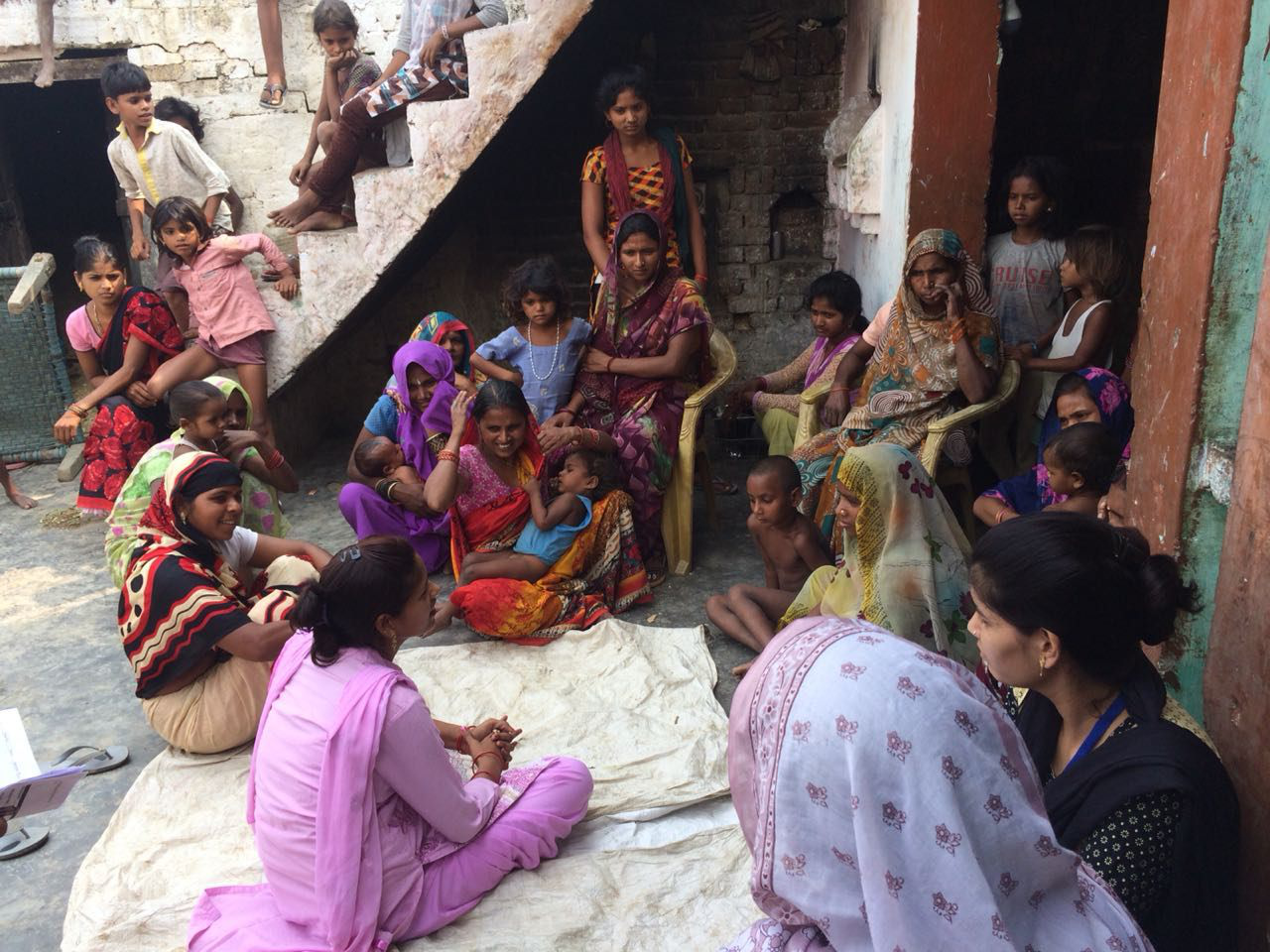
- Face-to-face: community mobilisation activities, consisting of 1 large introductory meeting to introduce the project to communities and 3 small meetings covering specific themes. Small-group meetings were held separately for men and women and in different geographical locations within villages to ensure ease of communication.

A cluster-randomised pilot trial with a 1:1 allocation ratio was conducted from January to September 2018. Villages were randomly assigned to either the intervention or control group. mHealth vaccination reminders were offered only to the intervention group; however, other interventions (mHealth edutainment and face-to-face meetings) were open to all village residents. Community workers (Anganwadi Workers (AWWs) and Accredited Social Health Activists, or ASHAs) were encouraged to participate and received advance access to intervention materials. All interventions were free of charge to end users. The control group received standard Government of India (GoI) health and welfare services.
Statistical methods included descriptive statistics to assess feasibility, penalised logistic regression and ordered logistic regression to assess coverage, and generalised estimating equation models to assess changes in intermediate outcomes. The paper presents quantitative findings for 2 secondary outcomes: (i) coverage (the extent to which the interventions reached specific populations) and (ii) adequacy of the programme theory. The researchers constructed a logic model describing the hypothesised programme impact pathway and mechanisms of action (see above) and adapted an established vaccination communication taxonomy to define indicators. They compared treatment groups on outputs (intermediate outcomes, such as knowledge and attitudes) related to the intervention theory of change.
A total of 387 households (184 intervention and 203 control) with children aged 0 to 12 months in 26 villages (13 intervention and 13 control) were included and randomised. Contamination was less than 1%. Participation in one or more interventions was 94.0% (173/184): 67.4% (124/184) for the mHealth strategy and 78.3% (144/184) for the face-to-face strategy. In modeled analyses, the number of mHealth items heard was influenced by 3 factors: mother's possession of a mobile phone, mother's ease of phone access, and women's empowerment. The number of small group meetings attended was influenced by 2 factors: living far from the meeting site and women's empowerment. For 11 of 13 intermediate outcomes, regression results showed significantly higher basic health knowledge among the intervention group, supporting hypothesised causal mechanisms.
In short, the pilot trial led to 4 salient findings:
- Criteria related to recruitment, randomisation, retention, and contamination were satisfied, providing evidence that the planned future main trial is feasible as planned. Uptake of interventions (adoption) was near universal (50% ex-ante vs 94% in practice), demonstrating strong interest and acceptability.
- Analyses of uptake and use demonstrated that intervention use was shaped by social determinants but that the chosen combination of strategies reached all population groups, even the most vulnerable.
- Constellations of determinants differed by intervention delivery channel. For example, mHealth vaccination reminders were taken up preferentially by more educated women and those with easy phone access within the household, whereas mHealth edutainment capsules were favoured by more empowered women and by lower caste groups, for whom the content was likely novel and useful. Face-to-face meetings were found to be the most equitable intervention channel; participation was equal or higher among those with greater needs. Women's empowerment increased uptake and intensity for all interventions.
- The interventions led to measurable improvements in basic health knowledge, supporting the potential to impact population health at scale. Changes in intermediate outcomes are consistent with the intervention theory of change.
The researchers highlight 3 insights relevant to the future large-scale RCT and other studies:
- mHealth interventions can achieve reach and improve knowledge even in highly underprivileged populations, but technical delivery and content must be substantially adapted. For instance, the researchers found that engaging story formats inclusive of diverse social groups were appreciated and that pure informational approaches such as vaccination reminders were taken up preferentially by the (relative) elite. As compared with SMS, audio messaging is more amenable to culture-specific contextualisation and an edutainment approach.
- Gender-related barriers shape immunisation access and affected the study interventions. For example, participation in face-to-face meetings was limited by norms governing women's freedom of movement. It is recommended that future interventions include a focus on men and families to strengthen inclusion and mitigate gender barriers.
- Although mHealth audio messaging is a promising strategy to deliver basic health information, it must be accompanied by face-to-face contact to enhance uptake and equity. Future research exploring innovative delivery modalities while considering potential trade-offs between equity and efficiency (cost-effectiveness) is recommended.
In conclusion: "The interventions achieved widespread reach in a highly disadvantaged population and showed early evidence of impact on participants' knowledge, supporting the intervention theory of change. Behavior change communication via mobile phones proved viable and contributed to standardization and scalability. Face-to-face interactions remain necessary to achieve equity and reach, suggesting the need for ongoing health system strengthening to accompany the introduction of promising mobile phone technologies."
JMIR Mhealth Uhealth 2020 (Sep 21); 8(9):e20356. Image credit: Tika Vaani
- Log in to post comments