










































Theatre for Vaccine Hesitancy
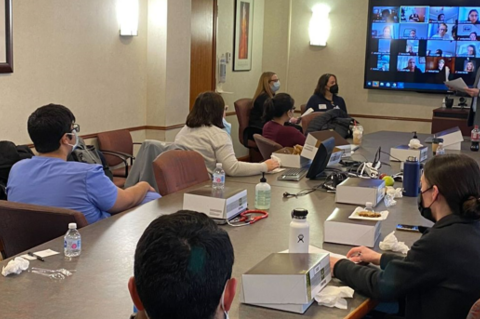
"...combination of improvisational theater techniques from the social justice movement grounded in evidenced-based motivational theory may help change vaccine-hesitant conversations, lighten the burden on health care providers, and improve the public's health." - John P. Cullen, Savanah Russ, and Holly Ann Russell
In the wake of the COVID-19 pandemic, researchers at the University of Rochester Medical Center (URMC) in New York, United States (US), developed a programme that combines improvisational (improv) theatre techniques with coaching on how to tap into patients' inner motivations to help healthcare workers guide their patients toward vaccination. Initially implemented within local healthcare systems for clinical personnel, the programme later reached healthcare workers, first responders, and staff in community-based organisations (CBOs) in surrounding rural counties. The programme was part of the 16-month Finger Lakes Rural Immunization Initiative (FLRII), which supported efforts of medical centre faculty, health project coordinators, and graduate students to address challenges with COVID-19 vaccine uptake.
With underuse of COVID-19 vaccines posing a public health concern, researchers at the URMC adapted theatre methods to try to help regional healthcare staff navigate potentially challenging conversations with vaccine-hesitant patients. Specifically, Forum Theatre is one of the components of Theatre of the Oppressed, a style of improv theatre developed in the 1970s by social theorist Augusto Boal to catalyse critical dialogue, explore alternative solutions to challenging social situations, and advance social justice. In 2017, members of the URMC Department of Health Humanities and Bioethics started using the Theatre of the Oppressed model to help healthcare workers and students learn how to react to instances of racial, sexual, or gender bias or discrimination. For the FLRII initiative, URMC researchers drew on this same methodology to teach healthcare workers appropriate, authentic, and respectful responses to patient expressions of bias in clinical encounters.
Each training session, conducted either online or as a hybrid (online/in person) experience, is framed as a 60-minute workshop comprising 3 components:
- The Science of Motivation (didactic) - The session began with a review of the importance of autonomy, competence, and relatedness - key tenets of self-determination theory (SDT) and motivational science - and how they relate to vaccine hesitancy, including imagining what it might be like to hear and believe conspiracy theories and then have a trusted clinician tell you they are not true. Developed by two University of Rochester psychologists in 1985, SDT suggests that people are more likely to choose a behaviour if their psychological needs of competence, autonomy, and relatedness are met. Using SDT techniques, URMC researchers trained attendees to empathise and connect with the patient, acknowledging and expressing interest in the patient's perspectives and feelings. They were also reminded to respect the patient's power to make their own decisions but to provide concrete recommendations and specific examples of how getting vaccinated fits with a patient's value system without preaching or arguing.
- Difficult Conversations (improv theatre) - Team members acting as healthcare workers and patients read scripted conversations reflecting the give-and-take of vaccine recommendation and hesitancy. The scripts purposely included controlling language and obvious frustration on the part of the clinician. The scripts were based on interviews previously conducted with healthcare workers and staff at affiliated CBOs as part of the FLRII to identify real-world social and behavioural drivers of patient reluctance (e.g., concerns about the speed of vaccine development). An impartial facilitator introduced the actors and instructs attendees (the "theatre audience") to watch and notice parts of the dialogue that do not lead to increased vaccination acceptance. After an initial run-through in which vaccine hesitancy was not effectively addressed, audience participants were asked to share feedback, including about specific parts of the dialogue that might have prevented increased vaccine acceptance. The scene was then reenacted, with audience members urged to yell "stop!" if they would change the dialogue of healthcare workers to improve the scenario outcome. The performance was paused, the facilitator asked the person why they stopped the performance, and the person was asked to step into the role of the healthcare worker to use the suggested approach to change the outcome of the conversation, becoming a "spect-actor" (spectator-actor, in accordance with Forum Theatre). The format was designed to help spect-actors and the audience realise that it is easier to suggest what should be done than to do it effectively in an actual situation.
- Changing the Conversation (post-performance interactive improv follow-up) - The session facilitator asked the spect-actors, "Did you accomplish what you set out to do?", asked the team member playing the patient role how they felt during the encounter, and asked the audience members what they think the spect-actors accomplished. Critics of the performance were asked to explain what they would do differently and are invited to assume the role of clinician and act out the patient encounter incorporating their suggestions. These scenarios were reenacted multiple times, permitting a number of individuals to practice having these difficult conversations.
Ultimately, the workshop trained healthcare workers to listen and connect with their patients rather than lecturing or cajoling. It also gave participants a low-stakes forum to practice what they have learned, which was designed to build their confidence through an entertaining-educational experience with the potential to foster a sense of camaraderie in a time of burnout.
COVID-19, Immunisation and Vaccines
Data show that almost one-quarter of Americans are unwilling to get immunised with available COVID-19 vaccines. Vaccine hesitancy remains a substantial obstacle to controlling the coronavirus pandemic. One of the researchers involved in the project said, "External motivators like mandates or monetary incentives have not worked for all of our patients and in some cases actually increase mistrust of public health and health care systems. So, we wanted to coach frontline health care workers on how to tap into patients' intrinsic motivation instead."
Between November 2021 and April 2022, URMC researchers conducted 6 sessions with 78 attendees, comprising 5 online and 1 hybrid online/in-person session; 1 was incorporated into routine family medicine resident didactic sessions. An additional 10 sessions were planned until funding ends in September 2022. In surveys sent to 46 participants, 79% said they felt more confident when discussing vaccines with their patients after the intervention, 45% judged that patients they had spoken to were more likely to get vaccinated according to their change in conversational approach, and 29% believed that vaccine-hesitant patients they had spoken to had been vaccinated because of the conversation. "The interactive workshop provided space to explore both in and out of my comfort zone," said Al Ogawa, a URMC medical student who participated in the programme. "The non-judgmental environment, peer feedback, and space for creativity spurred growth."
"Theater for Vaccine Hesitancy - Setting the Stage for Difficult Conversations", by John P. Cullen, PhD, Savanah Russ, MPH, and Holly Ann Russell, MD, MS. Journal of the American Medical Association, September 2 2022; "Using Improv to Address COVID Vaccine Hesitancy", by Susanne Pallo, URMC, September 1 2022; and URMC website - all accessed on September 13 2022. Image credit: URMC
- Log in to post comments