










































Routine Immunization Consultant Program in Nigeria: A Qualitative Review of a Country-Driven Management Approach for Health Systems Strengthening
Johns Hopkins Bloomberg School of Public Health, International Vaccine Access Center
"[R]ecruitment that prioritized advocacy and networking skills enabled a powerful player to exist within RI to act as a direct advocate for problem solving at the local level and to feed RI information up to state decision makers."
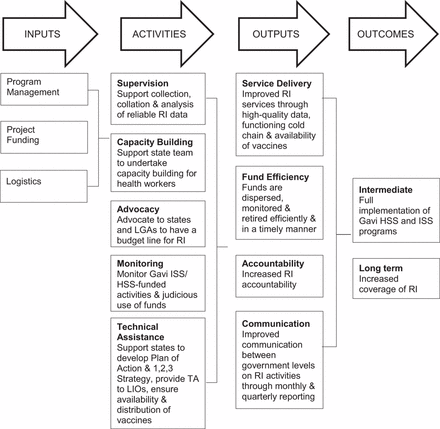
This article describes and reviews the Nigerian government's routine immunisation (RI) consultant programme, through which consultants to play a role in supportive supervision of health facility staff, capacity building, advocacy, and monitoring and evaluation. The programme is aligned with ongoing efforts in the country to improve accountability in RI by clarifying the roles of governmental players and increasing transparency of reporting, supervision, and evaluation mechanisms across different levels of government. The specific objective of this study is to understand the implementation, strengths, and weaknesses of the RI consultant programme in Nigeria to inform future strategies.
As detailed here, since 2002, the RI consultant programme has been jointly funded by Gavi and National Primary Health Care Development Agency (NPHCDA), a parastatal of the Nigerian Federal Ministry of Health (FMoH). The proposal and design process was country driven, and activities were designed by Nigerian stakeholders. In fact, several components of the design distinguish the programme's technical assistance (TA) model:
- The programme is designed and managed by domestic actors and tailored to the local context.
- Consultants are locally experienced staff recruited for long-term contracts.
- Consultants are selected by domestic actors.
- Work is primarily field based.
- An emphasis is placed on advocacy and networking skills.
- TA is focused on resolving broader problems within the public sector (e.g., capacity building for data quality assurance).
- Work is oriented toward outcomes that are uncertain and difficult to measure (e.g., judicious use of funds, capacity building, and advocacy).
At the time of data collection (September 2014), there were 23 consultants deployed to the 36 states. The researchers conducted a retrospective review from June to September 2014 of 7 states (Edo, Imo, Kano, Kogi, Niger, and Oyo) from all 6 geopolitical zones using a mixed-methods study design consisting of semi-structured qualitative interviews (they conducted qualitative data analysis on 70 in-depth interviews) and 2 online quantitative surveys - one of 59 state programme leaders (e.g., state immunisation officers, directors of primary health care) and the other of 15 RI consultants.
Qualitative interview data from the 3 states with an active RI consultant programme showed that consultants contributed to improved delivery of RI services through supportive supervision that improved the availability of high-quality data and improved functioning of the cold chain. This supportive supervision went hand in hand with capacity building through on-the-job training (either planned or ad hoc during field visits), which was focused on the transfer of skills to local government association (LGA)-level staff to build competency in providing RI services. "The 3 states that had RI consultants present and visibly working were distinct in that they actively engaged consultants, allowing them to be highly integrated within the state RI team through facilitated multi-stakeholder engagement....In these states, implementation of activities generally aligned well with the TOR [terms of reference], and consultants were identified as highly respected and highly motivated individuals, capable of coordinating effectively with the state RI sector and with NGO [non-governmental organisation] partners." Another finding related to programme design strengths included recruiting consultants who were highly committed and motivated, familiar with the local context and language, and well respected within their field.
Furthermore, "[t]he skills profile and gravitas of the RI consultants, who have many years of experience and strong professional networks, make them uniquely placed to conduct advocacy within their state for the appropriate use of Gavi funds and to state and LGA leadership for a budget line for RI. When active in their state, both qualitative and quantitative results indicate that consultants appear particularly well suited to facilitate the resolution of RI funding challenges by communicating directly to leadership within the state, such as the Commissioner, Executive Secretary, and Director of Primary Health Care, whereas other workers within the state team are not in a position to request these meetings. Importantly, the topic of advocacy was not constrained by a predetermined policy agenda but was focused on general problem solving within the consultants' state."
Key challenges in programme implementation were related to inadequate and inconsistent inputs (salaries, transportation means, dedicated office space) and gaps in management of the consultants (monitoring and supervision). Recommendations to address these and other weaknesses in the RI consultant programme are offered, such as: Implement an in-person orientation with the state team at inception of the RI consultant into the state to introduce the stakeholders, align expectations within the state, and allow for joint work planning between the national and the state level.
The report concludes that, despite challenges in material and managerial support, some state-level consultants appear to have improved RI programming through supportive supervision and capacity building of health facility staff as well as advocacy for timely dispersion of funds. "This country-led, problem-focused model of development assistance deserves further consideration."
Global Health: Science and Practice March 21, 2016, vol. 4, no. 1, pps. 29-42. doi: 10.9745/GHSP-D-15-00209
- Log in to post comments