










































The Role of the Polio Program Infrastructure in Response to Ebola Virus Disease Outbreak in Nigeria 2014
World Health Organization - WHO (Vaz, Mkanda, Banda, Komkech, Ekundare-Famiyesin, Onyibe, Abidoye, Hannah-Murele, Tegegne); Global Public Health Solutions (Nsubuga, Maleghemi)
"The support from the polio program infrastructure, particularly the coordination mechanism adopted (the EEOC), the availability of skilled personnel in the polio program, and lessons learned from managing the polio eradication program greatly contributed to the speedy containment of the 2014 EVD [Ebola virus disease] outbreak in Nigeria."
This article examines the organisation and operations of the response to the 2014 EVD outbreak in Nigeria and how experiences and support from the country's polio programme infrastructure accelerated the outbreak response. Polio Eradication Initiative (PEI) activities in Nigeria are coordinated by the National Polio Emergency Operations Center (EOC), established on October 23 2012 by the Presidential Task Force on Polio. The EOC is designed to be a flexible management arrangement that allows for all government agencies, international agencies, local non-governmental organisations (NGOs), and the private sector to work harmoniously together in polio eradication.
At the onset of the EVD outbreak in Lagos State, key officers from the national polio EOC were deployed to Lagos on July 23 2014 to start the Ebola Emergency Operations Center (EEOC). The polio EOC deputy incident manager (IM), whose responsibilities were to provide overall coordination of the outbreak response, headed the EEOC as the IM for that response and was also the spokesperson for the EEOC, responsible for communication with the media. The EEOC was organised around 6 functional units: management/coordination, epidemiology and surveillance, case management, laboratory services, social mobilisation, and points of entry and exit (POE). The IM designated individuals to lead each of these units. Technical officers from WHO and other partner agencies who had been working together in the polio programme provided training for personnel in all units of the EEOC on EVD outbreak and response. Each unit had a daily review meeting, and the decisions reached were then shared at the daily evening review meeting of the EEOC. At the end of these meetings, action trackers with designated responsible individuals and timelines were developed. The status of implementation of agreed activity plans were evaluated at subsequent meetings of the EEOC. Each day, the EEOC also prepared a situation report on the outbreak, and the IM shared it with all partners.
The article describes the work of all 6 EEOC units, including the social mobilisation unit, whose mandate was to: (i) create awareness, with a focus on community members around the homes of EVD case patients, contacts, and the most-at-risk groups; and (ii) conduct advocacy with key civic, political, and religious leaders, heads of media houses, schools, and spiritual healing homes. The unit also trained community informants, school teachers, and healthcare workers on key EVD awareness and prevention practices. Information education and communication (IEC) materials, such as hand bills, posters, and banners, were produced and distributed, and other health promotion activities included motorised rallies, community dialogue, focus group discussions (FGDs), health education segments jingles on radio and television, and health talks in schools, churches, and communities. An Ebola alert call centre with toll-free lines was created. WHO supported the production of 2 animated videos in Pidgin and English for use in social mobilisation. Together with social media, these conduits were used to quell rumors and disseminate accurate information to the populace.
Various reflections on how this process worked are offered. For example, EVD sensitisation and trainings were conducted in 15 of the 20 local government areas (LGAs) in Lagos State and in all 23 local government areas in Rivers State throughout the outbreak period and for 2 months after the outbreak ended. Figure 1 shows an example of a 9-day communication materials distribution and person-to-person EVD sensitiaation that was conducted in 15 of the 20 local government areas in Lagos State. "Each unit of the EEOC responded in an organized manner and rendered daily reports to the strategic group headed by the IM. This allowed for formulation of one mitigation plan with timely allocation of resources, which was designed based on experiences from polio work."
In the Discussion section, the authors assert that "[c]ontrol of the EVD outbreak within 93 days would have been difficult without the effective coordination mechanism adopted - the EEOC, the availability of skilled personnel in the polio program, and lessons learned in managing the polio eradication program, such as how to address noncompliance to polio vaccination, concealing of information, and tracking of suspected AFP [acute flaccid paralysis] cases using mobile device technology. Support and experiences from the polio program structure made the EVD response focused and hence enabled the rapid outbreak containment." Furthermore, "[t]he strong partnership between government and development partners and other nongovernmental organizations, which already existed in the polio program at the EOC, was harnessed to ensure seamless collaboration and expertise in mobilizing the much-needed finances for the EVD response. Informed decisions were quickly reached by the EEOC from data and information gathered using the mobile data devices. These decisions were disseminated equally quickly to stakeholders for prompt implementation."
Reportedly, "[a] single source of information dissemination to the general public, a lesson from experiences gained from the polio immunization campaigns, was key in ensuring proper information management and reducing undue panic." The authors note that skilled personnel from the polio programme ensured smooth operations in the EVD outbreak response, such as in the area of social mobilisation. Furthermore, the polio infrastructure's extensive network of personnel from community to state levels has experience in conducting active case searches for AFP. This skill was brought to play in the EVD outbreak, and their interpersonal communication skills often used in obtaining samples for laboratory analysis from difficult AFP cases were also useful in persuading difficult EVD contacts to comply. Data management with real-time mobile technology, which was already being used in the polio programme, was also used to ensure timely and complete follow-up of contacts and prompt response to suspected EVD cases.
Replicating this experience in controlling EVD in Nigeria in a short period could be difficult to replicate in other situations. For example, setting up the treatment centre, aside from being expensive, also caused some communal revolts, because no community in Rivers State wanted the Ebola treatment centre in its domain; without proper dialogue, this step could cause a lot of resentment. That said, the authors "recommend that this strong partnership in EVD response be emulated in tackling future public health emergencies, using resources that already exist in the country. The EOC structure should also be replicated in other states in Nigeria to enable immediate response to any public health emergency."
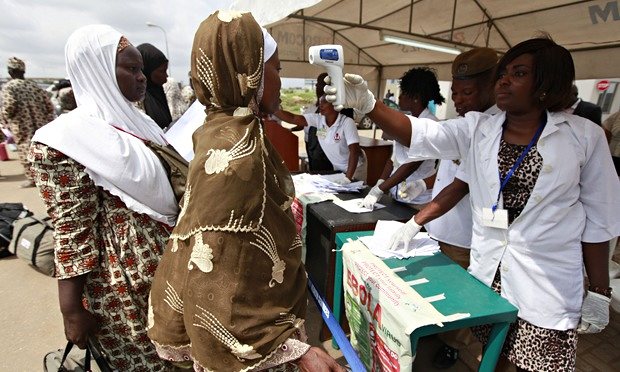
Journal of Infectious Diseases 2016 Feb 16. pii: jiv581 - from PubMed, March 7 2016. Image credit: Sunday Alamba/AP
- Log in to post comments