










































Risk Communication and Community Engagement Guidance on COVID-19 Vaccines for Marginalised Populations
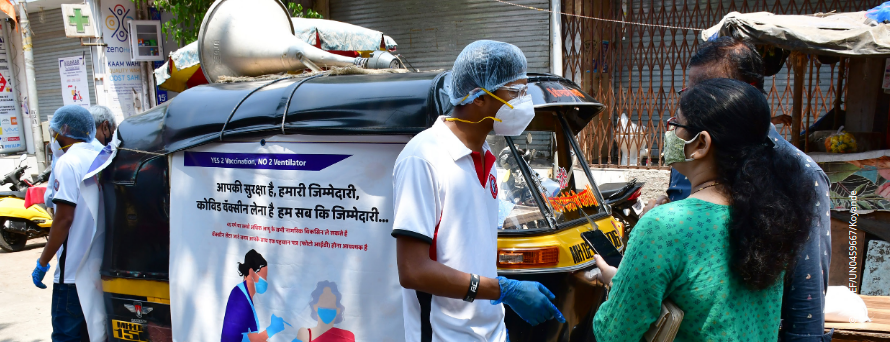
"Keep in mind that delivering top-down messages has been shown to be less effective than tailoring messages to specific populations and linking those messages to social and behavior change approaches and community engagement."
This guidance document highlights key challenges faced by marginalised people, including those in humanitarian contexts, with regard to COVID-19 vaccine access, acceptance, and demand creation. It presents recommendations that underscore the importance of inclusiveness in risk communication and community engagement (RCCE) for COVID-19 vaccines and the need for advocacy to national government decision-makers for fair and equitable access and distribution of vaccines to all people.
Developed by the Collective Service for Risk Communication and Community Engagement (RCCE), the brief may be of particular interest to: government officials and public health and humanitarian personnel in charge of designing policy and delivering the health and multi-sectoral humanitarian response to COVID-19 in their local contexts; RCCE professionals active in the pandemic response working on vaccine rollouts; and civil society groups working on human rights.
This document has two main parts. Part one focuses on general considerations related to RCCE and advocacy for equitable COVID-19 access for marginalised populations. For example, it details steps involved in taking action to:
- Advocate for vaccination plans and related communication plans to be inclusive of all populations, without any discrimination (due to gender, legal status, age, religion, origin, location, or any other characteristic).
- Adopt a "do no harm" approach, and conduct a protection analysis when seeking to reach populations at risk of exclusion. Develop strategies with an aim to avoid creating new risks, such as further stigmatisation.
- Plan for different stages of community engagement at each point of the vaccine process, as information and perceptions will change.
- Understand and use preferred and trusted communication channels that meet a range of different communication needs for people with disabilities and those with literacy and cognition needs.
- Encourage partners to adapt and agree on harmonised communication goals and strategies, supported by harmonised messaging for marginalised populations.
- Simplify and pretest messages with specific marginalised groups for easy understanding, adjust messages for literacy levels, and translate them into preferred languages, using local terms and concepts.
- Encourage discussion about on the lack of access or unavailability of the vaccine to avoid additional frustrations.
- Be aware that marginalised populations may have intersecting needs - for example, a migrant with a disability, or a community health worker (CHW) who is a refugee working in insecure areas.
- Consider the gender implications of COVID-19 vaccination programmes for all marginalised people.
- Include healthcare workers (HCWs) and CHWs as audiences in RCCE activities.
Part two focuses on specific considerations and recommendations for specific population segments. Population segments included are: refugees, migrants, internally displaced persons (IDPs), asylum seekers, stateless individuals; people with disabilities; older people; lesbian, gay, bisexual, transgender, queer, and intersex (LGBTQI+) populations; people living in insecure areas or areas not controlled by the government; people experiencing homelessness; people living in informal settlements; and indigenous populations. A series of tables provides considerations for including specific marginalised populations in vaccinations plans and specifically in RCCE strategies for the COVID-19 vaccine. Examples are provided.
At the end of the brief, the reader will find lists of, and links to, additional resources.
The document was developed through two collaborative initiatives of the Collective Service for RCCE: (i) the RCCE Sub-Group on Community Engagement in Low-resource Settings, co-led by the Johns Hopkins Center for Communication Programs/READY Initiative, Save the Children, and Internews; and (ii) the Sub-Group on RCCE for Refugees, Migrants, IDPs, and Host Communities Vulnerable to COVID-19, co-led by International Organization for Migration (IOM), United National High Commissioner for Refugees (UNHCR), and the United Nations Children's Fund (UNICEF).
30
Collective Service for RCCE website, February 15 2022; and emails from Ryan Toney, Ombretta Baggio, and Kathryn Bertram to The Communication Initiative on February 15 2022. Image credit: © UNICEF/UN0459667/Koyande
- Log in to post comments