











































Radi-Aid Research: A Study of Visual Communications in Six African Countries
"In this project, we have aimed at deepening our understanding of inter-national aid communication and how it is perceived. By listening to the thoughts and opinions of youths and adults from six different African countries on various issues relating to aid communication we get confirmations, contradictions, we find ourselves amused, astonished and curious but, most importantly, eager to learn and listen in order to broaden our minds."
Radi-Aid Research is a collaboration project between the Norwegian Students' and Academics' International Assistance Fund (SAIH) and the School of International Development at the University of East Anglia. The project aims to challenge the use of stereotypes and oversimplification in Western storytelling about aid in Africa. The project was conducted in sub-Saharan Africa: Ethiopia (Oromia Region), Ghana (Bawjiase), Malawi (Lilongwe), South Africa (Johannesburg), Uganda (Kampala), and Zambia (Lusaka). Data collection took place between July 2017 and July 2018. As background for the framing of the study, researchers took into account "The People in the Pictures" report from Save the Children in 2017 which resulted in an advisory ethics group of content producers for 15 non-governmental organisations (NGOs) in the United Kingdom. This report intends to add knowledge to those efforts.
Acknowledging the size limitations of the study, researchers formed 12 focus group discussions, two in each of the six countries, totalling 74 participants; 36 female and 38 male, across various ages. Each focus group was audio recorded and the transcript translated.
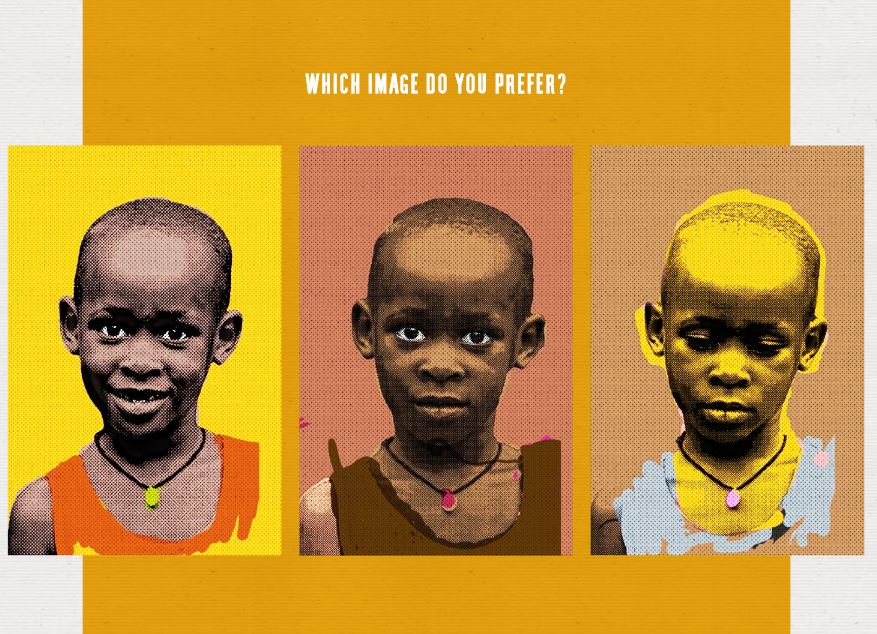
Imagery was chosen in the form of ten advertisements from international non-governmental organisation (INGO) campaigns by Amnesty International, Care International, Cordaid, The Disasters Emergency Committee, Dubai Cares, Oxfam, Save the Children, UNICEF, and War Child. Some were for fundraising, others for awareness raising, and still others for political action. "[T]hey all included visual representations of people in African countries, combined with a message reaching out to the public, calling for attention." An agency was chosen to make three similar "mock adverts" with the identical message but a photo of a child either smiling, looking pensive, or looking neutral.
Researcher/translators presented these three images to find out which one people liked and why. They asked further questions - for example, "How do you feel about children being used in fundraising adverts?"; some verbatim answers are included in the research report to show the complexity of response. NGOs were selected as collaborating partners in each country to provide an understanding of the community, their culture, and beliefs.
"A central element of the research was exploring whether participants preferred 'positive' or 'negative' images." Responses varied, especially based upon age demographics, but it appeared that images need to be accurate and show diversity. "INGOs should endeavour to replicate ...imagery, which promotes agency and respect....Dignity is paramount..." especially regarding images of children. Text and image must be related, and images must describe the reality of the situation. The context must be communicated by the image, and people in the images need to be seen as human beings with their own stories and feelings. Questions to consider in the use of images in advertising are listed at the end of the document along with further reading.
Key findings from the study include:
"There is a need for aid communication to show more diversity in terms of age and race.
Respondents acknowledge that aid communication is complex, with no single solution.
It is important that respect and dignity is preserved in the portrayal of people in aid communication.
The majority of respondents thought the images in adverts offer an accurate representation of the situation in Africa."
The research concludes: "By opening up to different and more balanced approaches, INGOs can help to change perceptions of Western citizens regarding people and countries in the Global South."
Radi-Aid website, April 10 2019
- Log in to post comments