










































Putting Public Health Infrastructures to the Test: Introducing HPV Vaccination in Austria and the Netherlands
University of Vienna (Paul); Erasmus University (Wallenburg, Bal)
Through a comparative qualitative analysis of the introduction of the human papillomavirus (HPV) vaccine in Austria and the Netherlands, this article asks: How did the HPV vaccine put existing public health programmes to the test and with what effect? As the researchers note, not only did the HPV vaccine have to match legal, social, and technical requirements of national immunisation programmes (NIPs) grappling with vaccine hesitancy, but it also had to be integrated alongside historically established screening programmes, such as Pap-smear-based screening. The paper's comparative approach examines two types of difference: first, country-based differences, and second, differences of "infrastructures" (logics - i.e., screening and prevention) within those cases.
In reviewing the history of the approval of two HPV vaccines, in 2006 and 2007, respectively, by the United States Food and Drug Administration (FDA) and the European Medicines Agency (EMA), the researchers note that observers raised a variety of economic, ethical, and societal objections to the novel vaccine. The notion of immunising children against a sexually transmitted infection (STI) was received with some opposition both in North America and Europe. The efforts made in HPV policymaking, according to the researchers, "are reminiscent of historical efforts to make the Pap smear 'good enough'....This means that much like the Pap smear, the HPV vaccine did not only have to fulfil technical criteria, but also come to satisfy pertinent 'social worlds' to become embedded in them....In the case of the HPV vaccine, the social worlds of both cervical cancer screening and immunisation were involved, and included clinicians, policymakers, parents' groups, and women's health advocates."
The study draws on three sources: (i) desk research on professional responsibilities, institutional relations in public health, and documents such as vaccination plans and screening guidelines; (ii) 21 in-depth interviews with public health officials, clinicians, and researchers in both countries; and (iii) a secondary analysis of data collected in an earlier participatory ethnographic study of the introduction of HPV vaccination in the Netherlands.
Brief summary of country case studies:
Austria:
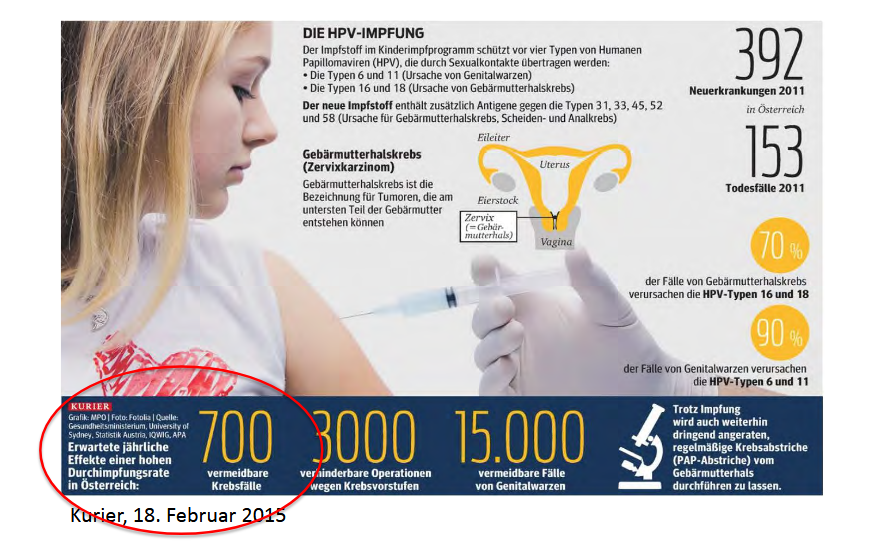
In September 2007, the Supreme Health Council (OSR), an advisory committee to the Ministry of Health (MoH), released a non-binding recommendation of HPV vaccination for girls and boys in Austria. Shortly afterwards, a young girl died a few weeks after her HPV vaccination, and a debate began to emerge; ultimately, the Minister decided not to include the vaccine in the NIP. Vaccination rates are comparatively low in Austria, with only 76% of infants being immunised against measles, mumps, and rubella (MMR) (OECD 2015). Opposition to vaccination reflects religious objections, views of immunisation as an unnatural interference in the course of childhood, fears of "unnatural" adjuvant substances, and beliefs that vaccination may cause allergies.
Despite this, room was made for the HPV vaccine in Austria's public health system, using a different path. In brief, the HPV vaccine is administered in schools or in private practices by paediatricians and general practitioners (GPs). Direct parental consultation can largely be bypassed in school-based vaccination. Any questions or concerns children may have regarding HPV and sexual transmission are compartmentalised to a professional paediatric setting, much like the Pap smear is in gynaecological practices. "Turning the HPV vaccine into a regular vaccine made it 'good enough' for public health in Austria. At the same time, the...renewed vaccination policy discourse focused on maximising vaccine uptake and providing information, or, as in the recent campaign for the MMR vaccine, with fear-inducing slogans. This way, opposition to HPV vaccination was easily sidelined as irrational, including that of experts in the field...and those public health experts calling for structural reforms to the NIP prior to any additions."
The Netherlands:
In contrast to Austria, vaccine uptake is comparatively high, with 96% of infants being vaccinated against MMR (OECD 2015). Furthermore, given "the highly institutionalised role of the youth health services and the programmatic approach of vaccine policies, most parents perceive immunisation as something quasi-compulsory." Nonetheless, a small, yet identifiable segment of the general population opts not to have their children vaccinated. "In the Austrian case, early HPV policy rejected the vaccine because of its novel, uncertain, costly, and politically sensitive character....Yet in the Netherlands, early HPV policy did not highlight its different character, but rather treated it as a vaccine just like any other that could be effectively 'rolled out' in the well-established and programmatic public health infrastructure." The MoH followed the Dutch Health Council's advice and included the HPV vaccine for 12-year-old girls in the NIP. In addition, a catch-up programme was announced for girls 13-16 years old. "The assumption underlying this infrastructure is that if (cost) effectiveness is proven and the NIP is scientifically monitored and robust, citizens will trust expert advice and partake in the programme." (Later, the HPV vaccination was moved to the general public health system in charge of prevention, the Public Health Services (PHS), thus setting HPV apart from the NIP, which is designed for children up to the age of 9 years.)
There were, however, some communication-related issues with the "rolling out" approach of the HPV vaccine in the Netherlands - issues that amplified public hesitance:
- The National Institute for Public Health and the Environment (Rijksinstituut voor Volksgezondheid en Milieu - RIVM) "embarked on a strongly gendered HPV campaign that focused on girls and their mothers, with an underlying appeal to making the 'right' choice. This approach turned out not to fare well in a time where social media, particularly the Dutch platform Hyves - at that time a popular Dutch version of Facebook - emerged as a new communication technology among teenagers. For the first time, the NIP included a vaccine that was not only to be discussed with parents, but that formed a matter of concern among young girls and their parents. It was also discussed and contested offline, at kitchen tables and in schoolyards - and led to an unprecedented amount of girls refusing vaccination. In other words, the felt need for public engagement and the gendered nature of the RIVM campaign backfired." (Eventually, the RIVM campaign shifted in its communication regarding HPV, steering away from its focus on mothers' and daughters' choices and referring to "families" as decision-makers regarding vaccinations instead. There was also an increased investment in risk communication skills and more attention paid to the role of social media.)
- "Individual experts, particularly clinical gynaecologists, publicly raised their voice against HPV vaccination, underscoring the vaccine's uncertainties and arguing for more effective and less costly measures against cervical cancer....This points to the friction that occurred between screening and vaccination infrastructures, in addition to infrastructural friction within each of those with the emergence of HPV diagnostics and prevention. The fact that these same critics were involved in screening infrastructures - not only as advocates, but as their active administrators - illustrates the friction between the two infrastructures...[T]he dissenting experts' position can be understood as instances of what Michael (2012) discusses as...'misbehaviour'; those activities or actions that do not make sense within the framing of the engagement event, but actually disturb the collective engagement - in this case, the creation of a shared understanding of the goodness of the vaccine for the NIP."
After reflecting on the findings, the researchers conclude that, "despite considerable differences in the reception of the vaccine and its implementation across countries, neither infrastructure nor technology was left unchanged by its emergence in political contexts....Future research may then consider to what extent infrastructures 'learn' when new technologies become adapted and adopted, and how not only technologies but also additional social worlds (e.g. social scientists) become embedded in them."
Sociology of Health & Illness, Vol. 40, No. 1 2018 ISSN 0141-9889, pp. 67-81. doi: 10.1111/1467-9566.12595. Image credit: Dr. med. Martin Sprenger, MPH
- Log in to post comments