










































Independent Evaluation of the Initiative 'Women Connect - Meet Your Strength'
Kaarak Enterprise Development Service Private Limited
"...gave women apparel workers the confidence to speak out..., but...more action was needed..."
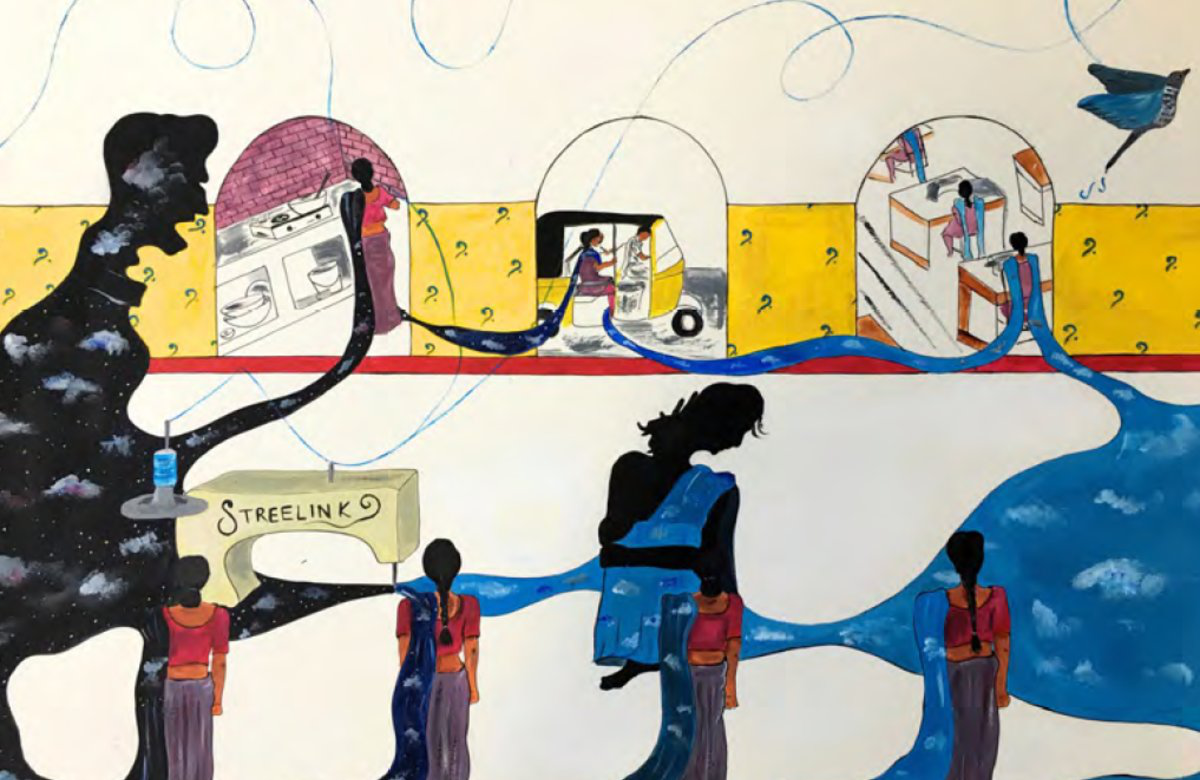
In India, Laudes Foundation funded an initiative, "Women Connect - Meet Your Strength", with the purpose of building a response system to sexual harassment (SH) at the workplace (SH@WP) and gender-based violence (GBV) within the apparel supply chain. Breakthrough (BT) India implemented this initiative from January 2017 to March 2020 with the branding "StreeLink - Milon Apni Taakat Se", partnering with Indian apparel manufacturer Shahi Exports Private Limited to implement it in 2 factories and 3 communities around these factories in Faridabad in the National Capital Region (NCR) bordering Delhi. Laudes Foundation commissioned this independent external evaluation to assess whether the initiative has met its intended goals to date, to document missed opportunities, and to provide a set of recommendations and lessons to inform the strategies and programmatic decisions of similar initiatives.
The evaluators explain that stigma and vulnerability associated with garment work, power differentials, and a repetitive and high-pressure work setting are among the factors that lead to a hostile work environment. Harassment includes the use of abusive language or tone, physical harassment, insistent advances, improper touch, groping, and rape. Due to absence of peer solidarity and culture of silence, victims of SH are afraid to speak out for fear of losing their job. As detailed in Related Summaries below, StreeLink responded to this context by aiming to develop the capacities of women apparel workers and their peer/support systems to respond to SH@WP and the different forms of GBV. The overall design had 4 major pathways to address GBV and SH: (i) capacity building of workers and factory staff; (ii) creation of network and support structures for working women; (iii) public campaign and mass/digital media; and (iv) advocacy.
The evaluation deployed qualitative and quantitative methods, which included in-depth interviews (IDIs), focus group discussions (FGDs), key informant interviews (KIIs), and a short telephonic survey with workers. The participatory approach was based on the key principles of gender-responsive evaluation: fair power relations and empowerment; participation and inclusion; independence and impartiality; quality and credibility; and ethics. The evaluation applied the Evaluation Rubric & Rating System (ERS) developed by Laudes Foundation, whereby 3 main dimensions were used to approach the evaluation: (i) initiative quality; (ii) intermediary outcomes; and (iii) long-term value.
In brief, the evaluation found that, though conceptually strong, the StreeLink initiative was not fully aligned to the project context or to BT's strengths. As a result, the project was unable to meet all of its outcomes. That is, it helped strengthen capacities and systems and changed narratives at factory level with regard to SH@WP, but it did not bring any change at the community or industry level.
In more detail, some selected results include:
- Project maturity: The evaluation team assessed StreeLink to be at maturity level 2 or at a developing stage, which is defined as "basics in place but still concentrating on making things work smoothly".
- Design and alignment ("unconducive") - for example:
- Sensitisation approaches for women workers on all forms of violence and gender-based discrimination (GBD) through melas (carnivals on Sundays once every 2 months) using edutainment tools was effective at spreading awareness in an easy yet comprehensive way. However, the 21 StreeLink melas for 5,432 workers, including 450 supervisors, were ultimately inadequate in building agency, as the women workers participated only once.
- Training held for factory personnel was relevant but insufficient to influence mindsets of factory human resource (HR) teams.
- The initiative's design did not consider the specific context of the urban settlements in Faridabad where the migrant workers live, such as their dispersed nature and the absence of credible civil society organisations (CSOs) as service providers in the localities. Consequently, as intended, the initiative could not engage with women workers and their families at the community level.
- The design of the initiative's advocacy component didn't account for the time needed to build trust and evidence of project effectiveness. However, the initiative contributed to the addition of DV and impact on workplace harassment at an international level within International Labour Organization (ILO)'s Violence and Harassment Convention 2019 (C190).
- In general, the initiative set unrealistic targets for itself and as a result struggled to meet them. For instance, the overall target of reaching 10,000 workers with a 60:40 women to male ratio was both over-ambitious and not reflective of the demography of the garment industry in Delhi NCR.
- Project implementation ("partly conducive") - for example:
- The project was implemented with professional standards and included strategies to capacitate the factory for identifying and eliminating GBV and SH@WP. However, it did not specifically seek to reach the more marginalised of the workers, like the new and younger female recruits.
- The creation of support structures, such as the community level core group and women support groups did not cater to the women apparel workers, and their relevance to SH and GBV in workplace was limited.
- The initiative established a new prevention of sexual harassment (POSH) policy for the 2 factories and introduced the policy to management for enforcement, leading to the formation of an internal committee (IC) on SH in both the factories. Anecdotal evidence reported positive differences in the factory floor environment (e.g., taunting, shouting, and insults less likely) in the last 2-3 years of the project.
- The community mobilisation and worker sensitisation activities used edutainment methods effectively to create awareness and nuanced understanding of GBV and GBD. This helped in building awareness and a gender-responsive environment, but a deeper, longer, and more regular engagement will be required to build the capacity for raising collective voices against GBV and SH (as the initiative had hoped for).
- In general, there is no evidence of any collective action at the factory or at the community level.
- Monitoring and adaptive management ("partly conducive"): The initiative had all the systems in place for proper monitoring of the project and collected a lot of real-time data, though it didn't make any systematic use of them. The project's willingness to adapt was mostly at the activity level, while the design largely remained the same despite evidence of its ineffectiveness.
- Communication ("conducive and supportive"): BT's communication strategies prioritised engagement, active participation, and mutual learning. The communication was effective and open with the workers, factory management, the women support groups, and influencers in community; however, it was inadequate or absent with the other garment industry players and policymakers.
- Changing narratives/gender-just conditions - for example:
- About 80% of the factory workers in the endline survey could recognise at least 3 forms of GBV and potential solutions, 98% of women workers in the endline survey were confident in reporting SH instances at the factory floor, and 89% felt there would be a resolution to complaints raised. Thus, the initiative created opportunities and presented validation to women workers to speak about their experiences regarding subtle forms of GBD, GBV, and SH.
- However, while enhanced awareness of GBV led to increased confidence among workers in terms of reporting to formal mechanisms, deep-rooted mindsets remained unchanged. The qualitative discussions suggest that a significant proportion of workers continue to believe in gendered roles and patriarchal norms, with some rationalising verbal abuse as justified by pressure at work.
- Within households, the initiative significantly broadened women workers' understanding on what constitutes domestic violence (DV); however, there is no significant change in the narratives within their families, and, in fact, 4% of the workers reported an increase in incidence of DV (due in part to COVID-19 lockdowns).
- Financial sustainability/scalability: The evaluation finds that the project was not financially sustainable, and could not demonstrate its scalability adequately. However, certain elements of the initiative - StreeLink melas for worker sensitisation and review of POSH policies of the garment factories - have potential for scalability and will need to be further developed.
Lessons to improve the quality, effectiveness, and long-term value of the initiative:
- Capacity-building component (factory level): In the absence of familiarity with the garment industry, partnership with organisations or experts with previous experience in garment sector should be considered at the concept development stage. Design must account for the time constraints of workers and staff. Development of training modules is an evolving process and has to incorporate feedback and validation of the factory. Level of sensitisation varies across factory, so training programmes should be designed as a multi-level module. Sustained efforts around key messages are required to change narratives.
- Community-level/-led component: Trust-building in the community is a time-consuming process; significant behavioural change requires at least 3 years of sustained intervention. Partnership with local organisations and service providers is critical; however, it is a challenge to find credible and committed civil society partners. Communities must be linked with verified support services, in parallel to the mobilisation activities. Worker sensitisation programmes can lead to generation of demand for safer and inclusive workplaces, but they to be matched with an effective response system and trust of workers in those systems.
- Public campaign component: Public campaigns should directly link with the outcomes of the initiative. Public campaigns at scale are cost intensive and must have an independent budget and outcome. The initiative should include a separate campaign evaluation that assesses its reach, targeting, impact, and recall.
- Advocacy component: Evidence-based advocacy is required for the industry to accept policy recommendations. This would involve documenting the effectiveness and success of a model and lobbying with industry stakeholders for its uptake. A multi-stakeholder and holistic approach is needed, where initiative engages with workers, factories/suppliers, brands, buyers/consumers, factory associations, media, etc.
The report concludes with recommendations specific to Laudes Foundation and BT. Overall suggestions relevant to others are:
- Acknowledge and understand the specific contexts where initiatives are to operate so as to design relevant approaches that achieve impact.
- Rather than rely on one-time use of edutainment tools and carnivals to spread awareness on sensitive issues such as GBV, include approaches that engage men and others in multiple ways for a comprehensive response to GBV.
- Be aware that building rapport and trust with industry associations, which is necessary for effective advocacy, takes time.
Email from Urvashi Gandhi to The Communication Initiative on December 17 2020; and Laudes Foundation website, December 30 2020. Image credit: Saheli Khastagir
- Log in to post comments