










































Correcting Vaccine Misinformation: A Failure to Replicate Familiarity or Fear-driven Backfire Effects
Affiliation
University of Western Australia (Ecker, Sharkey); Northeastern University (Swire-Thompson); Harvard University (Swire-Thompson)
Date
Summary
"...adds to the mounting evidence against familiarity backfire effects and has implications for vaccination communications and the design of debunking interventions."
Individuals often continue to rely on misinformation in their reasoning and decision making even after it has been corrected. This phenomenon is known as the "continued influence effect"; some argue that it can happen when a cue triggers retrieval of the misinformation - but not the corresponding correction - based on a myth's familiarity. A 2017 study by Pluviano et al. found that repeating vaccine myths and contrasting them with corresponding facts "backfired" relative to a control condition, ironically increasing false vaccine beliefs. The present study sought to replicate and extend the Pluviano et al. study.
In brief (see Related Summaries, below), Pluviano and colleagues investigated how corrections of childhood vaccine myths impacted (i) concerns about vaccine side effects, (ii) belief in the debunked link between the mumps-measles-rubella (MMR) vaccine and autism, and (iii) vaccination intention (vaccine hesitancy). The study randomly assigned participants to one of four conditions: a common vaccine "myths-versus-facts" condition; a visual-correction condition utilising an infographic comparing disease and vaccine risks; a fear-appeal condition using images of sick (unvaccinated) children; or a control condition presenting unrelated fact sheets about healthcare. None of the interventions substantially reduced misconceptions concerning vaccines relative to control. Instead, the myths-vs.-facts condition appeared to increase participants' belief in vaccine side effects and the vaccine-autism link, as well as reducing their intention to vaccinate. In a subsequent study, Pluviano et al. (2019) replicated this pattern of results in a parent population, where participants in a myths-vs.-facts condition held stronger misconceptions regarding vaccine side effects and the vaccine-autism link compared to control.
The present study included four conditions from the original Pluviano et al. study: the myths vs. facts, a visual infographic, a fear appeal, and a control condition. It also added a "myths-only" condition, which simply repeated false claims and labelled them as false; theoretically, this condition should be most likely to produce familiarity backfire. Participants received vaccine-myth corrections and were tested immediately post-correction, and again after a 7-day delay.
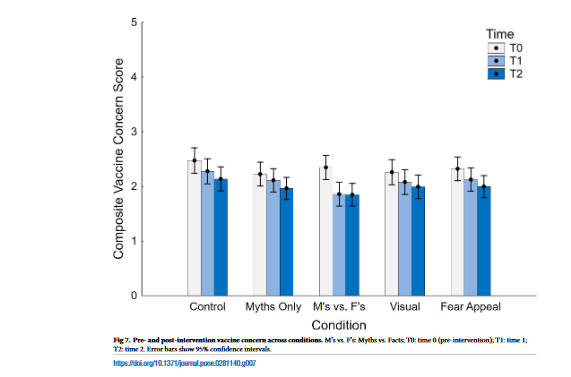
The study found that the myths vs. facts condition (in which 10 common vaccine misconceptions were juxtaposed against 10 corresponding facts taken from World Health Organization (WHO) educational materials) reduced vaccine misconceptions. None of the conditions increased vaccine misconceptions relative to control at either timepoint, or relative to a pre-intervention baseline; thus, no backfire effects were observed. In other words, no intervention was associated with greater misinformation belief or vaccine hesitancy than control at any timepoint. This finding held true across all analyses and subgroups, including in parents and in those participants higher in anti-vaccination sentiment.
In discussing the findings, the researchers note that "[o]ne reason for the efficacy of the myths-vs.-facts condition in decreasing misconceptions may lie in the clear and detailed alternative information presented when refuting the myths. It has been suggested that provision of alternative, factual information is the most important ingredient of a successful correction, allowing individuals to update their understanding and replace false with factual information in their mental models of the world....This also explains why no significant effect was found for the myths-only condition, which provided the weakest possible retraction....Despite the myths-only condition theoretically being the one most likely to cause a familiarity-driven backfire effect, though, no such effect was observed; this is particularly strong evidence against the notion of familiarity backfire."
A remaining question is: Why did the present study's findings differ from those of Pluviano et al. (2017)? The researchers offer several reasons. For example, the Pluviano et al. study included participants from both the United Kingdom (UK) and Italy (whereas the present study participants were only from the UK), and it is possible that the Italian participants were particularly vaccine-skeptical in 2016, when public discourse around mandates was polarising. Pluviano et al.'s finding may have also simply been a false-positive, given that their sample size was significantly lower than the sample size in the present study.
In conclusion: "A clear applied implication from this research is therefore that the hesitancy surrounding repetition of misinformation during correction is largely unwarranted. In light of the broader literature, the repetition of misinformation within a correction may actually be beneficial rather than harmful. Repetition may increase the salience of the correction while also facilitating processes for conflict resolution and knowledge revision....The only intervention successful in reducing vaccine misconceptions was a myths-vs.-facts approach that repeated the to-be-corrected misinformation and juxtaposed it with alternative factual information. It is thus recommended that this approach is used to proactively counter vaccination misinformation where it is encountered."
Individuals often continue to rely on misinformation in their reasoning and decision making even after it has been corrected. This phenomenon is known as the "continued influence effect"; some argue that it can happen when a cue triggers retrieval of the misinformation - but not the corresponding correction - based on a myth's familiarity. A 2017 study by Pluviano et al. found that repeating vaccine myths and contrasting them with corresponding facts "backfired" relative to a control condition, ironically increasing false vaccine beliefs. The present study sought to replicate and extend the Pluviano et al. study.
In brief (see Related Summaries, below), Pluviano and colleagues investigated how corrections of childhood vaccine myths impacted (i) concerns about vaccine side effects, (ii) belief in the debunked link between the mumps-measles-rubella (MMR) vaccine and autism, and (iii) vaccination intention (vaccine hesitancy). The study randomly assigned participants to one of four conditions: a common vaccine "myths-versus-facts" condition; a visual-correction condition utilising an infographic comparing disease and vaccine risks; a fear-appeal condition using images of sick (unvaccinated) children; or a control condition presenting unrelated fact sheets about healthcare. None of the interventions substantially reduced misconceptions concerning vaccines relative to control. Instead, the myths-vs.-facts condition appeared to increase participants' belief in vaccine side effects and the vaccine-autism link, as well as reducing their intention to vaccinate. In a subsequent study, Pluviano et al. (2019) replicated this pattern of results in a parent population, where participants in a myths-vs.-facts condition held stronger misconceptions regarding vaccine side effects and the vaccine-autism link compared to control.
The present study included four conditions from the original Pluviano et al. study: the myths vs. facts, a visual infographic, a fear appeal, and a control condition. It also added a "myths-only" condition, which simply repeated false claims and labelled them as false; theoretically, this condition should be most likely to produce familiarity backfire. Participants received vaccine-myth corrections and were tested immediately post-correction, and again after a 7-day delay.
The study found that the myths vs. facts condition (in which 10 common vaccine misconceptions were juxtaposed against 10 corresponding facts taken from World Health Organization (WHO) educational materials) reduced vaccine misconceptions. None of the conditions increased vaccine misconceptions relative to control at either timepoint, or relative to a pre-intervention baseline; thus, no backfire effects were observed. In other words, no intervention was associated with greater misinformation belief or vaccine hesitancy than control at any timepoint. This finding held true across all analyses and subgroups, including in parents and in those participants higher in anti-vaccination sentiment.
In discussing the findings, the researchers note that "[o]ne reason for the efficacy of the myths-vs.-facts condition in decreasing misconceptions may lie in the clear and detailed alternative information presented when refuting the myths. It has been suggested that provision of alternative, factual information is the most important ingredient of a successful correction, allowing individuals to update their understanding and replace false with factual information in their mental models of the world....This also explains why no significant effect was found for the myths-only condition, which provided the weakest possible retraction....Despite the myths-only condition theoretically being the one most likely to cause a familiarity-driven backfire effect, though, no such effect was observed; this is particularly strong evidence against the notion of familiarity backfire."
A remaining question is: Why did the present study's findings differ from those of Pluviano et al. (2017)? The researchers offer several reasons. For example, the Pluviano et al. study included participants from both the United Kingdom (UK) and Italy (whereas the present study participants were only from the UK), and it is possible that the Italian participants were particularly vaccine-skeptical in 2016, when public discourse around mandates was polarising. Pluviano et al.'s finding may have also simply been a false-positive, given that their sample size was significantly lower than the sample size in the present study.
In conclusion: "A clear applied implication from this research is therefore that the hesitancy surrounding repetition of misinformation during correction is largely unwarranted. In light of the broader literature, the repetition of misinformation within a correction may actually be beneficial rather than harmful. Repetition may increase the salience of the correction while also facilitating processes for conflict resolution and knowledge revision....The only intervention successful in reducing vaccine misconceptions was a myths-vs.-facts approach that repeated the to-be-corrected misinformation and juxtaposed it with alternative factual information. It is thus recommended that this approach is used to proactively counter vaccination misinformation where it is encountered."
Source
PLoS ONE 18(4): e0281140. https://doi.org/10.1371/journal.pone.0281140.
- Log in to post comments