











































Community Resource Centres to Improve the Health of Women and Children in Informal Settlements in Mumbai: A Cluster-Randomised, Controlled Trial
Society for Nutrition, Education and Health Action, or SNEHA (Shah More, Das, Bapat, Manjrekar, Kamble, Sawant, Shende, Daruwalla, Pantvaidya); UCL Institute for Global Health (Alcock, Osrin)
"This clearly defined model for integrated community-based health intervention in informal settlements merits adaptation and assessment in other contexts, particularly in Asia and Africa."
As of 2011, about 41% of Mumbai, India's households were in informal settlements, where women and children in particular face multiple health issues. The Society for Nutrition, Education and Health Action (SNEHA) is a non-governmental organisation working in these areas to address maternal and neonatal health, sexual and reproductive health, childhood nutrition, and prevention of violence against women and children. This cluster-randomised controlled trial (RCT) investigated an intervention model, developed by SNEHA, that revolved around community resource centres providing health service, outreach, and community mobilisation activities in two Mumbai wards with the lowest Human Development Indices.
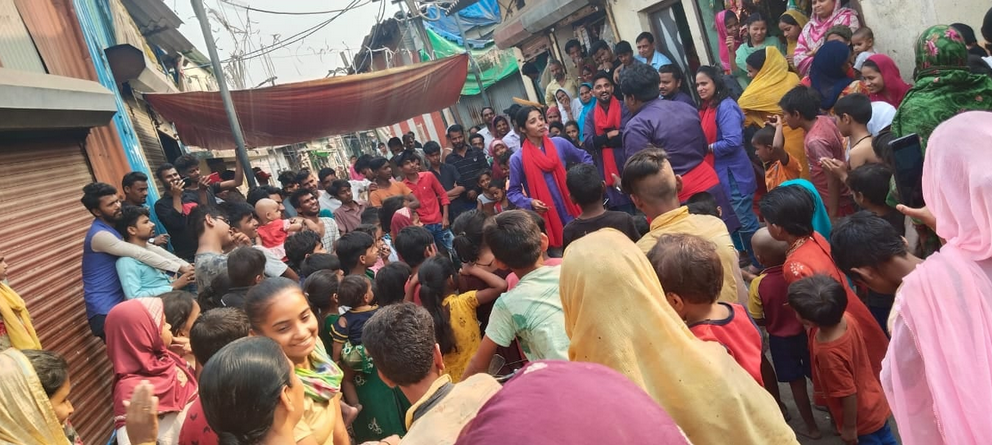
In 40 clusters, each containing around 600 households, 20 were randomly allocated to have a resource centre (intervention group) and 20 no centre (control group). A SNEHA centre was set up in each intervention cluster in rented premises. Each centre employed three full-time, salaried community organisers who were educated to at least the ninth grade and had similar socioeconomic backgrounds to potential beneficiaries. After 1 month of training (including in communication and negotiation skills), followed by regular supervision and follow-up visits by SNEHA staff and invited experts, the organisers were responsible for organising home visits, group meetings, day care for malnourished children, service provision (e.g., counseling and support for survivors of intimate partner violence), and liaision with existing systems. They also held community events, such as puppet shows, street plays, rallies, games, competitions, "flash mobs", cooking demonstrations, the Godbharai baby shower, Ushtavan initiation of complementary feeding, and celebrations of improvements in child health and nutrition that provided opportunities to discuss health behaviours and sought to create an enabling environment.
The preintervention census started in August 2011 and was completed in January 2013, and the postintervention census began in February 2014 and was completed in September 2015. The cluster RCT involved 12,614 households in intervention group and 12,239 in the control group. Postintervention data were available for 8,271 women and 5,371 children younger than 5 years in the intervention group, and 7,965 women and 5,180 children in the control group. Primary endpoints were met need for family planning in women aged 15-49 years, proportion of children aged 12-23 months fully immunised, and proportion of children younger than 5 years with anthropometric wasting.
Met need for family planning was greater in the intervention clusters than in the control clusters (odds ratio [OR] 1.31, 95% confidence interval (CI) 1.11-1.53). The proportions of fully immunised children were similar in the intervention and control groups in the intention-to-treat analysis (OR 1.30, 95% CI 0.84-2.01), but were greater in the intervention group when assessed per protocol (OR 1.73, 1.05-2.86) - that is, when women had been exposed to the intervention for 2 years. Childhood wasting did not differ between groups (OR 0.92, 95% CI 0.75-1.12), although improvement was seen at the cluster level in the intervention group (p=0.020). Feeding exclusively with breastmilk up to age 6 months and achieving minimum dietary diversity in children aged 6-23 months were increased in the intervention group compared with in the control group after the intervention (OR 1.54, 95% CI 1.02-2.33 and 1.48, 1.01-2.17).
The findings may be "generalisable to established informal settlements that have some amenities and high annual turnover"; such an intervention could be implemented by a non-governmental organisation in collaboration with public sector and civil society institutions. The researchers conclude that the model presented here is feasible and replicable, and they proceeded to expand the catchment area to achieve economy of scale.
Lancet Global Health 2017;5: e335-49. Image credit: SNEHA
- Log in to post comments