










































Lights, Camera, Action: The Participatory Video Experience in Nicaragua
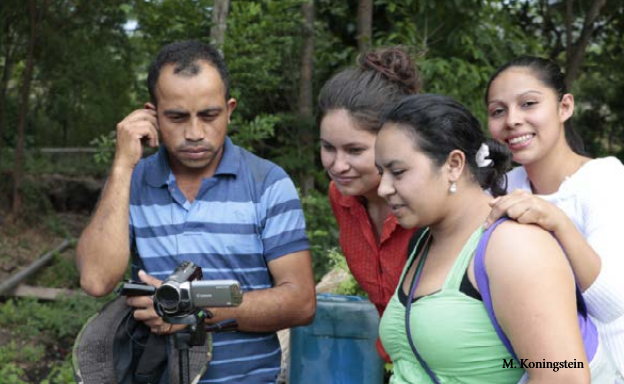
CIAT (Azadegan); Sivin Communications (Koningstein)
"The engagement of rural communities in ICTs, paying particular attention to women and youth, is a powerful channel to foster the leap from individual and collective learning to sustainable livelihood impacts through an integrated capacity development approach."
This report examines the participatory video (PV) project "Lights, Camera, Action: Participatory Video to Empower Rural Women and Youth", which was implemented in 2015 in Nicaragua by the CGIAR Research Program on Integrated Systems for the Humid Tropics (Humidtropics) and the CGIAR Research Program on Climate Change, Agriculture, and Food Security (CCAFS) through the International Center for Tropical Agriculture (CIAT)), and supported by the Capacity Development Unit of the International Livestock Research Institute (ILRI). By addressing what the PV project entailed, how it was conducted and with whom, what results were obtained, and what lessons were learned, the report aims to provide a practical, contextualised example of the application of the PV methodology for other partners to better understand the challenges faced and lessons learned during this PV experience as they apply the tool within their own agricultural research for development (AR4D) contexts.
PV is described here as a participatory research tool that involves members of a community in creating their own video message. The community learns to use video technology, write their own story, interview leaders and neighbours, and tell their own story. The PV methodology collects indigenous knowledge on factors that impact the effectiveness of sustainable development interventions based on local needs. It is a method for sharing ideas and learning, and through this, encouraging groups that are often marginalised to identify their own needs and implement their own forms of sustainable development. "PV is simple to replicate, disseminate, and track. Therefore, it can also serve as a versatile M&E [monitoring and evaluation] tool throughout the various phases of research interventions, generating insights and feedback from specific target groups. This creates a strong sense of project ownership within the community and a more fertile ground for technology adoption and social change."
The work was motivated by the observation that, "[a]lthough women have a fundamental role in Nicaraguan agriculture and livestock production, their contributions to achieving food security and sustainable development have been systematically ignored and undervalued....To better understand the gender context and include a gender perspective, it is important to provide participatory in-depth information and understanding of the challenges and opportunities faced by male and female smallholder farmers." The use of information and communication technologies (ICTs) - specifically, PV - is meant to empower these communities and bring their voices into the larger development debate. In brief, with cross-cutting linkages to inclusive gender, youth, and communication components, the projects explored the potential of transformative processes stemming from learning experiences at the community level. The first PV workshop was conducted with a group of 15 (7 men and 8 women, most of them between 19 and 23 years old) youth from La Danta (Somotillo, Nicaragua), a rural community in one of Humidtropics' Field Sites in the Central America and the Caribbean (CAC) Flagship project (see Related Summaries, below). Based on this PV experience, a training manual was developed and validated through a second PV workshop, which was conducted with a group of young rural women from the communities in the outskirts of Estelí, a municipality in centre-north Nicaragua.
Before going into depth about this work, the report explores the context - the country's basic statistics, as well as its agriculture, climate change, deforestation, rural women, agricultural knowledge sharing, and the site-specific context of the PV projects. For instance, with regard to the latter: "Various issues converge in the context in which the PV pilot took place, creating an environment that disempowers and discourages innovative and creative problem solving. The causes of these issues are, amongst others, inequitable social power structures; poverty and its impact on individual and collective access to resources, knowledge, and information; and gender differences due to political and social traditions. Various aspects must be considered when tackling these issues. For instance, the strong presence of local organizations and NGOs [non-governmental organisations] working on community awareness of gender equity issues often has a positive impact on these activities, whereas traditional machista culture and higher social regard of men over women is a common limitation that must be taken into consideration when designing interventions."
The report describes in detail the PV methodology used, which in general is participant-centred and participant-led at every opportunity to engage local people, enable them to determine local needs and opportunities, and adjust the PV process to be an effective tool for them. In brief, the process involves: demystifying technology, learning through doing, mapping the community and other exercises to harness local knowledge and new perspectives, working collectively, focusing on gender and equalising relationships, screening vidoes to function as a triangulation process, engaging in advocacy, taking a break from daily life, and stimulating creativity. Part 6 of the report presents a timeline of the activities carried out, as well as the main function of the exercise. Challenges the facilitators and participants faced while carrying out these activities are outlined. For instance, the project organisers noticed when working with youth that letting them move around and use different materials inspired their participation. However, an obstacle noted was that general education in Nicaragua does not encourage creativity and using problem solving methodologies. Furthermore, people are trained to learn reading and writing, so it was challenging for the participants to make a shift from words to drawings.
The PV intervention had various results and outputs, described through the following elements:
- Gender and inter-generational dynamics - e.g., "[i]n the PV experience in Estelí, it was noted that the single fact of being able to share experiences between the participants, and that they noticed they are all in similar situations, the girls felt more empowered, felt more organized and felt more connected to each other....The PV experience in Somotillo showed that the interviewing technique can be very empowering for both generations."
- Natural resource management and income generation - e.g., "through trainings such as PV, farm families felt more organized and structured, thinking through their problems in a collective manner."
- Equal participation - e.g., "[d]irectly linking to the inclusion of marginalized communities and groups is the equal participation of all in the intervention."
- Learning and innovation - e.g., "it seeks to create an environment in which both men and women feel comfortable participating, sharing their opinions, giving a voice to those lesser heard, and encouraging women and youth from local communities to acquire a new skillset, including learning about employing a transformative thinking approach when tackling community issues."
The report moves on to discuss the outcomes of the intervention - in terms of: (i) short-term/immediate outcomes, such as participants learning both technical skills and self-reflection skills, participants being empowered by learning how to employ a transformative thinking approach to community issues, partnerships being established, and the PV method being promoted to other regions; (ii) medium-term outcomes, such as the PV methodology being replicated (by the Soils Program in West Africa); and (iii) long-term impact and ultimate benefits, such as the transfer of skills to new groups, increased community empowerment, and following up the PV experience: "Conducting the appropriate follow up after a PV intervention may be the most important - and potentially challenging - step of the process. Although communities may show great enthusiasm and motivation for new practices to be implemented, social and behavior change is a slow process that demands time and patience, involves a complex web of factors, can create resistance, and must be managed carefully. Adequate follow up is key to facilitating the process started through the PV experience."
Concluding thoughts focus on what the PV project organisers would have done the same (e.g., "the combination of technical exercises aimed at teaching participants to use video equipment, alongside exercises aimed at understanding the community's dynamics and dilemmas, which ensures important information is collected at the same time that skills and capacities are being developed") and what they would have done differently. "As a direct result of this systematization and sharing of experiences with Africa and Asia, a new and improved PV manual will be proposed, presenting the 'bare bones' 6-day methodology, and providing the rest of the exercises as extras the facilitator can choose from to enhance their workshop as needed."
CGIAR website, April 24 2017; and email from Shadi Azadegan to The Communication Initiative, April 27 2017. Image credit: Manon Koningstein
- Log in to post comments