










































A doll with a difference
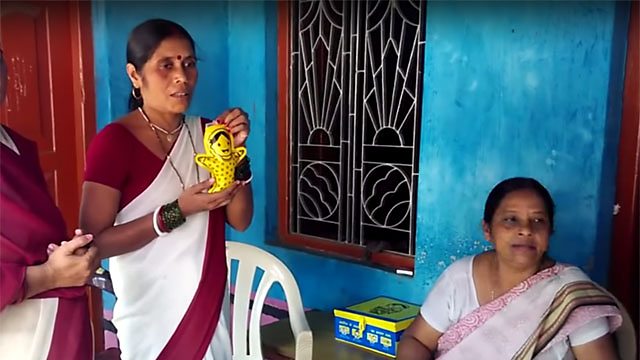
Author: Siddhartha Swarup, September 28 2015 - A simple but effective new prop is helping health workers in India tackle one of the country’s biggest killers, says BBC Media Action’s Deputy Country Director, Siddhartha Swarup.
Pari isn't exactly like the other members of our BBC Media Action team here in Delhi. She's made out of plastic, is only about 20 cm tall and lives in a doll's house. But in the three months since she's joined us, she's become a vital part of the team.
But then, Pari ("fairy" in Hindi) isn't your normal doll. Pari, the "diarrhoea doll" could save millions of lives. Here's how she works.
Pari acts as a prop for health workers to help educate people about the dehydrating dangers of diarrhoea and how to treat and prevent it.
During their visits to mothers, health workers fill her up with water through an inlet at the top of her head so she fills out to look like a healthy child. The health worker then opens an outlet at the bottom - slowly draining her of water - making Pari become thinner and thinner. The result? A vivid demonstration of what happens when a child becomes dehydrated.
The health worker then repeats the process, but instead of water, uses a one litre bottle of ORS (Oral Rehydration Salts). Pari starts to expand and resumes her original healthy shape. The outlet is then plugged, mimicking the ‘bulking’ the salts promote in the digestive system, keeping vitally-needed fluids retained in and absorbed by the body - and so making clear the value of ORS in rehydration and its ability to save lives.
But why is Pari needed?
In rural India, diarrhoea is common and can be a killer: more deadly than HIV and AIDS, malaria and measles combined.
Diarrhoea deaths are, we know, easily preventable. And people in rural India know about ORS and they're easily available. But for some reason, women weren’t using them. Our team decided we had to find out why.
This is what we learned: while most women were aware of ORS, they weren't sure how it could help. They didn't understand the dangers of dehydration and were focused on stopping the diarrhoea as opposed to rehydrating the child.
This was the fundamental insight that led to the birth of Pari - a way to easily communicate and demonstrate the complicated idea of dehydration to rural, often illiterate women in ways that created instant demand for life-saving ORS and zinc, another supplement which treats diarrhoea.
Eureka moment
Anecdotal evidence has shown Pari is already making her mark in Bihar. The simple demonstration of dehydration creates a ‘eureka moment’ for women, transforming ORS into a ‘must have-must use’ product. Several women have also asked for sachets of ORS and zinc right after the demonstration.
Health workers are finding it useful too. As Bibha Kumari, a health worker from Darbhanga said, “I was very happy to see this kit. With Pari, we’re easily able to explain the concept of dehydration. Now women in my area will be able to handle diarrhoea at home and treat their children.”
As we await a formal evaluation of Pari’s impact, we hope more and more women will learn from such a simple but effective doll, so more children will survive and thrive.
Click here to access this BBC Media Action blog and related links on their work in India.
Image credit: BBC Media Action
Contact:
BBC Media Action
BBC Media Centre, MC3A, 201 Wood Lane
London
W12 7TQ
United Kingdom (UK)
Phone: 44 (0) 20 8008 0001
Fax: 44 (0) 20 8008 5970
Media.action@bbc.co.uk
- Log in to post comments