










































Talking HIV & AIDS to Youth!

From January through December 2009, the Samoa AIDS Foundation (SAF) is carrying out a programme designed to prevent HIV infection by reaching out to out-of-school youth in public places in urban Apia, Samoa. Conducted as part of the Youth Visioning Project, funded by the United Nations Education, Scientific and Cultural Organization (UNESCO), Talking HIV & AIDS to Youth! has the following objectives:
- to increase young people's knowledge of HIV/AIDS through information provision;
- to boost involvement of young people in promoting awareness of HIV/AIDS among their peers;
- to advocate for behaviour change in young people by promoting prevention of sexually transmitted infections (STIs), including HIV;
- to increase knowledge about the connections between violence against women and the spread of HIV; and
- to promote the services of SAF through information about and referral to the voluntary confidential counselling and testing (VCCT) clinic.
This HIV prevention intervention revolves around the peer-to-peer strategy, whereby young people reach out to other young people to talk about issues that are conventionally sensitive. It was developed by a group of SAF peer educators who are also members of the theatrical group "Poula", which is reaching out to students in secondary schools around the country. They were motivated by the observation that not all youth are in school; those who are not have no access to various kinds of services and hence are more vulnerable to health threats.
The outreach programme is designed to engage out-of-school youth where they gather. One component is an annual evening youth rally in Apia with entertainment, information, quizzes, and prizes to be won. What is intended to be a "hip" setting is envisioned as affording ample opportunity to reach these often "invisible" youth with the accurate information, providing them with appropriate life skills to protect themselves on the streets.
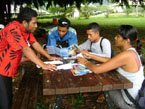
Along these same lines, a quarterly street outreach is held where peer educators reach out to young people with information about STIs, including HIV and AIDS, and disseminate printed materials available in both Samoan and English on prevention and available services. The outreach is designed to educate, encourage, and empower young people through information. The SAF held its first Public Outreach at the Fugalei Market on January 30 2009. Peer educators started the programme by introducing themselves, and informing those gathered about what HIV/AIDS outreach is all about. People of different ages stopped by to ask questions and to learn more about HIV/AIDS. SAF claims that the turnout was excellent at that first event, and noted that the market setting allowed for a variety of people to listen to the messages in a non-formal setting and to seek out health information without affecting their daily schedules.
HIV/AIDS, Youth.
According to SAF, young people who are not in the formal education system in Samoa are known to be increasing in number. They sell wares and exchange favours for money - exposing themselves to sexual exploitation and increasing their vulnerability to all kinds of diseases, including the HIV virus.
SAF developed a questionnaire to assess young people's level of knowledge of STIs, HIV, and AIDS. The majority of young people who responded (36%) were between the ages of 16 and 18 years with a relatively good level of general knowledge on HIV/AIDS. However, findings reveal that one in every three persons who completed the questionnaire still holds common stereotypes, which can turn into stigma and lead to discrimination against men, women, and children living with HIV.
Email from Khalissa Ikhlef to The Communication Initiative on September 16 2009; and Youth Visioning website, accessed September 23 2009.

- Log in to post comments