










































Social and Psychological Readiness to Take Collective Action Against Violence Against Women: A Mixed Methods Study of Informal Settlements in Mumbai, India
University College London (Gram, Osrin); Society for Nutrition, Education and Health Action (Chakraborty, Daruwalla)
"These findings open up avenues for policymakers to treat communities as less vulnerable and more capable of changing situations and problems that affect them."
Interventions that mobilise communities to tackle the social and structural drivers of violence have been found to be effective in some contexts to prevent violence against women (VAW). Such interventions generally involve establishment of relationships with stakeholders and mapping out of community resources, awareness-raising activities around gender inequality and VAW, capacity-building activities to help communities take action, and consolidation and institutionalisation of community-based activities to ensure sustainability. This study evaluated social and psychological readiness for collective action prior to the introduction of a complex community intervention to prevent VAW in urban informal settlements in Mumbai, India.
For the purposes of this research, collective action is defined as voluntary joint action by a group of people in pursuit of a shared goal. It emphasises intentional participation in a collective effort rather than spontaneous crisis response by individuals. "Readiness" to take collective action against VAW is the extent to which enabling drivers of such action are present in a given community. Below is the analytical model informing the study:

The study was embedded in an ongoing cluster-randomised controlled trial evaluating the effects of a complex community intervention to prevent VAW implemented by the non-government organisation (NGO) Society for Nutrition, Education and Health Action (SNEHA) in Mumbai, India. Data collection took place from December 2017 to December 2019. The researchers carried out a baseline survey in 54 trial clusters of around 500 households in 4 large urban informal settlements. The final sample size was 2,642, of whom 1,307 were cis men, 1,331 cis women, and 4 trans women. Qualitative data were collected from 264 community meetings.
The researchers found collective action to be common. Forty-six percent of women and 62% of men had witnessed a march, rally, or protest in the past year, and 21% of women and 28% of men had regularly attended meetings of a local community-based group or NGO in the past year. Thirteen percent of men and 12% of women had attended a group meeting or gathering addressing VAW as an issue. Men were more likely overall than women to participate in local groups or organisations; when women participated, they participated disproportionately in economic self-help groups.
In terms of opinions on the legitimacy of action against VAW, 40-60% of women and men agreed that VAW was a common issue in their community and that it was serious. A majority disagreed that VAW was a private matter between those directly affected or that others outside the family should not intervene if a husband mistreated his wife. However, a majority also agreed that it was good for a wife to be afraid of her partner. Women were slightly less likely than men to agree that wives were obliged to have sex with their husbands and that domestic violence was a private matter.
Over 80% of respondents agreed their community could stop domestic violence, persuade the police to take action, or persuade families to support survivors of violence by working together. When asked about specific platforms for collective action, more than three-quarters agreed that group discussion and peaceful demonstration would be effective, and a third of respondents even agreed that disruptive protest would be an effective means of stopping VAW. Even in terms of their own efficacy, over 80% felt they could make a personal difference to reducing VAW. On most indicators, men expressed greater confidence than women in the collective ability of their community to address VAW.
Over 70% of community members felt their families would approve of them joining activities to stop VAW, would think such action prestigious, and would not find it opposed to their values or a waste of time. Seventy-three percent of women and 82% of men agreed that people in their neighbourhood would approve of them joining activities to stop VAW. However, half of respondents - women, in particular - thought their neighbours might mock them for joining activities to stop VAW. Men were also more likely to expect family and community support in doing this than women.
Qualitative data suggested explanations for variation in perceived legitimacy of action against VAW. Some community members saw domestic violence as a private matter to be borne by women with thoughtfulness and understanding . Speaking openly of such experiences was equivalent to speaking ill of one's community and betraying the family's honour. Younger women in particular questioned the silencing of domestic violence survivors due to shame and fear and vocally supported intervention activities to address VAW.
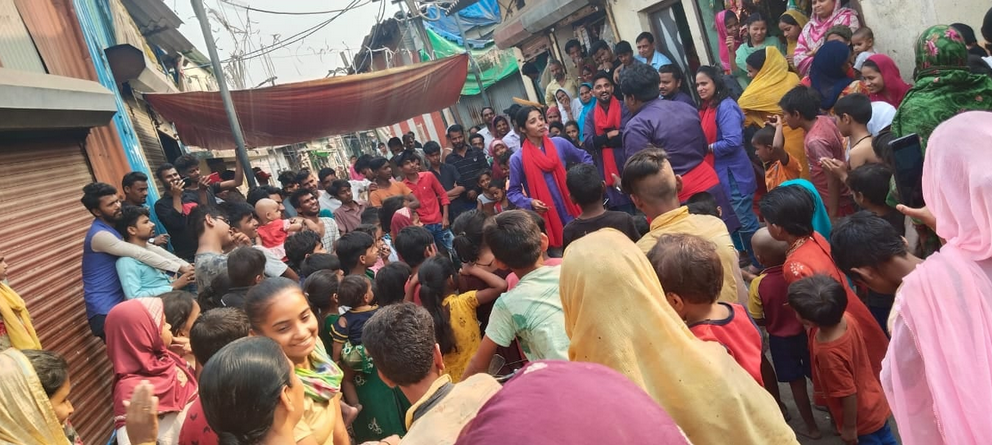
Collective action and self-organising were seen as vital to life in the neighbourhoods and involved working with elected representatives to get services and infrastructure in place or resisting slum demolitions. Community members said that shared historical ties bound them together and created unity and felt that their familiarity, close ties, and physical proximity to neighbours contributed to feelings of security.
Qualitative data help explain observed gender differences in participation in collective action. Some women worried that their group participation might invite negative judgments, alluding to an unseemly appetite for influence and power. By contrast, male leadership was seen as largely "natural", and many men already combined neighbourhood activism with religious practice by participating in cleanliness drives, health camps, or festivals organised by local faith committees. However, men's social identities rarely called for action to address VAW, and gender inequality was not a focus of these committees.
Qualitative data also suggested reasons for why not all respondents felt confident about taking action. For example, community members feared retaliation from friends of perpetrators of violence, particularly in communities where substance abuse and crime were widespread and local criminal gangs used violence to silence opposition. Some worried that survivors of violence might themselves question their motives for trying to help in a "private matter". Others thought community members might remain apathetic to the cause of preventing VAW due to domestic violence being normalised. A few men felt that managing one household was already complex enough without having to address neighbours' domestic disputes.
Reflecting possible future collective action efforts around VAW in the study communities, the researchers suggest that implementers could begin by identifying and seeking out those individuals in the community who are already aware of the problem of VAW. They could engage such actors in early tasks: finding other sympathetic community members, persuading them to join the cause, and raising awareness about the need to respect women's rights. In time, early volunteers could evolve into community organisers with responsibilities of their own for mobilising collective action.
Thus, while the study confirmed the presence of patriarchal attitudes in the study communities, large proportions of women and men did support collective action to address VAW. These findings suggest that "urban informal settlements are heterogeneous communities in which attitudes endorsing gender inequality and violence can coexist with significant enthusiasm and support for collective action against VAW. Overall, communities might be well prepared to engage with a community mobilization intervention to address VAW" in this context.
Violence Against Women. 2021 Dec; 27(15-16): 3176-96. doi: 10.1177/1077801220971360. Image credit (top): SNEHA via Facebook
- Log in to post comments