
























Development action with informed and engaged societies

After nearly 28 years, The Communication Initiative (The CI) Global is entering a new chapter. 

Following a period of transition, the global website has been transferred to the University of the Witwatersrand (Wits) in South Africa, where it will be administered by the Social and Behaviour Change Communication Division. Wits' commitment to social change and justice makes it a trusted steward for The CI's legacy and future. 

On the transfer, co-founder Victoria Martin expressed her pleasure to see this work continue under Wits' leadership, knowing that co-founder Warren Feek (1953–2024) would have felt deep pride in The CI Global's Africa-led direction. 

As Wits, we honour the team and partners who sustained The CI for decades and look forward building from that strong base. This includes co-founders Warren Feek (1953-2024) and Victoria Martin as well as La Iniciativa de Comunicación (CILA), which continues independently at lainiciativadecomunicacion.com with links to The CI Global site. We are also eager to forge new partnerships and entertain new ideas as we consider how best to contribute to social and behaviour change in our rapidly evolving environment.

If you are joining the International Social and Behaviour Change Communication (SBCC) Summit in Panama, please join Wits and CILA on Monday, 22 June, to share your thoughts and suggestion for the relaunch of the Communication Initiative. We will be in Pacifica 5 from 12-1:25 for the Refuel, Reflect, and Renew Lunch Series: The Communication Initiative: celebrating a driving force for Communication for Social Change and the way forward. We will reflect on the legacy of Warren Feek and family in creating the Communication Initiative, consider the contributions of CI over the years and then turn our attention towards the future in this dynamic session. 

If you are unable to join us in Panama, we still want to hear from you. Please contribute your thoughts by following this link: https://redcap.link/CommunicationInitiative2026 or reaching out to ci_surveys@commint.com

You can also follow the QR Code:

 https://redcap.link/CommunicationInitiative2026

Time to read
1 minute
Read so far

Zika Prevention Behavior Matrix
0 comments
Image
SummaryText

"Lessons learned from behavioral science, marketing and adult learning have demonstrated that individuals need to hear a message multiple times before they are compelled to take action."

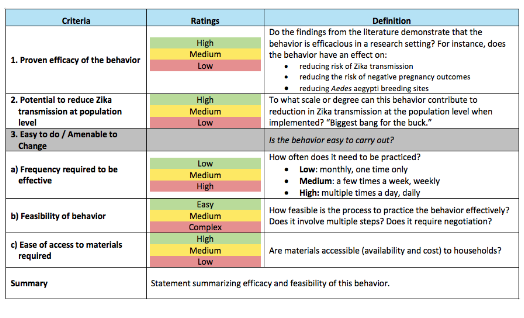
During the first year of the Zika response in Latin America and the Caribbean, the United States Agency for International Development (USAID) found that over 30 behaviours were being promoted as part of social and behaviour change (SBC) efforts. In an effort to increase the chances that behaviours to prevent Zika at the household and community level are adopted correctly, USAID worked with Breakthrough ACTION, Breakthrough RESEARCH, and the United Nations Children's Fund (UNICEF) to focus prevention efforts around a shorter, common set of most promising behaviours. The result was this Zika Prevention Behavior Matrix, which can be used in conjunction with an online guide available at Related Summaries, below.

Following a review of supporting literature, the team developed three criteria to analyse each behaviour in terms of efficacy, effectiveness, and feasibility. Colour-coding was used to show the rating of each criteria according to the literature and field experience. The tables are organised according to: Personal Protection Behaviors; Household and Community Vector Control Behaviors; and Enabling Behaviors. Prioritised behaviors are: applying mosquito repellent, using condoms, removing unintentional standing water, covering and scrubbing walls of water storage containers, seeking prenatal care, and seeking counseling on family planning if not planning to get pregnant. At the bottom of each table, there is a summary statement on the overall efficacy and feasibility of the behaviour.

Publication Date
Languages

English, Spanish

Number of Pages

30 (English); 37 (Spanish)

Source

"Prioritizing Behavioral Messages During the Zika Crisis", by Stephanie Desmon, October 7 2019, and Zika Communication Network - both accessed on October 29 2019.