










































Effectiveness of integrated health awareness program for women at reproductive age (15-49) through home-visits in Jordan
Summary
Background: Womens health has hit the spotlight in Jordan focusing on family planning and breast cancer awareness. Jointly, the Jordanian Breast Cancer Program and the Jordan Communication, Advocacy and Policy Activity established an innovative integrated SBCC program reaching out to women in the cities of Sweileh and Salt that is intended to increase awareness and uptake rate of modern family planning and breast cancer early detection methods. Method: Educational and practical training was done for the community health workers followed by 1153 home visits for married women in the reproductive age who were assessed on their knowledge and attitude towards FP and BC where women who were not using modern family planning methods were redirected to health centres. The retention of knowledge and changes in practices was evaluated after two months by selecting a random sample of 260 MWRA. Results: 1153 home-visits targeted ladies aged from 15 to 49 years old, where 43.4% of the women acted upon their referral. Following the home-visits, ladies were more confident to self asses their knowledge about the family planning, as 92/200 scored themselves (5) compared to 33/251 prior to the home visit. While 87/92 and 88/92 were well-informed that self-breast examination and clinical breast examination respectively is done by the age of 20. Conclusion: The adoption of family planning and breast cancer screening and early detection methods provided notions of women empowerment and autonomy over her health decisions that initiated sustainable development broadened to empowering them over all decisions.
Background/Objectives:
Womens health has hit the spotlight in Jordan focusing on family planning and breast cancer awareness. Jointly, the Jordanian Breast Cancer Program and the Jordan Communication, Advocacy and Policy Activity established an innovative integrated social behaviour change communication program reaching out to women in the cities of Sweileh and Salt that is intended to increase awareness and uptake rate of modern family planning and breast cancer early detection methods.
Description of Intervention and/or Methods/Design:
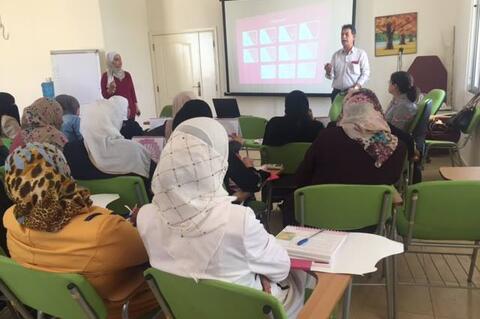
Training on social behaviour change, gender equality & equity, communication concepts and the methods for delivering FP and BC messages was done for the community health workers (CHW) where then they conducted 1146 home visits for married women in the reproductive age and questionnaires were given to assess their knowledge and attitude towards FP and BC where women that were not using modern family planning methods were redirected to health centers in order to utilize the services. The retention of knowledge and the changes in practices was evaluated after two months by selecting a random sample of 260 MWRA.
Results/Lessons Learned:
A total of 1146 home-visits were done covering women aged from 15 to 49 years old, where 43.4% of the referred women acted upon their referral. Women were more confident to self asses their knowledge about the family planning topic, as 92 out of 200 of the post-test sample scored themselves(5) compared to 33 out of 251 prior to the home visit. While 87 out of 92 from the post-test sample stated that a lady should start self-breast examination by the age of 20 and the majority (88 out of 92) were well-informed that clinical breast examination is important when you hit the age of 20 and also figures regarding the mammography knowledge were outstanding, when compared to pre-test results.
Discussion/Implications for the Field:
The adoption of family planning methods and breast cancer screening and early detection has become an integral component in women's norms. Both provided notions of women empowerment and autonomy over her health decisions.
Abstract submitted by:
Rasha Fakheraldeen - Jordan Breast Cancer Program
Batool AlJammal - Jordan Breast Cancer Program
Approved abstract for the postponed 2020 SBCC Summit in Marrakech, Morocco. Provided by the International Steering Committee for the Summit. Image credit: Jordan Breast Cancer Program.