










































What Is Different About Evaluating Work with Men and Boys on Challenging Dominant Masculinities?
Authors: Ranjani K. Murthy, originally posted March 23 2019 - This article explores lessons from evaluations that I have done on work with men and boys to challenge dominant masculinities in India, Bangladesh, Sri Lanka and Afghanistan. It also asks what lessons are different from evaluating work with women and girls on gender equality and women’s empowerment.
Reflecting back on around eight evaluations that I have done on working with men and boys, the following unique lessons emerge:
- Gender transformation or men’s/boys’ gendered needs? Evaluations need to examine whether the project/programme focus is instrumental in nature that is to achieving men’s needs and interests, or whether it is oriented towards gender transformation. An example of the former, is efforts to work with men and boys on the problems they have faced as a result of the social construction of gender (e.g. pressure to be breadwinner), while not discussing privileges they have experienced. An example of the latter is effort to work with men and boys to reduce violence against women in domestic and public spaces, through giving up/reducing their power ‘over’ space. Ideally projects should work men and boys with largely a gender transformative agenda, which does not preclude some attention to working on issues confronting men and boys as a result of social construction of gender. Gender gap is high in economic and political sphere and sexual and reproductive rights and bodily integrity are violated the world over.
- Benevolence or partnership with women’s groups? Another aspect that evaluations need to examine is whether the work with men (and boys) on gender and social equality encourages men to form alliances with women’s groups in villages and slums to address strategic gender issues like violence on women under joint leadership, or whether the work with men and boys is restricted to encouraging benevolent behaviour with men and boys acting on behalf of women and girls without the latter’s agency. A good example of the latter is how adolescent boys after a life skill programme formed a “vigilance committee” during village temple festival in Tamil Nadu, India to ensure that boys from other villages who came did not mix with the girls from their village. On the other hand, a partnership approach entails how male youth partnered with women’s groups to combat acid violence in parts of Bangladesh or men and women came together in the We Can Campaign to address violence on women in Sri Lanka, India and Bangladesh.
- Norms around caste, class, relations, disability, heteronormativity are being broken or perpetuated? Another aspect to be examined is whether norms around other identities amongst men and boys are broken or reinforced. In an evaluation in Jharkhand, India it was found that men and boys of different castes, religions, class and abilities came together in Bokaro and visited/ate in each other’s houses (and more frequently than before). While norms on arranged marriages were breaking, love marriages were mainly within the community.
- Assess whether discourse on relation position is non patriarchal: We need to look at the underpinning discourse of the project/programme on men and boys, and ask whether the discourse is dominated by patriarchal concepts like men and boys as fathers, sons, husbands, brothers or goes beyond to reconstruct relation position as parents, children, partners, friend, activist etc. At the same time, we need to understand that discourses take long to change, and it may take several project cycles to make this shift.
- Are men, boys, women and girls coming together to hold institutional accountable to gender equality? Apart from men/ boys and their families, evaluations need to assess whether norms and practices are changing at community, market, local government and service provider levels in favour of gender and social equality. For example, in Afghanistan as part of the evaluation discussions were held with Community Development Councils and men traders in markets to see whether their thinking was changing on gender norms. In Jharkhand and Tamil Nadu, India efforts were made in evaluations to assess how far men’s groups were holding local government, schools and Anganwadi centres to account on gender equality.
- Do the projects work with men and boys on peace: It is well known that men and boys are more involved in conflicts than women, and resolve conflicts in violent ways. It is important to assess if projects and programmes promote non violent ways of resolving differences amongst men and boys- be it on the basis of race, caste, class, religion, gender etc.
- Cross bridges, triangulate and do not expect full participation: Men’s labour force participation in many south Asian countries is higher than that of women. It is difficult to expect full participation in meetings, especially if held during day time. It is important to look at average attendance in group meetings and not just your meeting. Alternatively meet them in the evening, on a day convenient to them given migration. Further, the tendency to give the politically correct answer may be higher amongst men than women, and hence cross verification with partner, children and other group members is a must. As a woman evaluator know what questions can be asked, when, and what cannot. Asking questions on women’s sexual rights can be tricky and more so if by women.
This article explored what is unique or “added” about evaluations of work with men and boys on challenging dominant masculinities, when compared to work with women and girls. What, how, when and why of evaluations differ when we assess work with men and boys on masculinities. Lessons from such evaluations can contribute to progress towards SDGs, in particular SDG 5 on Gender Equality as well as SDG 10 on Reduced Inequalities and SDG 16 on Security.
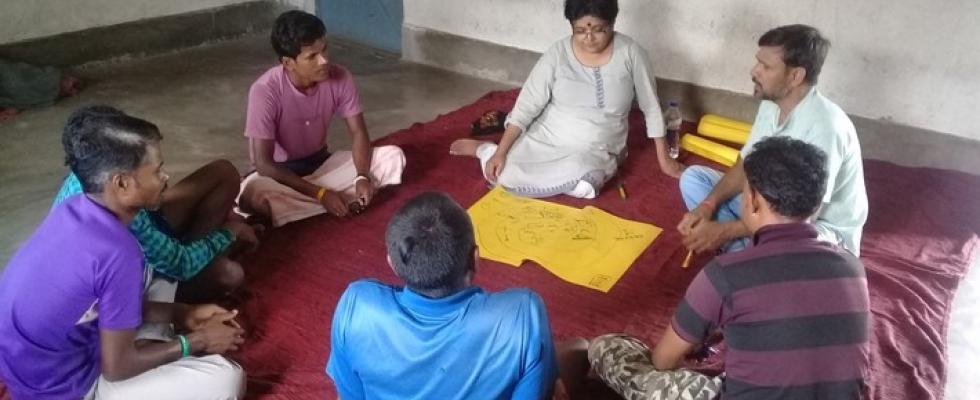
Image credit: Center for Health and Social Justice
As with all of the blogs posted on our website, the content above does not imply the endorsement of The CI or its Partners and is from the perspective of the writer alone. We do not check facts and strive to retain the writer's voice, as is detailed in our Editorial Policy.
- Log in to post comments