










































Transparent Communication of Evidence Does Not Undermine Public Trust in Evidence
University of Cambridge
"...framing information in a balanced way and acknowledging uncertainties do not substantively undermine the trustworthiness of a message or its source, compared to a more persuasive communication."
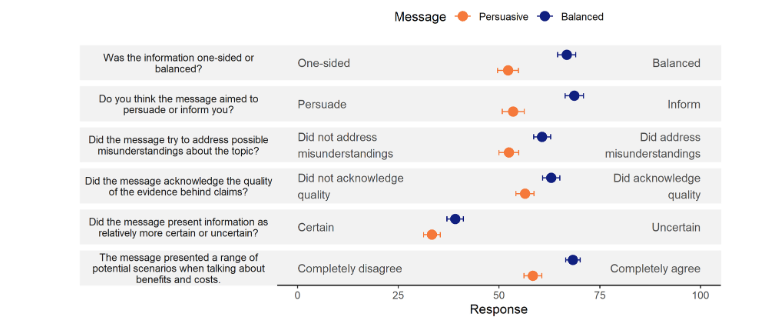
Authorities often seek to shift behaviour through persuasive messages and "nudges" that are designed to persuade the audience that the opinion of the communicator should be followed. However, in many situations, there are strong practical, ethical, and legal reasons why communicators, particularly experts, should instead provide balanced, clear, and understandable evidence to their audience, allowing them to come to an informed decision of their own making. Through two randomised controlled trials (RCTs), this paper tests whether audiences perceive realistic messages written in a traditional persuasive style to be more or less trustworthy than those produced according to principles of transparent evidence communication that are designed to inform decision-making: communicating a balance of risks and benefits, disclosing uncertainties and evidence quality, and prebunking misperceptions.
Study 1 was conducted in April 2021, prior to rollout of the COVID-19 vaccine to the general United Kingdom (UK) public under 50 years of age. In an online experiment, 2,928 UK adults were randomly allocated to read one of three messages: (i) The Persuasive message was adapted from the UK's National Health Service (NHS) website, encouraging vaccination against COVID-19 and describing the available vaccines simply as safe and effective. (ii) The Balanced message: framed vaccination as a personal choice; included information on efficacy, side-effect frequency, uncertainties; and anticipated and corrected possible misperceptions. (iii) In the Partial condition, participants were presented with a minimally edited version of the Persuasive message including only one sentence for each of the five recommendations for trustworthy evidence communication.
Study 2, which involved 1,034 UK adults, applied a slightly modified experimental design to the issue of building a new nuclear power plant in the UK. The nature of the decision was different: a collective, policy decision (support for a new plant) as opposed to an individual decision (getting a vaccination).
In Study 1, there were no significant differences between the Persuasive and Balanced conditions in terms of how trustworthy participants rated the information or its producers. In Study 2, participants who read the Balanced message (vs. Persuasive) rated the information as significantly more trustworthy and its producers as significantly more trustworthy. However, the researchers found a moderating role of prior beliefs such that balanced messages were consistently perceived as more trustworthy among those with negative or neutral prior beliefs about the message content. They also note that participants who had read the persuasive message on nuclear power plants voiced significantly stronger support for nuclear power than those who had read the balanced message, despite rating the information as less trustworthy. There was no difference in vaccination intentions between groups reading the different vaccine messages.
Having presented some suggestions for future research directions based on these findings, the researchers note "some challenges the evidence communication approach presents for communicators. Acknowledging both risks and benefits while disclosing uncertainties and evidence quality requires the addition of more information. This necessarily increases the length of communications and may increase the complexity for readers. Communicators should aim to incorporate such information in a clear and simple manner to minimize the effort required from the audience using formal readability indices to check this, alongside piloting information with the intended audience."
In conclusion: "balanced and transparent messages aiming to inform rather than to persuade are not perceived as less trustworthy. Indeed, it appears such message are perceived as more trustworthy and broadly elicit less psychological reactance among those with negative or neutral prior beliefs about the message content....[T]hose wishing to communicate evidence in a way that is more trustworthy, and that is recognized as such by an audience with a broad range of prior views on a topic, should consider...setting out to inform, with balanced, transparent information and discussion of uncertainties, rather than using traditional, persuasive writing styles. Conversely, those who wish to maximise their influence on their reader's opinions and behavior may lose some of their audience's trust. A proportion of the audience (particularly those with an opposing opinion on the topic beforehand) may see such a persuasive approach as less trustworthy."
PNAS Nexus 2022, 1, 1–11. https://doi.org/10.1093/pnasnexus/pgac280.
- Log in to post comments