










































Training Supervisors to Mentor Health Workers Who Provide Counselling on Infant and Young Child Feeding
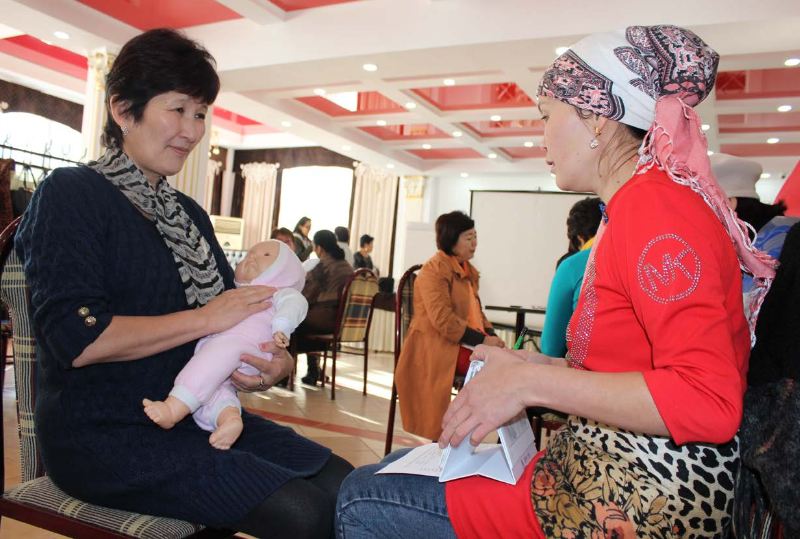
"Strengthening the ability of mentor-supervisors to provide ongoing mentoring can help health workers improve their counseling performance with patients and clients."
This is a training resource on providing mentoring (mentoring-supervision) to health workers (HWs) who conduct infant and young child feeding (IYCF) counselling in the Kyrgyz Republic. With its outline of a 3-day course, the guide provides facilitators with the technical knowledge and skills they need to foster an ongoing and collaborative effort to help the HW improve his/her performance and confidence. The guide's developer, the United States Agency for International Development (USAID)'s Strengthening Partnerships, Results, and Innovations in Nutrition Globally (SPRING), indicates that the mentoring skills included can also be applied to other counselling areas. Furthermore, mentoring is intended to be used flexibly and as needed: As HWs become more proficient in one area (e.g., IYCF counselling), the mentoring process may be used to address another task (e.g., counselling on women's nutrition).
SPRING explains that, in the mentoring process, the HW and mentor-supervisor together define objectives. The mentor-supervisor observes the HW's interactions with mothers/caregivers and provides constructive feedback. The mentor-supervisor and HW work together, discussing and problem-solving in order to identify areas of strength and address any areas of difficulty. The HW should feel motivated by the process and be encouraged to continue improving his/her skills, resulting in more skilled judgment and increased independence and self-confidence.
By the end of the training, participants are expected to be able to: (i) define mentoring (mentoring-supervision) and its components; (ii) suggest a model of mentoring appropriate for their setting; and (iii) describe how mentoring can contribute to monitoring and improved programmes, services, and worker performance. They should also be able to:
- Use mentoring skills to help a health worker improve his/her IYCF counselling performance;
- Provide effective feedback based on observation of IYCF counselling, including feedback on basic IYCF counselling skills: Listening and Learning, Building Confidence and Giving Support, and 3-Step (Assess, Analyze, Act) IYCF counselling;
- Use tools (job aids and tabulation forms) to facilitate mentoring;
- Identify individual worker weaknesses and shared group challenges, and determine a course of action to identify how to address the issues; and
- Develop action plans for needed actions (at national, oblast, or rayon levels) to implement mentoring within the existing supervision system.
English, Russian
96 (English); 115 (Russian)
SecureNutrition and SPRING website, both accessed on August 3 2017. Image credit: SPRING/Kyrgyz Republic
- Log in to post comments