










































Trading Rights
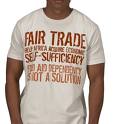
Trading Rights
What connections are there between the internet and gold prospecting? Of course, the obvious one is that most digital technology processes seem to emerge from Northern California and that was also the scene of the great 1849 Gold Rush. But the possible connection that I am thinking of is that, like gold prospectors, we can all spend so much time on the internet dredging through useless sludge before we find a little nugget!
Nuggets of knowledge are ones that really make you think - get the emotions and synapses firing just like the 49ers would have gotten excited by their findings. So when, accidentally (I was looking for something else), I discovered this data from 2004 related to the UK Commission for Africa, which had a very high profile at the time, as a non-economist I had this intense "what the heck" (or equivalent word) emotion.
“In the era of globalization, international trade has more than tripled. Yet Africa's share of global exports has declined from nearly 5 per cent in 1980 to under 2 per cent today.” Mr. K.Y. Amoako, Executive Secretary of the UN Economic Commission for Africa and a member of British PM Tony Blair's Commission for Africa (Financial Times, November 23, 2004)
This was followed by: Africa has 13 percent of the world's population, yet it commands only 1.6 percent of world trade and one percent of global investment.
As the CIDA report that summarised these comments highlighted: "Trade can be a powerful engine for growth and poverty reduction. It generates income, attracts foreign investment, creates jobs, and improves competitiveness."
No wonder so many of us on the people side of development, immersed in issues like media freedoms, HIV/AIDS, child rights, clean water, and the like feel like our swinging of picks at these big time concerns are hitting rock-hard ground with little sign of any gold anywhere. I feel this way and I do not live in Africa.
Local people in their communities work really hard to get a quality school, address gender violence, sell their products, find work, advance their culture. And for all of us it turns out that we are trying to focus on these issues whilst the economic element that is fundamental for progress across all of them just gets steadily worse.
Economic growth requires trade. And Africa now has significantly less trade as a percentage of global trade. And it seems to be getting worse (finding more recent data than that quoted above was difficult - please let me know if you have any).
It is very difficult to understand what can be done. The economically rich have their own economic crisis at present - though it diminishes in comparison with the crises facing people in the 50 economically poorer countries. Powerful local constituencies in many rich countries - think farmers in Nebraska, auto-workers in Ontario, rural village mayors in France, for example, will simply not allow substantive changes to the trade barriers, subsidies, and bail outs that are woven into their present economic fabric. The predominant western gaze is to its own backyard in the hopes of finding some more of their own gold.
Pretty depressing really.
Which again raises the issue of what can be done. How can media and communication processes play a role on this issue? On that theme some ideas soon... But they are pretty flimsy!
And I would love to hear your ideas. Related to this vitally important international development policy issue - what is the media and communication role?
Please submit all ideas below.

- Log in to post comments