










































Time to Act! - Toolkit for Practitioners: Gender-Transformative Programme Strategies for Addressing Child, Early and Forced Marriage and Unions in Asia-Pacific
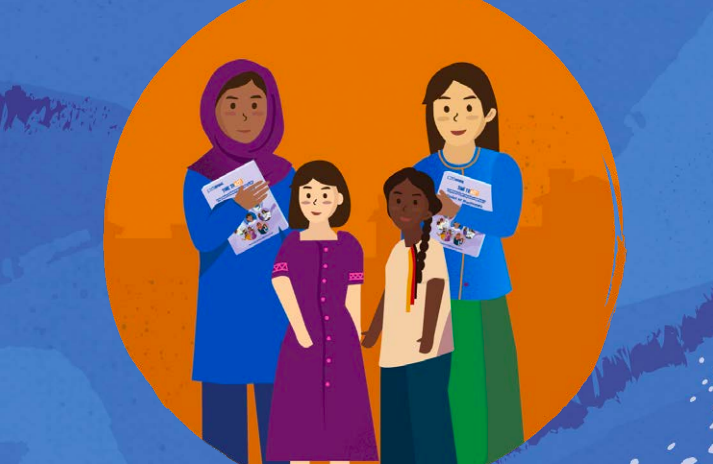
"Child, Early and Forced Marriage and Unions (CEFMU) is a harmful practice and global issue disproportionately affecting girls and reinforcing gender inequality, while also undermining a child's right to education, health, participation and life opportunities."
This toolkit, developed by Plan International Asia-Pacific Regional Hub, is designed to serve as a practical compendium of programming guidance for practitioners and to contribute to accelerating efforts to end CEFMU by 2030 in line with the Sustainable Development Goals (SDGs). It seeks to offer practical guidance on effective and impactful CEFMU programming and practices for Plan International and other civil society practitioners and actors in the region and beyond. The guidance and ideas presented in the toolkit have been developed based on good practices, lessons learned, and programme evidence from the Asia-Pacific region and promote a gender-transformative, multi-sectoral. and multi-stakeholder approach to CEFMU programming.
As explained in the toolkit, "a gender-transformative approach aims to promote gender equality. This approach tackles the root causes of gender inequality and aims to reshape unequal gender and power relations to achieve the full realisation of girls' rights and equality between all children, young people and adults regardless of their gender. When designing a project to address CEFMU, a gender-transformative programming and influencing approach requires you to improve the condition of girls and women while advancing their position and value in society, and support girls and women to be able to make informed choices and decisions and to act upon these free from fear or threat of punishment. Our approach encourages critical reflection, questioning and challenging of gender norms. It also challenges the distribution of resources and roles based on a person's gender. It fosters an enabling policy, budgetary and institutional framework for gender equality, that adequately protects girls' and women's rights, tackles the barriers they face and meets their particular needs. It requires working at all levels (as individuals, and within, families, relationships, communities, institutions and societies) and across a person's life course. It involves active listening and continuous engagement with power holders, with girls, boys, women, and men, and people of other gender identities."
The toolkit is divided into three sections:
Section 1: Unpacking Child, Early and Forced Marriage and Union in Asia Pacific - This section provides an overview of CEFMU in the Asia Pacific region, outlining prevalence, main drivers and root causes, and key harmful effects and consequences.
Section 2: Key principles and concepts - This section outlines key principles and concepts for a gender-transformative approach. When designing and implementing a CEFMU programmatic intervention, Plan International's gender-transformative programming and influencing approach help ensure that the interventions go beyond addressing the symptoms and explicitly tackle the root causes and drivers of the harmful practice.
Section 3: Taking action to address CEFMU - This core part of the toolkit focuses on the practical aspects of CEFMU programme design and implementation. Around programme design, it offers guidance on carrying out a needs assessment, developing indicators, conducting a baseline study, tailoring an intervention, analysing risks and assumptions, and finalising programme design. Related to implementation, it offers a wide range of possible interventions to address CEFMU using a holistic, multi-sectoral, and multi-dimensional approach, organised under seven key thematic intervention clusters, in line with Plan International's 18+ Theory of Change (a programme to end child marriage in Eastern and Southern Africa) and the Asia-Pacific Strategic Framework. For each intervention, the toolkit provides a synthesis, as well as key considerations and helpful tips. The seven cluster interventions are:
- Influencing policy, legal, and accountability frameworks
- Awareness raising and transforming negative behaviours and social and gender norms, as well as harmful traditional beliefs and religious misconceptions
- Education
- Economic empowerment
- Girls' empowerment, leadership, and activism
- Protection from violence
- Accessible and quality gender-responsive services
The following short thematic briefs have also been published together with the toolkit:
Publishers
Plan International website on July 18 2024. Image credit: Plan International
- Log in to post comments