










































Strengthening CORE Group Polio Project Impact: Community-Based Surveillance Activities in South Sudan - 2017 Annual Report, The Bill and Melinda Gates Foundation
This is an annual report on the work of the CORE Group Polio Project (CGPP) in South Sudan. CGPP is a multi-country, multi-partner initiative providing support to strengthen host country efforts to eradicate polio. The Secretariat team facilitates communication, coordination, and transparent decision-making among all CGPP partners - unifying the community-level expertise of international non-governmental organisations (iNGOs) and local NGOs with the international knowledge and strategies of the Global Polio Eradication Initiative (GPEI) partners.
Based in Juba, the four-member CGPP Secretariat works closely with the Ministry of Health (MOH), the World Health Organization (WHO), the United Nations Children's Fund (UNICEF), and the Centers for Disease Control and Prevention (CDC) on the Expanded Programme on Immunization (EPI) Technical Working Group. The Secretariat directs the work of three national organisations: BioAid, Support for Peace and Education Development Program (SPEDP), and Universal Network for Knowledge and Empowerment Agency (UNKEA). Two Gates Foundation consultants collaborate with South Sudan-CGPP and regularly attend monthly meetings held with all project partners to review field implementation, discuss improvements to project implementation, document challenges, and share information on best practices. "The 2017 minutes of the meetings were structured with clear resolutions; this detailed documentation allowed for improved accountability and timely response to critical issues." Other types of CGPP-led meetings, designed to foster collaboration and cooperation in South Sudan, are described in the report.
Three cases of circulating vaccine-derived polio virus (cVDPV2) in 2014 and 2015 exposed South Sudan's high vulnerability to another polio outbreak. Per the MOH, approximately 400,000 children under 5 as of July 2015 were unvaccinated or under-vaccinated in the three conflict states of Jonglei, Upper Nile, and Unity, where the CGPP works. (CGPP also works in one county in Eastern Equatoria state.) The destruction of health facilities, including the cold chain, and the near absence of health care staff add to the country's public health crises.
As part of the effort to address these issues, the CGPP's community-based surveillance (CBS) system detects and reports suspected polio cases in South Sudan. Through the efforts of a network of 2,366 men and 991 women community volunteers, this approach has pushed past growing insecurity and lack of access to reach children in the unstable areas of the country; 90% of the suspected acute flaccid paralysis (AFP) cases detected in the reporting period were found by CGPP volunteers. In fact, since 2014, there has been a steady increase in the proportion of AFP cases reported by CBS versus those reported through facility-based surveillance.
The report explains how the CBS system works. It was designed with a heavy supervision component, which is detailed here. The project deployed 34 county supervisors to each county and 230 payam assistants to each of the project's payams. The latter conduct social mapping and ensure timely reporting of cases; each also supervises 10-20 community volunteers, or key informants, on a daily basis. CGPP recruited 3,129 key informants who are well respected in the community, such as traditional chiefs, healers, birth attendants, clinic owners, teachers, church or Muslim leaders, and headmen. Caretakers consult with one these community members in case a child is suffering from AFP symptoms.
The project did not reach the 90% threshold (95% after July 2017) for supervision in any of the supervision indicators - county supervisors, payam assistants, or community informants. Numerous factors contribute to missing the target: insecurity, violence, and logisitical challenges. However, upward trends in supervision were seen throughout the project period. During quarter four, 83% of county supervisors, 86% of payam assistants, and 72% of key informants received supervisory visits. During the remainder of the project period, CGPP will strive to improve the sensitivity and detection of AFP cases through further training and greater levels of supervision.
One of the key elements of the CGPP approach in South Sudan is cross-border collaboration and coordination. The conflict has resulted in the internal displacement of 1.8 million people and the exodus of more than 2 million people to the neighbouring asylum countries of Uganda, Ethiopia, Sudan, Kenya, the Democratic Republic of Congo (DR Congo), and Central African Republic. The South Sudan Secretariat in collaboration with WHO, UNICEF, and the Ministry of Health leads the national cross-border collaboration with Uganda, Kenya, Ethiopia, and DR Congo. CGPP South Sudan plans, organises, and implements meetings with neighbouring countries to work towards establishing Special Vaccination Posts (SVPs) at heavily travelled cross-border sites. During the reporting year, 39,770 children under 15 years old were vaccinated with one dose of oral polio vaccine (OPV) at 11 SVPs.
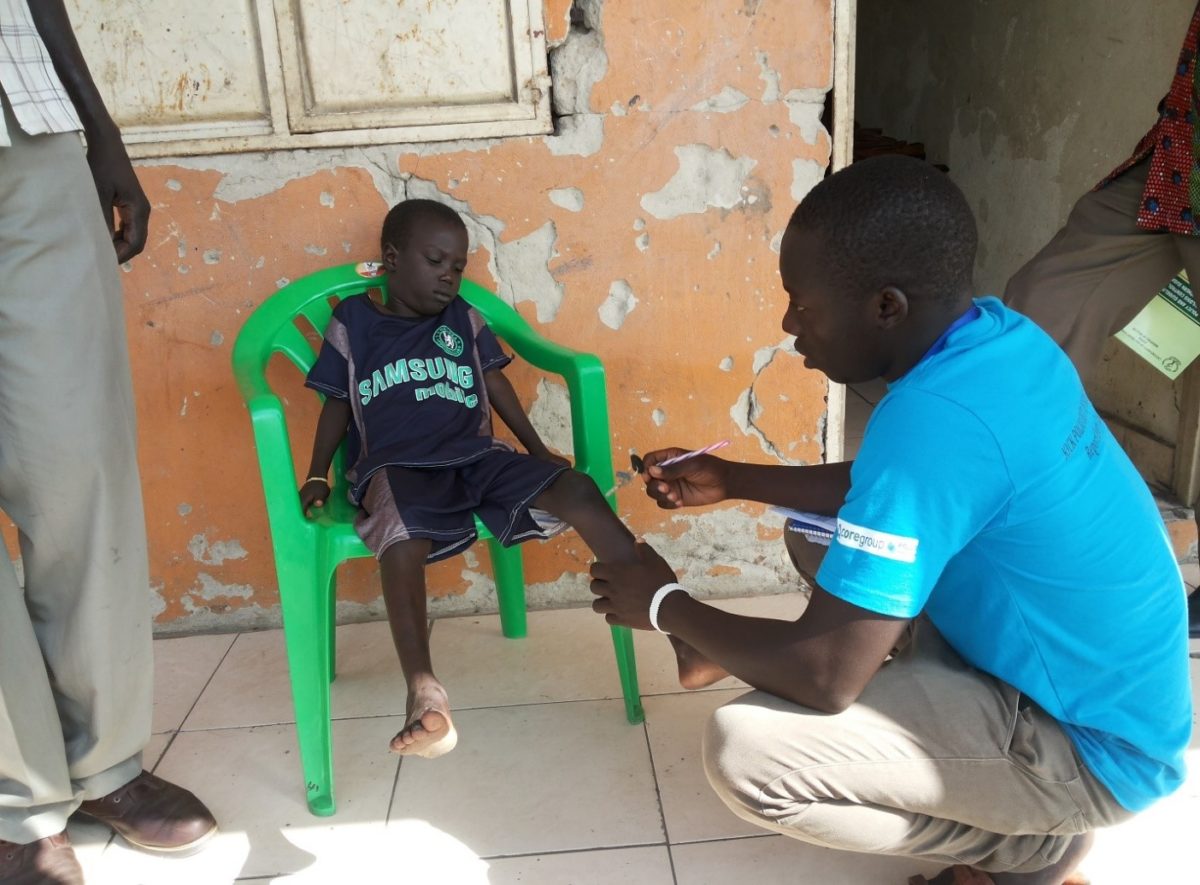
CGPP website, February 23 2018. Image caption/credit: "Koma Samuel, from local NGO BioAid, investigates a case of Acute Flaccid Paralysis (AFP), a symptom associated with the onset of polio, in a young boy in the village of Moloktoch. Moloktoch is located in hard-to-reach and conflict-affected Pibor County, South Sudan. Through CORE Group's Polio Project in the country, Koma Samuel is supporting community-based surveillance for AFP." CORE Group/B. Abjuda
- Log in to post comments