










































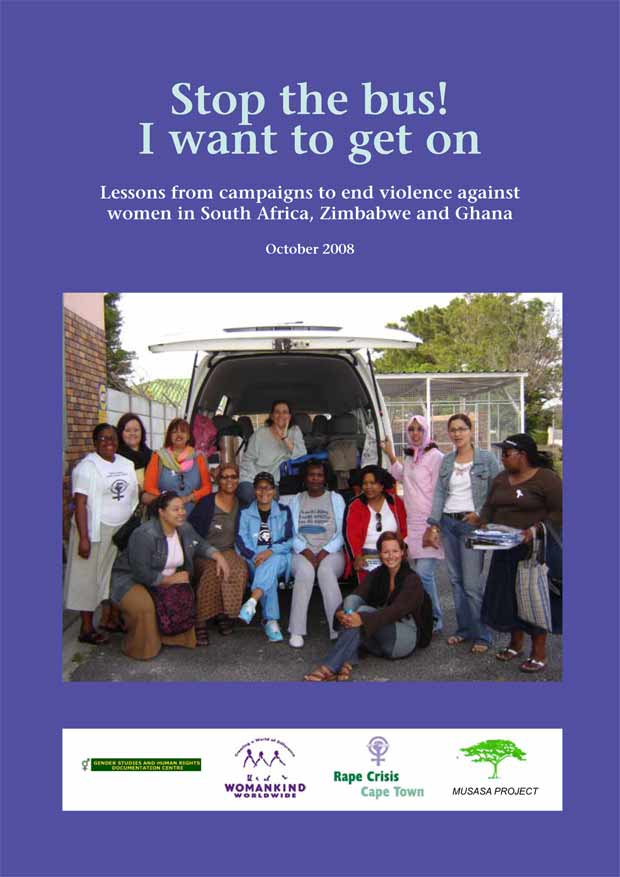
Stop the Bus! I Want to Get On: Lessons from Campaigns to End Violence Against Women in South Africa, Zimbabwe, and Ghana

This 37-page report offers lessons learned from the "Stop the Bus" campaigns which were run in South Africa, Zimbabwe, and Ghana to raise awareness about and contribute to a reduction in violence against women. The report includes lessons and guidelines for non-governmental organisations (NGOs) and community-based organisations (CBOs) to encourage community awareness and understanding of gender-based violence, as well as to help those organisations build campaign strategies and monitor their impact effectively. The report highlights the fact that community involvement and ownership of the campaign initiatives is essential to their long-term success.
According to the report, while each campaign is unique, certain common factors in planning and managing a campaign emerge. For example, the campaign should be passionate and be designed to achieve change at several levels within the field of gender violence: at the individual, family, and community levels, as well as in the policies and laws that govern societies. In addition, although campaigns can be multifaceted, involving different communication approaches, the campaign should stick to three or four key messages that should be included and promoted in all campaign materials, media interviews, and advocacy work. The four points should follow on from one another and make sense as a whole.
The report provides case studies from three WOMANKIND partners: the Rape Crisis Cape Town Trust in South Africa, the Gender and Human Rights Documentation Centre in Ghana, and the Musasa Project in Zimbabwe. All three organisations ran campaigns during the 16 Days of Activism to End Gender Based Violence in 2006 and 2007.
The Rape Crisis Cape Town Trust, in collaboration with WOMANKIND Worldwide, the Western Cape Network on Violence Against Women, the Gender Advocacy Project, and Women on Farms, conducted a campaign, beginning in 2006, with the aim of establishing and maintaining stronger relationships with rural communities in the Western Cape. The concept for the campaign was to take a busload of volunteer trainers, community activists, and counsellors on a tour of the rural areas of the Western Cape offering workshops, networking meetings, training, and counselling on issues relating to violence against women.
Some of the lessons identified were:
- It is difficult to plan from a distance for a community you know nothing about and where you have no existing networks;
- During the planning phase, include volunteers right from the beginning;
- Clarify roles and responsibilities way ahead of the start of the campaign;
- Every person involved in the campaign is a monitoring "tool"; and
- When dealing with provincial government stakeholders, ask provincial counterparts to tell their local district offices to participate in the campaign.
According to the report, over the last 10 years, activism working towards the elimination of violence against women (VAW) has increased significantly in Ghana. The Gender Studies and Human Rights Documentation Centre (Gender Centre) decided to implement the 2007 "16 Days of Activism" campaign in rural communities. The report states that the women of the communities appreciated the Gender Centre's intervention to educate them about their rights and committed themselves to fight violence in their communities. While the men were receptive and actively participated in the discussion, some expressed fear that the outside intervention would give too much power to women. The chiefs, opinion leaders, and the state agencies all welcomed the intervention. By collaborating with the media, the Gender Centre spread the issue nationwide, reinforcing public discussion on VAW and around Ghana's Domestic Violence Act. The campaign's logo featured a Ghana police officer with his hand stretched out signalling for VAW to stop. The police officer was used as a symbol for the law. Under the logo the campaign slogan – "Stop Violence Against Women, Break the Silence" – was printed on campaign t-shirts and banners.
Some of the lessons identified were:
- Role play is a highly effective tool for monitoring impact: It is entertaining, helps members feel involved, stimulates interest and - most importantly - allows women to talk about violence without having to recount personal experiences.
- Using resource persons with significant experience in community work may be more successful than using those who understand the local language. Such individuals will know best how to communicate sensitive issues like VAW and will help make events interesting.
- Handing out leaflets will be more successful and interesting if teams are able to take the time to talk to people as they distribute the leaflets: This creates interest in the issue and motivates people to actually read the leaflet.
- Understanding the beneficiaries of the campaign is important to identify appropriate campaign strategies.
- The media play an important role in spreading information and shaping attitudes.
The Musasa Project's 2007 campaign theme for the 16 days of Activism Against Gender Violence was: Demanding Implementation, Challenging Obstacles: End violence against women. It was designed to help dismantle and overcome challenges posed by social attitudes and policies that continue to condone and perpetuate gender-based violence. According to the report, positive outcomes of the project campaign included:
- communities demanding that the police should be more gender sensitive when dealing with reported cases of GBV;
- an increase in reported cases of GBV, especially domestic violence, to the police and to the Musasa Project both during and after the campaign;
- reduced incidences of sexual abuse in the Budiriro community compared to the previous months of August and September 2007; and
- an increase in requests from communities for training and awareness-raising activities, especially for working men - identified as a group that was not around when the campaign was taking place.
WOMANKIND hopes that the experiences and recommendations of Rape Crisis Cape Town Trust, the Gender Centre, and the Musasa Project provide insights for any organisation wishing to carry out campaigns against gender-based violence.
WOMANKIND Worldwide website on October 20 2009 and June 1 2010.
- Log in to post comments