










































Standardising Humanitarian Data for a Better Response: The Humanitarian EXchange Language
Active Learning Network for Accountability and Performance in Humanitarian Action (ALNAP)
"Standardisation efforts are challenging in the humanitarian sector, as defining a common vocabulary can easily become very political. Issues can arise at all levels, on everything from country names to how to refer to the affected population."
This case study explores how the United Nations Office for the Coordination of Humanitarian Affairs (UNOCHA) led the innovation process in developing and testing Humanitarian eXchange Language (HXL), a data standard which aims to facilitate the exchange and merging of data across agencies to create a more complete and accurate operational picture of a crisis. HXL has gone through a number of technical iterations. With the first idea, Linked Open Data, the HXL team attempted to move the humanitarian community past its reliance on Excel spreadsheets. Linked Open Data is an extension of the worldwide web, whereby users are provided with a standardised way of expressing data so relationships between data points are clear. This allows computers to consistently report the meaning of hyperlinked data, which in turn facilitates cooperation. Challenges gaining wider uptake inspired the idea of Hashtags, which focus on creating commonality across spreadsheets without asking users to change their headers or titles or needing to agree on a common terminology. Information management officers (IMOs). IMOs simply add a row of hashtags, very similar to those used in social media, to their datasets. In this way, software could then be developed to address the next level of data-related problems (e.g., cleaning data, merging data, facilitating analysis of data).
To understand how this transpired, the research team conducted a review of project documents and 10 informants, including project partners and other stakeholders, over a period of 3 weeks in October and November 2015. The resulting case study uses a model based on 5 stages:
- Recognition of a specific problem, challenge, or opportunity to be seized - IMOs throughout the humanitarian sector had recognised the inability to quickly compile a common operational picture across several crises over a period of at least 5 years, including in responses in Haiti, Pakistan, the Philippines, and West Africa. Compiling a common operational picture is a problem that involves at least 3 types of actor: IMOs, individuals responsible for data entry and reporting, and members of senior leadership. In this case, problem recognition had occurred largely at an individual level. In 2011, after years working as an IMO in the field, CJ Hendrix moved to UNOCHA and provided the impetus for the Linked Open Data solution. As explained in detail in the case study, this initial solution stalled. As David Megginson, who was to become the person to lead the HXL standard, explained, a second round of problem recognition involved a more realistic, incremental approach to tackling the core problem of data compilation in a crisis.
- Invention of a creative solution or novel idea that addresses a problem or seizes an opportunity - In short, a Working Group was established in late January 2014. It focused on resolving smaller issues underlying the inability to carry out a timely compilation of data in a crisis so as to build up support step by step. Although personas, or ideal end-users, were not explicitly defined, all Working Group members had a thorough understanding of the problem, the humanitarian context, and the potential end-users. To start, the Working Group and Technical Team chose to focus on the lack of a shared language for data and identified Hashtags as a more user-friendly solution that would help address this. (See Table 2 on page 14: HXL Hashtag design considerations - e.g., every crisis and activity has different data requirements, so HXL offers a dictionary of hashtags that can be mixed and matched to suit particular reporting needs).
- Development of the innovation by creating practical, actionable plans and guidelines - The OCHA Data Team envisioned a stepped process, but overestimated what level of ambition was appropriate for each step. In a way, Linked Open Data was the ideal model and the end goal, and the Hashtag model was a first step in the right direction. The team said: "Unlike most data standards, HXL is cooperative rather than competitive. Competitive standard typically considers the way you currently work to be a problem, and starts with a set of demands....For HXL, we reversed the process and started by asking how you're working right now, then thought about how we can build a cooperative standard to enhance it." Table 3 on page 17 captures some of the key steps in the refinement of the Hashtag solution. The Working Group would brainstorm approaches and refinements on their calls, and the Technical Team would attempt to develop concrete samples of these (e.g., sample datasets or software), which would then be reviewed by the Working Group and discussed on their next call. The Working Group and Technical Team made the decision to narrow the focus of HXL to only 3W data (Who is doing What Where information sheets compiled by OCHA). This was a crucial decision, as these sheets are no longer political. To keep less technical members informed, monthly half-hour meetings were put in place, and the core Working Group discussed its work over more bilateral means (e.g., Skype, email). Notes from Working Group meetings were shared via a shared Google Drive account and email. This restructuring helped the group maintain momentum without it becoming exclusive. The Alpha version of HXL was launched in mid-2014.
- Implementation of the innovation to produce tangible examples of change, testing it to see how it compares with existing solutions - Members of the Working Group took on the Alpha version of the Hashtag solution and started to play with it, with some testing the hashtags against their own agency data and others testing them against open data. However, the boundaries between development and implementation began to blur when HXL was used during the Ebola response. The work in Guinea, and more broadly within the Ebola response, helped identify the need for an additional layer of granularity in the coding, which later became Attributes. Furthermore, this field test put into perspective some of the difficulties IMOs face. The HXL team has observed that individuals tasked with data entry and reporting may not understand its importance or, in some cases, why it is their responsibility, making establishing a habit difficult. Soon after, the Beta version of the Hashtag solution was launched via the HXL website and promoted through a handful of blog posts.
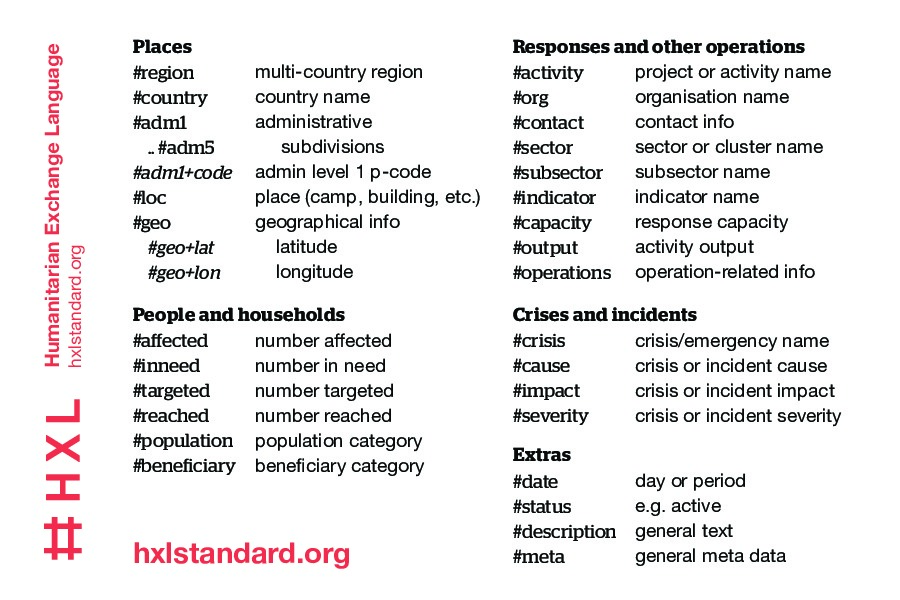
- Diffusion of successful innovations - At the time of writing, not all interviewees agreed if the diffusion phase had truly started. The Working Group and Programme Team openly communicated with potential end-users throughout the innovation process but placed greater importance on users with a higher technical competence. Beginning in January 2014, the wider community was engaged via a public forum and mailing list. The HXL website was used to very transparently share learning. The Working Group sees the HXL index cards (a small index card for information-management practitioners with the essential information needed to produce HXL-tagged data) as an effective communication tool with potential users. This approach of focusing on potential early adopters seemed appropriate as it helped foster HXL champions and matched the collaborative nature of the digital humanitarian community. The Working Group has transitioned to a Governance Group comprised of key potential users and early adopters of HXL. One of its principal tasks is to identify, define, prioritise, and help develop HXL-based tools. So far, this list still focuses on data-cleaning, mapping, and data visualisation tools. However, according to the lead, HXL could also be used to facilitate combined reporting.
The research team used evidence collected for this case study to assess the success of the HXL innovation process against 3 criteria. HXL was highly successful in terms of increased learning and evidence. Pilot participants expressed great confidence in the HXL Hashtag solution, and these tools are viewed as helping to make IMOs' work more efficient. However, as the implementation and diffusion phase started much later than expected, the innovation process can be rated only moderately successful as an improved solution at this time. As diffusion is in its earliest stages, it is still too early to confidently assess the criterion of adoption. "If incentives are not created for data entry specialists, any solution - no matter how good for other actors - could fail in the long run."
Next, the case study explores several factors generally held to be fundamental to successful innovation processes and the way in which each works in the context of HXL. In brief:
- Managing relationships and setting common objectives - "In the HXL innovation process, the common recognition mid-way through the process that the problem needed to be reassessed seemed to reaffirm the Working Group's and the Programme Team's common objective. This may have helped congeal support for the project within the Working Group. In technology-focused innovations at least, it does appear that having wider input at all stages of the innovation process is important to build support for the decisions made."
- Resourcing an innovation - "Funding played an important role in the HXL innovation. In a way, different grants have enabled the innovation to get over hurdles in the development, implementation and diffusion phase. Therefore, funding helps keep momentum. The relevance of 'momentum' to successful innovation, however, is much less clear."
- Flexibility of process - "Had the innovating team stayed fixed to its original plan, it is quite likely it would not have reassessed the core problem and adapted the solution. This flexibility was very important to the development of an improved solution and did lead to the generation of learning and evidence. Additionally, being able to say 'yes' to unexpected pilot activities, such as the Ebola response, and provide support to piloters, such as in the Nepal Earthquake response, seems to have been crucial in moving the Hashtag solution quickly and effectively to its Beta version and thus to developing an improved solution."
- Assessing and monitoring risk - "The Programme Team and Technical Team developed a risk matrix at the beginning of 2014. This was regularly reviewed and updated."
- Drawing on existing practice - "HXL drew significantly from existing practice, in particular from a strong understanding of past solutions and potential users."
Several emerging lessons are identified for best practice in innovation, such as: "Innovating teams are successful when they exhibit mutual respect amongst team members and a healthy level of trust or confidence. The practice of giving credit where it is due amongst an innovating team is useful for creating a positive environment that rewards contributions, which in turn supports the type of creative and proactive engagement that can support strong innovation processes."
This study is one in a series of 15 case studies, undertaken by Active Learning Network for Accountability and Performance in Humanitarian Action (ALNAP) in partnership with Enhancing Learning & Research for Humanitarian Assistance (ELRHA)'s Humanitarian Innovation Fund (HIF), exploring the dynamics of successful innovation processes in humanitarian action. They examine what good practice in humanitarian innovation looks like, what approaches and tools organisations have used to innovate in the humanitarian system, what the barriers to innovation are for individual organisations, and how they can be overcome.
- Log in to post comments