











































Systematic Approach to demand Generation for voluntary medical male circumcision services to achieve modification of social and cultural norms in traditionally circumcising and non-circumcising communities in Western Province of Zambia
Summary:
Male circumcision is highly cultural; therefore, one cannot engage in effective and sustainable demand generation minus engaging with the custodians of cultural practice, norms and beliefs. Through use of Social behavioral change communication (SBCC), it has become evident that it is possible to achieve cultural conversion. Therefore, SBCC is the future for sustainable demand generation strategies and innovation. At each step, internal factors (e.g., cognitive and emotional) as well as environmental ones (e.g., cultural factors or issues around service delivery) influence the individual's immediate needs and wants, which, in turn, govern subsequent actions. It is important that programs consider evidence about individual/personal, social cultural and structural barriers to VMMC to develop and refine their demand creation strategies. The involvement of key stakeholders at various levels was therefore, key to success achieved. The uptake of VMMC in 2018 increased considerably as a result of the robust demand generation innovations employed by CIDRZ to bring about awareness and adoption of new cultural practice compared to 2017 respectively. The strategies were mindful of the cultural significance of the Mukanda (traditional circumcision) to the community and other factors at play.
Background/Objectives:
CIDRZ is helping build capacity to provide comprehensive and sustainable HIV prevention to MOH in Western Province, among them VMMC. The prevalence of HIV among adults 15-59 years in Zambia is 12.0%. Prevalence in Western Province stands at 15.9%, (ZAMPHIA, 2016). Western Province is dominated by non-circumcising tribes. However, there are of circumcising tribes who traditionally circumcise boys at a rite of passage ceremony called Mukanda. The ZDHS of 2013/14 determined male circumcision rate for Western Province at 47.9% with the dominant tribes at 23.3%. The objective, therefore, was to create awareness and achieve cultural transformation around VMMC.
Description of Intervention and/or Methods/Design:
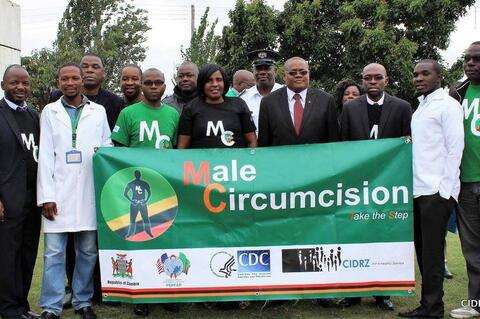
In 2017, CIDRZ embarked on a series of aggressive VMMC demand creation interventions to mitigate devastating effects of HIV infections. This included advocacy with key community leaders (traditional, political and religious). 13 traditional leaders from both circumcising and non-circumcising tribes and 6 district commissioners were met. The focus was messages on benefits of VMMC and addressed fears of cultural erosion through adoption of new practice. This was a two-way engagement to understand social-cultural behaviour and practice and deal with barriers and facilitators to VMMC uptake. Use of IPC provided an in-depth conversation for more understanding. Emphasis was that nobody should be deprived an opportunity of 60% HIV protection because of cultural identity and practice. HIV cuts across tribe and culture as evidence showed the province's HIV prevalence was second highest in Zambia. The circumcising tribes were encouraged to bring their boys for safer circumcision at health facilities near their homes.
Results/Lessons Learned:
The VMMC target in 2017 was 23,811 while for 2018, it was 21,705 according to Zambia VMMC Operational Plan 2016 :2020. Resulting from the strategies employed by CIDRZ, 23,904 males were circumcised in 2018 compared to 11,383 in 2017 giving a 110% increase. (Zambia Health Management Information System, 2019). This has helped lead to the development of the VMMC National SBCC strategy which was launched in 29th September 2019 Lessons learnt to help in the behavioural change process included tailoring messages carefully to the client's specific needs, target custodians of customs and cultural belief systems to help change existing norm, give reassurance, and lend authority to a program. Further, using mobilizers for Interpersonal communication to get a sense of client's individual concerns and targeting women as an audience for messaging and using them as change agents.
Discussion/Implications for the Field:
The effective engagement and active participation of traditional leaders and other key community stakeholders in behavioural change communication for VMMC at planning and implementation stages contributed significantly to addressing barriers and motivators hence, leading to increased uptake. Clearly, SBCC using the human centred design approaches are the future for sustainable demand creation.
Abstract submitted by:
Bright Jere - CIDRZ
Lane-Lee Lyabola - CIDRZ
Male circumcision is highly cultural; therefore, one cannot engage in effective and sustainable demand generation minus engaging with the custodians of cultural practice, norms and beliefs. Through use of Social behavioral change communication (SBCC), it has become evident that it is possible to achieve cultural conversion. Therefore, SBCC is the future for sustainable demand generation strategies and innovation. At each step, internal factors (e.g., cognitive and emotional) as well as environmental ones (e.g., cultural factors or issues around service delivery) influence the individual's immediate needs and wants, which, in turn, govern subsequent actions. It is important that programs consider evidence about individual/personal, social cultural and structural barriers to VMMC to develop and refine their demand creation strategies. The involvement of key stakeholders at various levels was therefore, key to success achieved. The uptake of VMMC in 2018 increased considerably as a result of the robust demand generation innovations employed by CIDRZ to bring about awareness and adoption of new cultural practice compared to 2017 respectively. The strategies were mindful of the cultural significance of the Mukanda (traditional circumcision) to the community and other factors at play.
Background/Objectives:
CIDRZ is helping build capacity to provide comprehensive and sustainable HIV prevention to MOH in Western Province, among them VMMC. The prevalence of HIV among adults 15-59 years in Zambia is 12.0%. Prevalence in Western Province stands at 15.9%, (ZAMPHIA, 2016). Western Province is dominated by non-circumcising tribes. However, there are of circumcising tribes who traditionally circumcise boys at a rite of passage ceremony called Mukanda. The ZDHS of 2013/14 determined male circumcision rate for Western Province at 47.9% with the dominant tribes at 23.3%. The objective, therefore, was to create awareness and achieve cultural transformation around VMMC.
Description of Intervention and/or Methods/Design:
In 2017, CIDRZ embarked on a series of aggressive VMMC demand creation interventions to mitigate devastating effects of HIV infections. This included advocacy with key community leaders (traditional, political and religious). 13 traditional leaders from both circumcising and non-circumcising tribes and 6 district commissioners were met. The focus was messages on benefits of VMMC and addressed fears of cultural erosion through adoption of new practice. This was a two-way engagement to understand social-cultural behaviour and practice and deal with barriers and facilitators to VMMC uptake. Use of IPC provided an in-depth conversation for more understanding. Emphasis was that nobody should be deprived an opportunity of 60% HIV protection because of cultural identity and practice. HIV cuts across tribe and culture as evidence showed the province's HIV prevalence was second highest in Zambia. The circumcising tribes were encouraged to bring their boys for safer circumcision at health facilities near their homes.
Results/Lessons Learned:
The VMMC target in 2017 was 23,811 while for 2018, it was 21,705 according to Zambia VMMC Operational Plan 2016 :2020. Resulting from the strategies employed by CIDRZ, 23,904 males were circumcised in 2018 compared to 11,383 in 2017 giving a 110% increase. (Zambia Health Management Information System, 2019). This has helped lead to the development of the VMMC National SBCC strategy which was launched in 29th September 2019 Lessons learnt to help in the behavioural change process included tailoring messages carefully to the client's specific needs, target custodians of customs and cultural belief systems to help change existing norm, give reassurance, and lend authority to a program. Further, using mobilizers for Interpersonal communication to get a sense of client's individual concerns and targeting women as an audience for messaging and using them as change agents.
Discussion/Implications for the Field:
The effective engagement and active participation of traditional leaders and other key community stakeholders in behavioural change communication for VMMC at planning and implementation stages contributed significantly to addressing barriers and motivators hence, leading to increased uptake. Clearly, SBCC using the human centred design approaches are the future for sustainable demand creation.
Abstract submitted by:
Bright Jere - CIDRZ
Lane-Lee Lyabola - CIDRZ
Source
Approved abstract for the postponed 2020 SBCC Summit in Marrakech, Morocco. Provided by the International Steering Committee for the Summit. Image credit: CIDRZ via Facebook