










































Social Media, Social Life: How Teens View Their Digital Lives
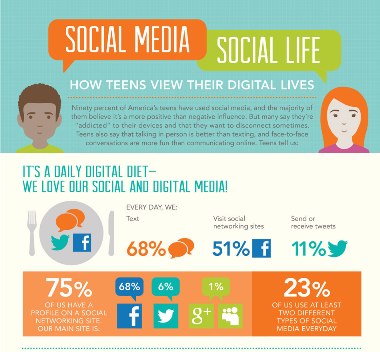
This study describes the role of social media in the social and emotional lives of United States (US) teenagers. Using survey data of US 13- to 17-year-olds, the study addresses these questions:
- "How often are teens texting and using Facebook and Twitter?
- What are teenagers’ favorite ways to communicate with their friends and family?
- How do teens think these new communications tools are affecting their friendships and family relations, if at all?
- How does social networking make most teens feel about themselves and their relationships with their peers? Does it make them feel more connected or more isolated? Better about themselves, or more depressed and lonely?
- How do the heaviest social media users compare to other teens in terms of their social and emotional well-being?"
Results include the following on frequency of social media use:
- Daily texting: 68%
- Daily social network site use: 51%
- Daily tweeting: 11%
- 75% have a social network site profile
The study found that teens feel that social networking helps their relationships (52%) versus hurts relationships (4%); they increase confidence (29%). Although 5% feel more depressed by using social networking, 10% feel less depressed. Most teens still prefer face-to-face communication and are frustrated when face-to-face communication is interrupted by use of electronic networking.
More than a third of teens sometimes wish to go back to a time before social networking offered its possibilities; 41% feel addicted to a mobile phone and 20% to social sites; 43% wish to "unplug" sometimes. In its gender findings, the study found higher usage among teen girls of texting, tweeting, and photo posting. Stressful feelings around photo posts include feeling left out of photos, worrying about ugly photos, and feeling the need to edit photos.
The study concludes that there are real concerns are about privacy, bullying, hate speech, body image, and over-sharing, but percentages of negatively affected teens in the study are not high. From the study: "And we won’t know for a long time how the immediacy of digital communication may be shaping interpersonal relationships and social skills. But the results of this survey do help put the challenges and pitfalls of social media into a broader perspective and offer reassurance that, for the most part, the kids are all right."
Click here for an infographic (poster-style information) of the results.
Email from Seeta Pai to The Communication Initiative on June 26 2012.
- Log in to post comments