










































Small Islands, Big Impact [Video]
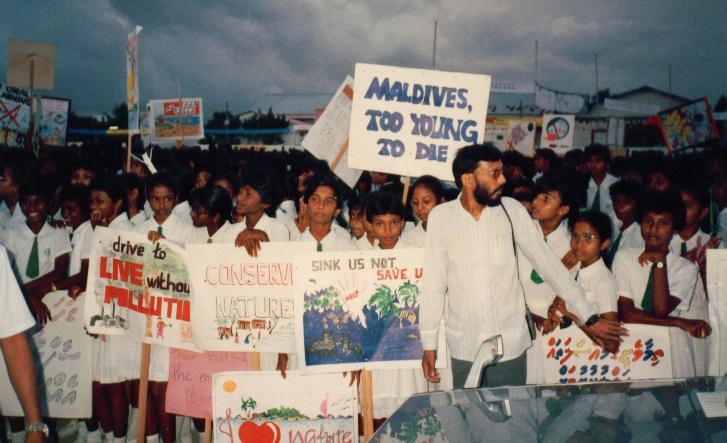
Small Islands, Big Impact, a film produced on an editorially independent basis by Television for Education Asia Pacific (TVEAP) in collaboration with COM+ Alliance of Communicators for Sustainable Development, is about the effect of climate change on the Indian Ocean island nation, Maldives. It uses excerpts from an exclusive interview with then-President Mohamed Nasheed of the Maldives. The full text of the interview with Nalaka Gunawardene is published on the TVEAP website.
President Nasheed [who resigned on February 7 2012] explains the peril of rising sea levels resulting from climate change and the effects on the 200 islands of the Maldives, on which the highest geographic point is 1.5 metres (5 feet) above sea level. He points to lower fish catches resulting from warmer oceans and lower rates of tourism due to effects on the coral reefs. His response to the conditions, which appear to be the effect of behaviours of other nations, not his own, is not to point fingers, but to name a number of international strategy and policy changes.
President Nasheed frames the issue as a fundamental right for life and points out that the deteriorating conditions are a security threat. "We are one of the frontline states of a security threat, and we feel that countries should be defending frontline states." He describes physical adaptation efforts - embankments, breakwaters, etc. - but emphasises that "the most important adaptation issue is good governance and, therefore, consolidating democracy is very important for adaptation. When climate changes, and when you start feeling the actual impacts of it, you will be wasting all the resources without a proper governance system."
Examples the President gives of a lack of good governance are the "60 - 70 per cent of the projects [that] are not moving, simply because of governance issues. Either you gave the contract to the wrong person, or you started doing a whole variety of works without proper consultations with the people, and then we're finding difficulties...If you are to make good use of the resources you have, you have to be able to have a proper governance system."
Following discussion of the Maldives’ relocation fund and efforts to become carbon neutral, the President is asked for a key message to the Copenhagen Climate Summit. His message includes the following: 'Don't be stupid!'. Going on and on about who did it is not going to save us. This is the time to realise that the deed is done. So let's see how we may be able to proceed from here. If you have some money, please give it to someone who doesn't have. If you have technology, please give it to someone who doesn't have that technology. There is no point pointing fingers."
Press release from TVEAP on October 25 2009; and email from Nalaka Gunawardene to The Communication Initiative on April 12 2013. Image courtesy of TVEAP.

- Log in to post comments