










































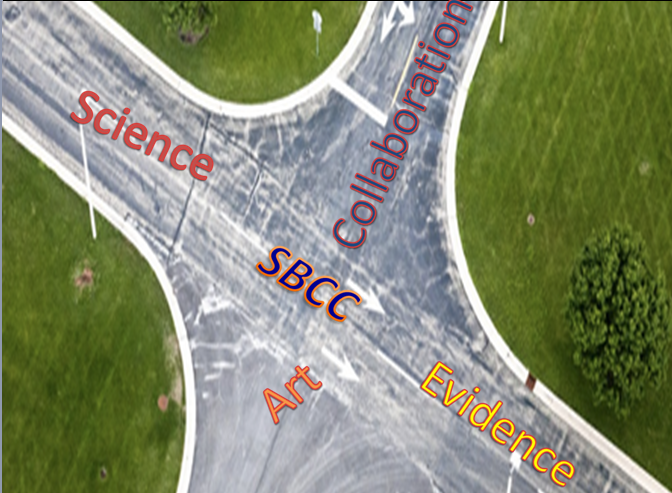
SBCC at the Crossroads (and Crosshairs): Where Next?
Milken Institute School of Public Health at George Washington University
Dr. Rajiv N. Rimal opens by suggesting that we in the social and behaviour change communication (SBCC) community have clipped our own wings by focusing too much on constraints and barriers in our work, at the expense of taking advantage of tremendous gains the community has made in so many domains. Some examples of constraints that seem to stymie many health communication professionals are that many buy into the idea that randomised controlled trials constitute the only acceptable standard for sound evaluation, that donors do not understand that behaviour change is hard, that the communication environment is always shifting, etc.
In response, Dr. Rimal offers a "working draft" of what he calls "The Addis Declaration". It consists of the following propositions:
- SBCC is a process. It is not messaging or "communications"; it is communication, dialogue, and deliberation. It is a reciprocal process, evolving continuously in the interaction.
- Let's change our assumptions. "Our clients do not just want to live without diseases; they want to lead happy and productive lives to better themselves, their children, their communities, their countries, and the world we all inhabit. We want to design and implement programs with them, not for them or to them."
- How we live our lives. "We (in this room) are also inhabitants of the world in which our clients live; it is incumbent upon us to model our lives in the way we would have our clients live theirs."
- Our approach has to be multidisciplinary. The "[p]roblems we tackle are complex, requiring multiple methods, perspectives, and solutions. No one discipline - not even SBCC – can do it alone. We need to include other disciplines in our work & also infiltrate other disciplines. We need to train SBCC professionals to speak the language of other professions."
- We have professional obligations to: (i) disseminate our findings, not only to the funder, but also to the larger SBCC community and to the community that provided the data, (ii) train future SBCC professionals by networking, mentoring, promoting their education, and role modeling.
- We must relentlessly pursue rigorous evaluations. This means starting from programmes with known effectiveness and contributing to that evidence base so others can do the same.
- We need to build in cost effectiveness analyses in our programmes, and cost benefit analyses when we can. We need to ask: What is the unit outcome per dollar spent? What are the savings in dollars because of the programme?
- Adopt a behavioural attribute approach. This involves recognising that not all behaviours are created equal. Behaviours can be aligned according to different attributes, some of which are: anonymity concerns; whether the behaviour is performed privately or in public; one-shot behaviour or long-term; addictive or done with full volition; stigmatising or pride-inducing; costly, cheap, or free; and of high cultural significance or not. The approach/theory/programme will depend on the attributes that define the behaviour.
- Let's recognise that the action is in the interaction. There are structural factors (e.g., clinics, insurance, transportation, policy, housing, poverty) and individual- and community-level factors (e.g., knowledge, attitudes, skills, efficacy, motivations, community resiliency, social ties, organisations) - these can be in tension. It is necessary to ask conditional questions - not: "Is mHealth better than radio?", for example, but: "Is mHealth better than radio in urban rather than in rural settings?". Instead of asking: "Do attitudes and social norms matter?", we should ask: "Does a person holding favorable attitudes toward the behavior react differently to a strong social norm as compared to a weak social norm?"
- We communicators need to communicate more clearly. Using acronyms excessively, for instance, makes ourselves inaccessible to others.
- Let's pay special attention to unintended effects. We should ask questions like: Does exposure to anti-drug messages increase curiosity about drugs among some youth? Does the implementation of more bike paths increase cycling...but also increase fatalities? Does a heightened focus on one disease bring extra funds through policy change...but also take funds away from other causes?
- Let's have fun doing our work!
SBCC Summit website, March 2 2016; and email from Rajiv N. Rimal to The Communication Initiative on March 3 2016.
- Log in to post comments