










































Satellite Education: Providing Quality Education under Extreme Conditions

This information and communication technology (ICT) for development (ICT4D) initiative uses digital television to ensure that students living in conflict-ridden areas can continue to enjoy their right to a high-quality education.
Building upon the research of the Jasper Project from Vanderbilt University in the United States, Sat-Ed focused on delivering content that would not replace teachers, but instead would enhance their effectiveness by delivering short video clips highlighting visually what a teacher is trying to impart. (The Jasper Project proved that students who are taught by educators in conjunction with video enhancements learned more quickly, retained that knowledge, and felt better about the subject matter.) Content examples include clips of a frog being dissected for a biology class, a chemical reaction for a chemistry class, or news clips of events in history. It has also been used in language courses, with native speakers featured in the clips.
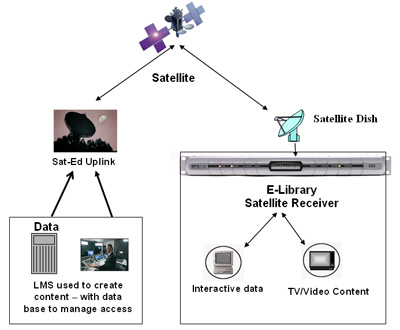
Through their partners, Sat-Ed was able to obtain content that they felt enhanced the educators' ability to teach while ensuring that it fit into the curriculum and was sensitive to the Islamic religion which is predominant in this area. Sat-Ed then began using a digital system to deliver the content. As the system is based upon IPTV (Internet Protocol Television) protocols, teachers with no computer or ICT experience can access the material using a common TV remote control and TV in the classrooms. (IPTV is a system where a digital television service is delivered using IP over a network infrastructure, that is, a broadband connection. That is, instead of being delivered through traditional broadcast and cable formats, IPTV content is received by the viewer through the technologies used for computer networks, all of which employ IP and related standards such as Simple Network Management Protocol, or SNMP). Specifically, content is delivered and updated using Sat-Ed's Head-End uplink in Bangkok. The Sat-Ed Digital Library is a proprietary satellite receiver, video on demand server, web cache, Digital Rights Manager, reference library, and bandwidth "multiplier". The digital library is able to play out different video streams to 8-12 separate classrooms at a time as well as manage 50 personal computers (PCs). Each digital library can be updated as often as necessary and old content can be removed and new content can be added. This is done remotely through the satellite.
In order to train the staff to use the digital libraries, Sat-Ed hosted a weekend session for the 9 schools and brainstormed with the headmasters and their staff on how to best use the technology for their needs. They were also trained on the use of and troubleshooting for the digital libraries. These digital libraries are built to military specifications to be rugged and durable and need little or no maintenance.
Education.
At the end of 6 months, a consortium of 3 Thai universities undertook a study to determine the effectiveness of the system and found that 7 of the 9 schools "were using it extensively and found it a great help and that the students showed dramatic improvement." One year into the project, the Thai government is in discussions to expand the project, and some of the schools have begun producing their own content to share with others. The project will expand to include more schools and a deeper penetration of existing classrooms.
The project area is the deep south of Thailand, where insurgents are fighting a guerrilla war against the government infrastructure. School buildings have been bombed and teachers have been targeted for assassination from drive-by motorcycle shootings. Using digital video discs (DVDs) or video compact discs (VCDs) is an obvious way to deliver the material. However, in the area where Sat-Ed is working, anyone on a motorcycle can be a target. Further, caching of content within the school by satellite is actually cheaper than making and delivering DVDs direct to schools. In addition, DVDs and VCD can be lost, damaged, or misplaced.
Sat-Ed Systems is a using their proprietary technology and teaming up with strategic partners to improve quality of life for people all over Asia and to bridge the digital divide through their "Room for Life" (digital library) concept. "Experience has taught us that simply supplying PC's to remote villages will never solve the problem. Lack of training in PC use, shoddy maintenance and unreliable power supply crashes most PCs in 2 months. There they sit unused....Villagers have stopped buying PCs as the[y] see them as a poor investment. With trained staff that problem can be solved for a village and bring back faith in the use of PCs..." To that end, Sat-Ed's Room for Life is staffed by trained personnel able to fix computers as well as use them as instructional tools, working to ensure that the Room for Life becomes the digital heart of the community.
Click here to view a video about the Sat-Ed system.
United Nations Educational, Scientific and Cultural Organization (UNESCO) Bangkok's News on ICT in Education, March 3 2009; Sat-Ed website; and email from John Hawker to The Communication Initiative on November 17 2009.


- Log in to post comments