

























Development action with informed and engaged societies

After nearly 28 years, The Communication Initiative (The CI) Global is entering a new chapter. 

Following a period of transition, the global website has been transferred to the University of the Witwatersrand (Wits) in South Africa, where it will be administered by the Social and Behaviour Change Communication Division. Wits' commitment to social change and justice makes it a trusted steward for The CI's legacy and future. 

On the transfer, co-founder Victoria Martin expressed her pleasure to see this work continue under Wits' leadership, knowing that co-founder Warren Feek (1953–2024) would have felt deep pride in The CI Global's Africa-led direction. 

As Wits, we honour the team and partners who sustained The CI for decades and look forward building from that strong base. This includes co-founders Warren Feek (1953-2024) and Victoria Martin as well as La Iniciativa de Comunicación (CILA), which continues independently at lainiciativadecomunicacion.com with links to The CI Global site. We are also eager to forge new partnerships and entertain new ideas as we consider how best to contribute to social and behaviour change in our rapidly evolving environment.

If you are joining the International Social and Behaviour Change Communication (SBCC) Summit in Panama, please join Wits and CILA on Monday, 22 June, to share your thoughts and suggestion for the relaunch of the Communication Initiative. We will be in Pacifica 5 from 12-1:25 for the Refuel, Reflect, and Renew Lunch Series: The Communication Initiative: celebrating a driving force for Communication for Social Change and the way forward. We will reflect on the legacy of Warren Feek and family in creating the Communication Initiative, consider the contributions of CI over the years and then turn our attention towards the future in this dynamic session. 

If you are unable to join us in Panama, we still want to hear from you. Please contribute your thoughts by following this link: https://redcap.link/CommunicationInitiative2026 or reaching out to ci_surveys@commint.com

You can also follow the QR Code:

 https://redcap.link/CommunicationInitiative2026

Time to read
1 minute
Read so far

Safe Journey Campaign
0 comments
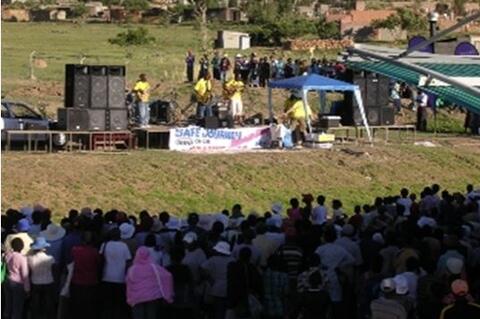
The Safe Journey Campaign was a music road show that aimed to raise HIV/AIDS awareness among SeSotho-speaking migrant populations in Lesotho and in Free State province in South Africa. Carried out from December 6-15 2005, the campaign also drew on peer education and radio production as strategies. Safe Journey was a collaboration between Integrated Regional Information Network (IRIN) Southern Africa and the International Organization for Migration (IOM) Regional Office in Pretoria, working in partnership with Population Services International (PSI) - Lesotho, Harmony Mines, and the Society for Family Health South Africa.
Communication Strategies

This project centred around a road show that was designed to be an entertaining way to raise awareness about HIV/AIDS in migrant communities, as well as to provide a forum for migrant workers to voice their issues. Specifically, the project organised concerts at nine different locations with the music of a Lesotho-based group called Bhudaza. The concerts featured three new songs developed for the event, which focused on HIV/AIDS in migrant communities. These songs were released on World AIDS Day (December 1) 2005.

During the concerts, peer educators moved among the audience distributing condoms and HIV/AIDS materials. In this way, PSI-Lesotho provided education and awareness through an approach described as “fun and interactive” during the music breaks.

Accompanying the road show was a team of radio journalists from Lesotho and South Africa who interviewed people from the community, local health workers, government officials, and others - to gather material for a series of radio programmes to be broadcast on air. Four journalists interviewed in SeSotho, and one interviewed in English. A pre-road show training and planning session with the journalists served as a forum for developing the ideas for the radio programmes based on the four stages of migration: source, transit, destination and return.

Development Issues

HIV/AIDS

Key Points

According to the organisers, the music road shows and radio programmes aimed to:

  • raise awareness among the general population and key stakeholders on the structural and environmental causes of HIV vulnerability among migrants and mobile populations
  • identify and educate groups of migrants and mobile populations on possible actions and behaviour change to reduce HIV vulnerability and enhance the quality of life for those infected and affected by HIV and AIDS
  • build capacity of the participating journalists and musicians on reporting and talking about HIV/AIDS issues.
Partners

IRIN Southern Africa, International Organization for Migration (IOM), PSI-Lesotho, Harmony Mines, Society for Family Health-South Africa.

Sources

E-mail from Daniel Walter to Soul Beat Africa on January 9 2006 and the Irin News website on January 12 2006.