










































Rural e-Governance in India: For Whom?

Association for Progressive Communications (APC)
"In India's rural e-governance initiative, 33% of local government seats are reserved for women. Rural village heads of Chhattisgarh State - one of India's poorest - can now participate in the public process and in theory remotely communicate the needs of their villages through the use of a low-cost computer that does not require computer literacy. But women are not taking the active roles that were expected."
This article explores the use of Association for Progressive Communications (APC)'s Gender Evaluation Methodology (GEM) to understand why winning an electoral seat in does not necessarily guarantee that your voice is heard within India's governance system if you are a woman.
As detailed here, in 1993, the Panchayati Raj (village self-government) system was introduced as a tool to improve rural communities. One of the key features was that 33% of elected seats were reserved for women, a quota that has also recently been increased to 50% in the state of Chhattisgarh, one of the economically poorest states in India, and where Dr. Anupama Saxena of Guru Ghasidas University conducted the study described here.
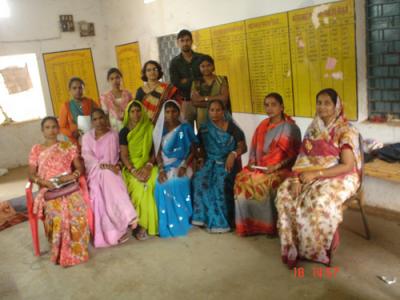
The Simputer, a low-cost, portable alternative to personal computers (PCs) that requires limited computer literacy, has been introduced to give a voice to the marginalised through their locally elected leaders. Dr. Saxena sought to understand the substantial differences between male Simputer use and female use. Whereas 1 in 3 males who were given a Simputer transferred information to and from it, less than 1 in 100 of women used it (0.7%) to transfer data. So, even with their presence in local governance officially guaranteed, women sarpanchas (democratically-elected village heads) have not been able to participate on an equal footing to men in rural governance. As reported here, using GEM helped uncover why.
GEM is a guide to integrating a gender analysis into evaluations of initiatives that use information and communication technologies (ICTs) for social change. Using this methodology, Dr. Saxena learned more about ingrained inequalities that hampered women's participation. For instance, reproductive and productive roles, lack of education and financial independence, and deeply rooted cultural and religious taboos make it difficult for women to be heard in traditionally male-dominated spaces like politics. "When we asked who the village sarpancha was, in most of the cases it was the name of the husband that was told to us and only after asking a second time and insisting on the actual name of sarpancha, the villagers informed about the women sarpancha."
Along these lines, only 1 in 10 women sarpanchas attended the Simputer training independently. The other 90% were accompanied by either a male relative or a sachiv (secretary of the village government). This is because, in rural India, women are not encouraged to travel alone and in public. The trainers were also male, and the women interviewed said they did not feel at ease approaching them with questions. This was not the case for male sarpanchas, because many men had already been exposed to new technologies such as mobile phones or computers. Men can also learn with fellow men through informal circles, whereas women do not have opportunities to discuss technology outside of the one-day training. In fact, 53% of female sarpanchas told Dr. Saxena that they had had problems with the training for a variety of reasons; for instance, given the low levels of English and Hindi literacy levels, many women simply did not understand the content and could not perform sarpancha tasks in these languages. Only 29% of the women sarpanchas have a working knowledge of English, as compared to 66% of the men. The working language of Simputers is Hindi; 83% of men were fluent in Hindi, compared to 70% of the women. Only a very small percentage of male sarpanchas is illiterate, whereas 1 in 10 female sarpanchas is illiterate.
Furthermore, the survey found that only 1 in 5 Simputers used by the sarpanchas interviewed were in working condition; this number dwindled to just over 1 in 10 for Simputers used by women representatives. Technical support was typically only available in Janpad Panchayata offices (head offices for the area) - often over 30 kilometres away from some of the villages. "The need to visit the Janpad Panchayat office could have provided the female sarpanchas with an opportunity to get out of their houses and villages and to feel a sense of power while meeting the concerned officers face to face in their offices," Dr. Saxena noted. "But most women explained to us that their male family members were in control of their official work and denied the women the little opportunity they had to leave their houses and villages. They actively prevented them from meeting others and learning from them."
Dr. Saxena presented her findings at the Internet Governance Forum in Hyderabad in December 2008, as well as at the workshop on "Human-Centered Computing in International Development" in Boston, Massachusetts, United States, in March 2009. Incorporating a gender analysis, via GEM, has reportedly helped Dr. Saxena uncover how ICTs are being used in ways that change gender biases and roles, or whether they reproduce and exaggerate existing ones - and to give her the confidence to follow through with her advocacy.
Email from Lisa Cyr to The Communication Initiative on April 29 2010; and APC website, May 14 2010.
- Log in to post comments