










































Right to Be Heard
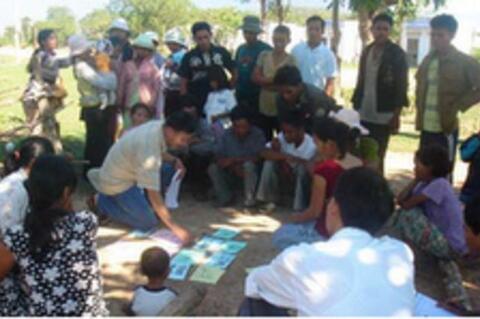
"'When I came to Bac Ai five years ago local people rarely spoke out, and there were few community-based organizations. Now this has changed. I am happy about that.' - Truong Thu Huyen, Oxfam Programme Co-ordinator, Right to Be Heard programme, Vietnam."
This project aimed to strengthen the participation of economically poor men and women from the Raglai ethnic minority in local government programmes and also to build skills among local government officials in Bac Ai district, Vietnam. The Oxfam project, which was carried out in a number of stages between 2007 and 2010, worked in 4 communes - Phuoc Tan, Phuoc Tien, Phuoc Chinh, and Phuoc Thang - and had a particular focus on women's participation and leadership.
First, Oxfam carried out an analysis of the social and power dynamic and status of community-based organisations (CBOs). This showed that they did not have the necessary skills to mobilise people's participation - for example, skills in communication, negotiation, and facilitation, or the ability to supervise implementation. Next, it focused on raising awareness of local Raglai men and women on their rights and responsibilities, so that they could participate in plans and development issues at local level. The project did this in a number of ways, including:
- Small-group discussions using pictures and practical examples;
- Theatre related to issues in the village, written and performed by villagers;
- Recorded tapes in the Raglai language;
- Live broadcasting in Raglai and Vietnamese through loudspeakers;
- Production and distribution of posters and leaflets;
- Training on participatory planning and other issues for members of CBOs and local commune authorities;
- Forming Village Development Boards and strengthening Community Investment Monitoring Boards;
- Training on the Grassroots Democracy Ordinance, which states that people have the right to be informed, to participate in discussions, and to make decisions on local socio-economic development activities, especially when these activities require community resources; and
- Training on communication and facilitation skills and policy analysis and monitoring, including monitoring of the construction of houses and toilets.
The project also facilitated the formulation and operation of 12 CBOs to represent economically poor people in the different villages in three communes and to monitor government programmes. "We were given training in monitoring techniques and skills such as how to check the quality of the cement, bricks, and concrete mixture," says Trinh Xuan Truong, Vice-Chair of the Phuoc Tien Commune Fatherland Front, and team leader of the Group. "We were also shown how to explain to villagers about the design and the materials and encourage them to take part with the builders so they could monitor the quality themselves. About 20 men and ten women were trained in this way."
In general:
- The programme was in line with government policies.
- It was based on the province's local context of decentralisation, social accountability, and participation in the planning and monitoring of policies.
- It focused on better co-ordination between provincial and district authorities.
- It mobilised people's participation in planning.
- Its approach to raising people's voices was, according to Oxfam, relevant to local culture, promoted dialogue between local people and authorities, and strengthened the role of CBOs in supporting one another.
Political Participation, Women.
The poverty rate for areas where many Raglai people live is high - for example, in Bac Ai in 2009, the poverty rate was 54%, compared with 10% for the whole of the province.
Nearly 1,000 Raglai women and men participated in various communication activities as part of Right to Be Heard. According to Oxfam, at least 70% of those who participated said they felt that they had greater understanding of their roles and responsibilities in the community development process. Oxfam also contends that the presence of women leaders potentially paved the way to raise gender awareness and to improve women's economic position and access to leadership roles among the Raglai people. "There have been changes in the mindset. Previously it was thought that female deputies, even when elected, were not capable enough. Now they even nominate women into these positions," said a People's Council deputy in Phuoc Tan commune.
"No Longer Sitting Quietly: Building Space for Community Participation in Vietnam" [PDF], by Nikki van der Gaag, May 30 2012 - sourced from Oxfam Policy & Practice, May 2012. Image caption/credit: People in Da Trang village, Phuoc Tan commune choose appropriate communication tools with the help of an official from the district People's Committee. Photo: Oxfam GB
- Log in to post comments