










































Respect? Campaign
Respect? is a campaign urging young people to take ownership of the media, and make their opinions heard, by using comment opportunities and new technology. The Respect? campaign is led by eight 16 to 24-year-olds who together form the Respect Young Peoples Advisory Group (RYPAG), supported by YouthNet and the British Youth Council (BYC). Their goal is to improve the representation of young people in the media, government, and United Kingdom (UK) society as a whole, by encouraging young people to speak up and society to listen. The key aims of Respect? are to:
- Ensure that young people's views are at the heart of political debate;
- Challenge the use of labels (stereotypes) in media coverage and government polemic; and
- Encourage decision-makers to directly involve people when drawing up policy and make informed judgement on youth issues.
The core strategy of this youth-driven initiative is providing young people with the needed tools to help change how they are perceived by the media. The RYPAG is educating peers about how to exercise their right to reply to articles on websites by sending comments. In turn, Respect? has a strong advocacy element in that participants are demanding that newspapers, websites, and television make it clear that not all young people are involved in negative stories. "So in an article about a stabbing, you get neighbours interviewed but no young people. Including their views would show that not all young people are the same....We're trying to convince the media to help us make sure that negative stereotypes aren't carried on."
A key component of the Respect? campaign is engagement with the media. One of the responsibilities of the RYPAG was to act as media spokespeople. In order to give the members the skills and confidence they needed to talk to journalists, they received a day of media training. This included taking part in media interviews, linking to key messages, and preparing for journalists' questions. It also showed them how to facilitate interviews and identify opportunities to speak up publicly on the issue of the portrayal of young people in the media.
The campaign has cultivated and made available guidance for young people and others about how to amplify and engage the youth voice in the media. Click here to access tips and resources designed to build the communication skills (including blogging skills and representing views online through film and photography) of youth who want to "tackle the mainstream media". Also, a guide for elected representatives on best practice for working with young people was made available in the spring of 2009. Another Respect? publication features 13 tips on how to involve young people in campaigning for positive images in the media, such as making sure that young people know what's in it for them, recruiting a diverse group, and making it easy to get involved.
Social media activity has included a Respect? campaign Facebook group which, as of this writing, has attracted over 400 supporters, as well as blogging and online participation, such as YouthNet's input into debate for the Media Standards Trust on the media portrayal of youth crime.
Respect's political lobbying led to an Early Day Motion (EDM) being tabled by the newly appointed Chair of the Labour party and Chair of the All Party Parliamentary Group on Youth Affairs (Dawn Butler MP - Minister of Parliament) on July 11 2007. It calls for an end to negative representation, is still open, and (to date) has secured 115 signatories. The EDM communications plan was implemented to galvanise young people to lobby MPs to support the motion, and as a result stories appeared in local, regional, and online media.
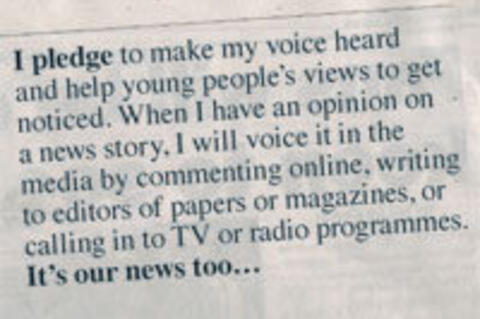
Mobilisation has seen campaign action moving from a strategic level to grassroots action, with an appeal to young people across the UK to urge the media to represent them and their issues more fairly. Respect? launched this new phase to encourage young people to speak up in the media with a public event on November 11 2008 on London's Fleet Street. Young campaigners were joined by former BBC broadcaster and founder of YouthNet, Martyn Lewis, to pose for photos in front of a giant newspaper front-page prop. This phase of the campaign is asking 1,000 young people to sign a pledge (by November 30 2009) to speak up when they see a story in the media which affects them. Click here to sign the pledge and to learn about how to spread the word - on- and offline (e.g., by sharing it through various social media, by printing out customised flyers, by promoting it on one's own website or blog, and/or by creating a local version of the pledge. Also, see the contact information below to request Respect? postcards designed to promote the campaign.
Youth.
The campaign was created in 2005 in response to research, commissioned by YouthNet and BYC, which showed that young people were increasingly concerned about their negative portrayal in both the media and politics. The July 2006 report "The Voice Behind the Hood" [PDF] highlighting that survey of people aged 16-24 across the UK revealed that:
- 90% of young people denounce anti-social activities and the majority accept that swearing, arguing, and loud music can be anti-social.
- 98% of young people feel that the media always, often, or sometimes represents them as anti-social.
- 75% of young people lose respect for politicians when they say negative things about young people.
- Over 80% of young people believe the way they are portrayed leads to older people respecting them less.
The government's 10-year youth strategy, Aiming High for Young People, cites the campaign as an example of good practice. In July 2009 the campaign won a Children & Young People (CYP) Now Positive Images Award for best involvement by a young person in promoting positive media portrayal.
YouthNet and the British Youth Council (BYC).
"Charities Encourage Young People to Promote Positive Images", by Ruth Smith, Children & Young People (CYP) Now, August 25 2009 - forwarded to the Young People's Media Network (YPMN) listserv on August 26 2009; Respect? Campaign website, accessed on September 8 2009; and Respect? Evaluation Report [PDF].

- Log in to post comments