











































Personal Hygiene and Sanitation Education (PHASE)
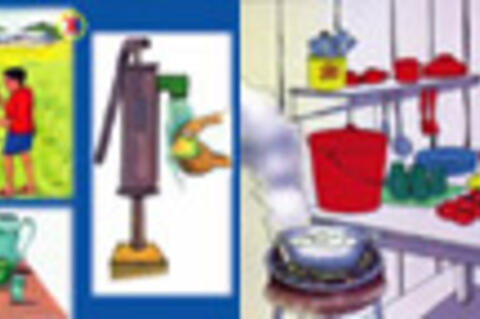
The educational materials used in PHASE are designed to be simple, easy to use, and effective. They include cloth books and story cards which are adapted for each country based on input from local teachers and pupils to ensure they are meaningful in each context. For instance, in Tajikistan, pupils commented that one of the proposed characters looked like a shepherd, while another was wearing old-fashioned clothes. In response, the characters were redesigned to give relevance to the local population. By providing teachers and community leaders with specialised training to deliver the programme in schools, organisers hope that PHASE materials will foster participatory discussions that enable participants to identify the problems and come up with practical solutions.
Along these lines, a central component of this programme's strategy for sustainability is training representatives from the provincial level to roll out PHASE nationally. To facilitate this capacity-building process, PHASE partnerships have been created in an effort to foster closer connection between schools, families, and local communities. For example, following the launch of PHASE in Bangladesh a national working group for School Health and Nutrition (SHN) was created; Save the Children was asked to take the lead in this group and is now, according to organisers, in a position to advocate the national adoption of PHASE strategies within a SHN programme. Mette Kjaer, County Director, AMREF Kenya, says "The key to the success of PHASE is its incorporation into the school curriculum with the support of the Ministries of Health and Education in order to reach even more children."
Click here to read specifics (in PDF format) about one PHASE programme, implemented since 2001 in Namanga, a division in Kajiado district about 160 kilometres from Nairobi near the Kenya/Tanzania border in Africa.
Children, Health.
According to organisers, every year 3 million people globally die of diarrhoeal disease, most of them children. Poor provision of healthcare in so-called "developing countries" means that children suffering from diarrhoeal diseases and other parasitic infections do not get the simple-but-effective treatment they need. Even when the disease is not fatal, organisers say, it often results in poor school attendance. However, they claim, schools which have adopted PHASE have seen a drop in pupils' absence due to ill health, and as the availability of latrines and clean water in schools has increased the number of days lost to sickness has decreased. For instance, in Nicaragua the frequency of hand-washing after using the latrine among pupils reportedly increased fivefold and the proportion of children reporting diarrhoea in a 2-week period fell from over 40% to 13%. The number of families showing improved hygiene practice in handling and conserving drinking water has trebled. Similarly, in the Ongielo community in Kenya the reported incidence of diarrhoea in participating schools decreased by 40% between 2000 and 2002; in contrast, in the nearby Gobei community, which is not participating in PHASE, the incidence of diarrhoea actually increased by 70% in the same period.
Organisers indicate that the impacts of the programme go beyond the children; many pupils report that when they go home they implement the ideas they have learned at school, therefore transferring their knowledge to their parents. As a result families and the broader community also benefit from PHASE. For example, in Kenya the number of pit latrines increased by 70% between 2000 and 2006. It has become standard practice to provide hand-washing facilities and separate toilet facilities for boys and girls in many of the participating schools. Protected sources for drinking water have also increased in both Kenya and Bangladesh. Other improvements to the local infrastructure include schools building new kitchens so children can have meals prepared in a hygienic environment, and schools planting shrubs and trees nearby, marking out defined areas to prevent animals wandering in and spreading disease.
"PHASE: A Simple Hand-washing Programme that Saves Lives" [PDF], produced by Global Community Partnerships, GlaxoSmithKline, in May 2007; and the PHASE page on the GlaxoSmithKline website.
- Log in to post comments