










































Perceptions of Factors Influencing the Introduction and Adoption of Electronic Immunization Registries in Tanzania and Zambia: A Mixed Methods Study
Dolan Consulting LLC (Dolan); University of Washington (Dolan); Johns Hopkins University, Bloomberg School of Public Health (Alao); Ministry of Health, Lusaka, Zambia (Mwansa); Ministry of Health, Community Development, Gender, Elderly and Children, Dar es Salaam, Tanzania (Lymo, Bulula); PATH (Carnahan, Beylerian, Werner, Shearer)
"Community sensitization was seen as an important component that allowed for the EIR to be accepted and appreciated by caregivers and community leaders."
The use of digital health interventions (DHIs) such as electronic immunisation registries (EIRs) is one strategy for increasing adherence to vaccination schedules and vaccine uptake in low- and middle-income countries (LMICs). The BID Initiative, led by PATH and funded by the Bill and Melinda Gates Foundation, worked in partnership with the governments of Tanzania and Zambia to introduce an EIR at the sub-national level in both countries within 5 years as part of a multi-component intervention package that focuses on data use capacity-building. This framework-based mixed methods study describes the perceived facilitators and barriers to, as well as trends in introduction and adoption of, EIRs in each country through the lens of the BID experience.
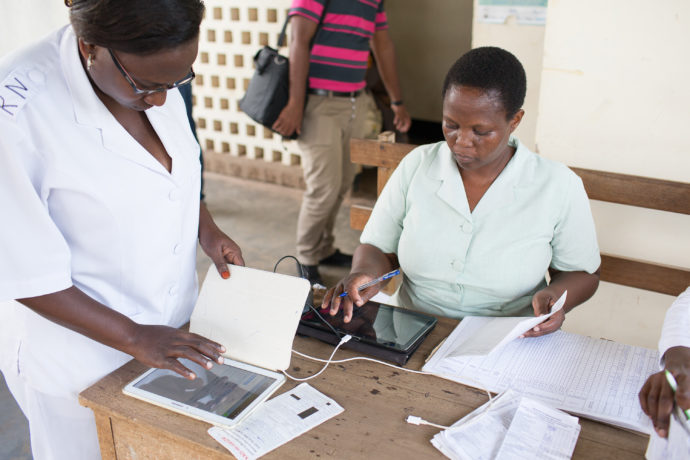
As detailed here, the BID Initiative partnered with the Ministries of Health (MOH) in Tanzania and Zambia to address key challenges in immunisation data collection, quality, and use beginning in 2013. The resulting tablet-based EIR software, which has on- and offline functionality, allows healthcare workers (HCWs) to register children, record vaccinations administered, identify vaccinations due, and generate aggregate facility-level reports that feed into the health management information system (HMIS). In both countries, the intention of the EIR was to replicate and eventually replace the use of paper-based data collection tools.
The researchers used the axes and domains outlined by the mHealth Assessment and Planning for Scale (MAPS) Toolkit as the conceptual framework to guide the study's data collection approach, interview questions, and analytic framework. The team conducted semi-structured interviews between September and October 2018 with 12 key informants (e.g., from MOH and PATH). In addition, they reviewed documents related to BID from PATH's files.
Among facilities in Tanzania, the median EIR use over active-weeks ranged from 39-86% per district (95 facilities); in Zambia, the median percent of active-weeks using the EIR ranged from 22-59% per district (302 facilities).
Perceptions of facilitators and barriers to EIR introduction and adoption based on the key informant interviews are summarised in Table 3 in the paper. Examples:
- In the areas of groundwork, partnerships, and financial health - Sample facilitator: In both countries, the MOHs demonstrated an interest in shifting to increased use of electronic data, and therefore supported EIR introduction. Sample barrier: Lack of electricity in some health facilities was an initial barrier.
- In the areas of technology and contingency planning - Sample facilitator: System security was ensured by only granting selected staff user credentials and passwords, and strong policies were in place for replacement of lost or stolen tablets. Sample barrier: Some users became discouraged by synchronisation problems between the stock management system and EIR, possibly leading to drops in EIR use.
- In the area of operations (training) - Sample facilitator: Trained HCWs acted as mentors and champions to help train staff in other districts during scale-up. Sample barrier: Some informants felt training was too short and that there was a need for ongoing HCW training and coaching to sustain EIR use.
- In the area of operations (supervision and technical support) - Sample facilitator: Supervision improved when MOH staff could view EIR reports to identify facility needs, emphasising the importance of data accessibility for monitoring activities. Sample barrier: In Zambia, it felt as if there wasno contingency plan, and that district teams did not have the capacity to sustain the project, which may have influenced buy-in and acceptance of the EIR.
- In the area of operations (personnel and outreach) - Sample facilitator: In Zambia, community health workers (CHWs) helped orient the community to the project, and local leaders were sensitised to increase EIR buy-in. To encourage community mobilisation, posters were provided at the facilities, and HCWs were trained to address caregiver concerns. It was noted that scale-up went well because PATH was involved at every stage of the process. Sample barrier: Most HCWs were not confident tablet users and/or were slow learners; therefore, they needed additional training.
- In the area of monitoring and evaluation (M&E) - Sample facilitator: In Zambia, the district management teams reviewed facility performance monthly, and at the lower levels, neighbourhood health committees supervised CHWs and reported to the district. Sample barrier: Generally, it was felt that resources for monitoring were unavailable and, therefore, monitoring was weak.
- In the area of sustainability - Sample facilitator: The EIR fostered a data use culture in Zambia, as the HCWs expressed joy in being able to produce and view tables and graphs that allowed them to identify gaps in the continuum of immunisation services. Identification of supporting partners was mentioned as a factor to facilitate scale-up. Sample barrier: In Zambia, informants mentioned how partners lobbied telecommunication companies to make short message service (SMS) free for another project; they felt something similar should be done to get free data/air-time for their EIR.
In sum: "Key enablers of EIR adoption included adequate staffing, supervision, internet and electricity connectivity,and community sensitization, along with strong strategic engagement. Barriers of EIR adoption included lack of personnel and inadequate training and internet and electricity connectivity."
A list of recommendations for scale-up based on findings from this study can be found in Table 4 of the paper. For example, in the area of operations (personnel and outreach):
- Incorporate all levels of EIR-users into programme decision-making.
- Use community mobilisation/sensitisation to increase buy-in for the system.
- Consistently engage with partners at every step of the roll-out.
- Understand existing user capacity and incorporate this into training strategies.
- Plan for sustained use of the system from the beginning, including handover of activities from partner organisations to the government.
The researchers conclude: "Using rigorous assessments alongside a strategic plan for scale-up that involves a high level of government commitment can ensure that future DHIs are sustained and impactful....Organizations deploying DHIs in the future should consider how best to adapt their intervention to the existing ecosystem, including human resources and organizational capacity, as well as the changing technological landscape during planning and implementation. To have an impact on health outcomes, EIR introduction and adoption have to be sustained at scale."
Implementation Science Communications (2020) 1:38 https://doi.org/10.1186/s43058-020-00022-8; and BID website, April 8 2020. Image credit: PATH/Trevor Snapp
- Log in to post comments