










































Migrantes de Otro Mundo [Migrants from Another World]
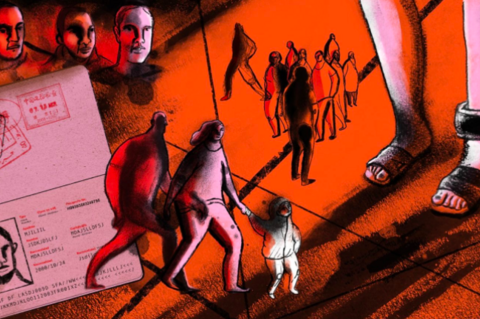
"By its wandering nature, migration is a story that can only be properly told through collaboration."
The Migrants from Another World (Migrantes de Otro Mundo) project involved a team of more than 40 journalists from over a dozen countries who collaborated to tell the untold story of migrants from Asia and Africa who travel through Latin America each year to reach the United States and Canada. This cross-border investigative collaboration sought to create awareness of this particular migration route, which has remained largely undocumented and invisible, and to help audiences understand the phenomenon of migration as a global process that is about human stories, not just about numbers, isolated tragedies, or nationalist responses. The project, which involved data collection and storytelling, culminated in a website that maps the paths migrants take, the dangers they face, the political hurdles they have to overcome, and the people who profit from trafficking.
The investigation was led by María Teresa Ronderos, founder and director of the Latin American Center for Investigative Journalism (CLIP). As she explains, "We called it 'Migrants From Another World' because the project tells the stories of people who travel between five and ten thousand miles to the opposite side of the planet. Once in the Americas, they cross the continent in express buses or planes, in speedboats or rafts, in clandestine taxis or private cars taking hidden routes and tricky shortcuts, always towards the north, to the United States or Canada, like stunned swallows. Often, they cross entire stretches relying only on their legs."
CLIP had been aware of a number of stories of migrants from Asia and Africa who travelled through Latin America. However, the extent of the migration, the migratory paths, and the personal stories behind the migrations were not well known. The idea was, therefore, to document the extent of the migration, as well as to tell stories of migration along the routes - from beginning to the end. In particular, the project wanted to hear from those who managed to settle in the north and ask them whether it was worth the cost, to find out what happened to those deported or imprisoned, and to put a face and a name to those who died and whose remains lie in unknown places or mass graves by the roadside.
As the stories involved long distances and multiple borders, local journalism, cross-border collaboration, and cross-media alliances were required. The first step was, therefore, to seek partners inside and outside Latin America with the aim of creating alliances with media outlets and journalists at key points in the story. In total, 24 media organisations in 14 countries (including countries of origin such as Cameroon, India, and Pakistan) joined the project, resulting in a collaboration of more than 40 reporters and editors, videographers, photographers, programmers, designers, and artists.
According to Ronderos, there are different ways to create a collaborative research project like this. "In many collaborations, each party takes on its particular country, the story that they assume will interest their audience. In this project, we understood that the collaboration had to be more radical: it cannot be 'I'll do my story,' because in the end you end up with a local story, when what you need is to tell truly transnational stories."
As existing data on migrants were lacking or not readily available, CLIP built its own databases based on input from reporting partners, who made information requests from public databases in their respective countries, and from reports published by different organisations. Through the collection of data, the project estimated, for example, that every year between 13,000 and 24,000 Asian and African migrants and refugees travel this route. The reporting also revealed the expansive nature of some of these journeys, starting in countries as diverse as Cameroon, India, the Democratic Republic of the Congo, Bangladesh, Angola, and Sri Lanka. Project participants worked for nine months in 2020 tracking and reporting stories, setting up databases, and creating multimedia content that could be shared with the world.
The collaboration process involved many meetings and trainings on, for example, digital security. Members of the team also had to agree to the conditions of the project, which set out the editorial responsibilities of each partner and of CLIP as the lead organisation. In addition to the general discussions, there were subgroup meetings for particular stories and meetings for follow-up or to review progress. Throughout the process, there was constant communication through work platforms and chats.
The stories and the data have been made available on the Migrants from Another World platform, which includes five chapters featuring data visualisations or a series of stories in video or written format (in Spanish, English, and Portuguese):
- The Great Journey - This chapter offers an animated map that traces the main routes of the first transatlantic leg of migrants' voyages. The map of routes is based on studies by experts, judicial records, and reports published by other media, but above all it is based on the stories of the transcontinental travellers themselves.
- Routes through the Americas - Having reached the Americas, this chapter offers a map that shows the flow of Asian and African migrants to North America by the most frequent nationalities and as each country reports when they register them. It is built with the official statistics available on the public portals of some countries or that journalists requested from its authorities in each country.
- Forbidden Passages - This chapter features a series of documentaries and written articles that tell stories of forbidden passages in countries where laws and circumstances often require migrants to hide and move undetected through countries.
- The Fallen - This chapter maps the trail of death and disappearance left along the routes pursued by migrants of all nationalities, documented by the project and the International Organization of Migration (IOM) between 2016 and February 2020. For example, the project counted 110 people of various nationalities suspected of having died or gone missing on the border between Colombia and Panama. Among the dead are 21 people who were shipwrecked and today lie buried as anonymous victims in Acandí, a fishing village on the Gulf of Urabá, in Colombia.
- A Cruel Business - The stories in this chapter show how border restrictions have helped create a huge market that is riddled with corruption and human trafficking, in which people are charged thousands of dollars at each stage of the trip. Stories reveal how the criminal networks and their various rings of power operate: from elites who charge thousands of dollars in advance and coordinate payments between big cities to corrupt local authorities who take their share, as well as to "coyotes".
Migration, Human Rights
Migrants from Another World won the first prize in the Contribution to Civil Rights category of the Fetisov Journalism Awards 2020.
Bellingcat website; Global Investigative Journalism website and Organised Crime and Corruption Reporting Project (OCCRP) website - all accessed on February 24 2022. Image credit: Migrantes de Otro Mundo
- Log in to post comments