










































Merlin's Maternal Health Project

This health communication initiative is based on the premise that when community members have accurate information about health, they can make better choices about how to stay healthy. A key part of the project is a comprehensive behaviour change communication (BCC) strategy. Core health messages are developed and delivered through a variety of culturally appropriate methods including focus groups discussions, awareness sessions by community leaders, songs, and plays. According to Merlin, working closely with community members and focusing activities on prevention and awareness can make a real difference in improving the health status of these vulnerable communities.
Merlin provides community health workers with direct support and ensures they have the backing of the village health committee. This relationship is designed to feed health workers' confidence in passing on key health messages in awareness raising sessions and in suggesting new methods and forums. Specifically, monthly meetings are designed to provide a supportive environment for community health workers to discuss any problems with Merlin staff and with volunteers from other villages. Merlin observes that many of these workers face significant challenges in treating patients and at the same time generating income for themselves. Village health committees discuss these challenges, and community members are encouraged to value and support the importance of community-level services.
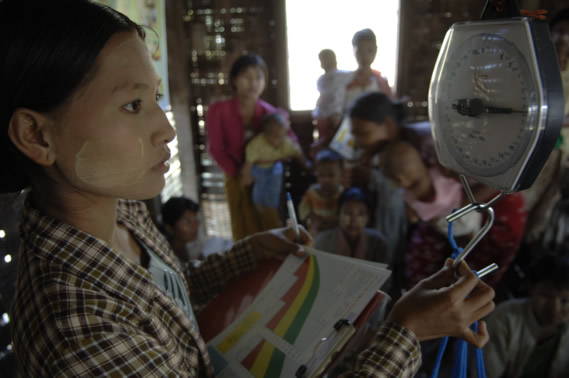
Merlin also provides training, basic equipment, and medical supplies. Auxiliary midwives receive training in basic care during pregnancy, safe motherhood, and care for newborn babies. Community health workers have been trained to care for children under-five years and provide basic treatment for the most common diseases including diarrhoea and malaria. All Merlin-trained community level health workers receive basic equipment and medical supplies, which are replenished during monthly meetings where they also receive supportive supervision.
Maternal Health
Prior to the project's inceptions, questionnaires and focus group discussions with different groups - new mothers, men, and grandmothers - generated baseline information about community knowledge and health seeking behaviour. This research, which fed into Merlin's activities, found that antenatal and postnatal care coverage is less than 25%. Even those who receive this care are visiting unskilled providers and not accessing a full package of services. If complications occur during delivery, few women receive proper care. Furthermore, there are many taboos around diet during pregnancy. Mothers reduce their food intake and do not take vitamins or iron tablets because they are concerned that high food consumption means they will have a "big" baby which will make delivery more complicated. While exclusive breast feeding is generally recognised as crucial for child development, strong beliefs that feeding colostrum to the baby is unhealthy mean that many babies are not breastfed until 8 to 48 hours after birth. Many also believe that if they breastfeed when they are hot from working in the fields, their "hot" milk will give the baby diarrhoea.
The survey also highlighted many good practices, including rest for the new mother, strong family support, and community members being open to finding solutions to their health problems. In addition to promoting changes to behaviour, good practices are reinforced and built upon.
Thantlang Township is one of four townships where Merlin works. Located in western Chin State on the border with India, Thantlang's steep-sided mountains dropping down to narrow valleys mean there is almost no road access, and all areas are prone to landslides during rainy season. The majority of the population are subsistence farmers living in small remote villages. Populations in these isolated villages have had little contact with those from outside the area and are strongly self-reliant, Merlin claims. Merlin helps them identify reasons for poor health and strategise about how to improve the village environment, for example, cleaning up and digging pit latrines. According to Merlin, more women are accessing ante- and postnatal care with the support of their families. When communities identify a solution for which they need extra funds, technology, or skills, Merlin aims to provide them with what they need - for example, bednets, pit latrines, and clean delivery kits.
Funded by Three Diseases Fund and Europeaid.
Emails from Alison Dunn and Sally Clarke to The Communication Initiative on March 3 2009 and May 26 2009; and "Steps to Better Health in Rural Myanmar" (Health Exchange, Spring 2009 - produced by Healthlink Worldwide, Merlin, and RedR).
Comments

this is just what am trying
this is just what am trying to do in my community in ogoja Cross River state Nigeria.
Please i really want to work closely with you to learn from your work.
Thanks a million for giving your life to this project.
Iam Margaret Onah, the executive director of Safehaven International, an NGO based in Lagos Nigeria working on women issues.

- Log in to post comments