











































A Light Touch Intervention with a Heavy Lift - Gender, Space and Risk in a Global Vaccination Programme
Johns Hopkins Bloomberg School of Public Health (Kalbarczyk, Closser, Agrawal, Alonge); Addis Ababa University (Hirpa, Deressa); Universitas Gadjah Mada (Cintyamena, Azizatunnisa); Global Innovations Consultancy (Rahimi); University of Ibadan College of Medicine (Akinyemi); University of Kinshasa (Mafuta)
"The success of global initiatives like the GPEI relies heavily on the body work of FLWs so it is critical to reflect on how these individuals, who are largely women, can be supported by their organisations."
Frontline workers (FLWs) in the Global Polio Eradication Initiative (GPEI) go door to door delivering oral polio vaccine (OPV) to children. They have played a pivotal role in eliminating wild polio from most countries; at the same time, the mostly-female FLWs face great challenges: difficult work, long hours, very low pay, and bodily risk. This study explores how polio FLWs manage these complex demands through an approach grounded in body work (handling, assessing, and manipulating bodies). In so doing, it highlights aspects of health delivery, including intersections with gender, that are often neglected in the literature yet are, as argued here, critical for explaining the success or failure of global health programmes.
This research was conducted through the Synthesis and Translation of Research and Innovations from Polio Eradication (STRIPE) consortium, a collaboration between Johns Hopkins University (JHU) and seven academic and research institutions representing countries with different epidemiologic profiles of polio: Afghanistan, Bangladesh, Democratic Republic of the Congo (DRC), Ethiopia, India, Indonesia, and Nigeria. Data were collected between August 2018 and December 2019 through a survey of 826 FLWs across 14 countries, the majority of whom were based in the seven STRIPE countries (97.9%). Key informant interviews (KIIs) were conducted with 22 FLWs who completed the survey in those settings, 11 of whom identified as women. Survey respondents were asked to indicate which objective(s) they worked on in their role(s). Forty-seven percent vaccinated populations, 19.11% conducted community engagement, and 12% conducted acute flaccid paralysis (AFP) environmental surveillance.
The study found that polio workers perform a different kind of body work than many other FLWs. While providing 2 drops of OPV to each child only requires a light touch, physically manoeuvring large catchment areas and widely dispersed settlements, and conducting repeated campaigns, can be exhausting. Also, gendered spaces can make the work physically dangerous. Polio FLWs must bend or break gendered space norms as they move from house to house. In fact, navigating male spaces carries risk for women, including lethal risk, particularly in conflict settings. In their own homes, women face additional gendered hierarchies, as they are expected to complete domestic duties in addition to their polio work. Married women FLWs have been shown to face increased threats of domestic violence.
Furthermore, FLWs must manoeuvre between skeptical community members who may ultimately refuse the vaccine for their children and the demands of supervisors. Communities who desperately need more government services but who are only offered polio vaccines are often frustrated. FLWs bear the brunt of this frustration, experiencing criticisms and insults. Compounding distrust in some areas is the fact that many polio-endemic communities are marginalised populations who have been targeted by their own governments and international agents in the past, and thus have good reason to distrust those actors. These larger dynamics are beyond the power of FLWs to address, and yet their job is to convince parents to accept polio vaccine for their children - these other factors notwithstanding. Navigating these conversations requires intense emotional labour.
FLWs in DRC, Ethiopia, and Indonesia reported developing solutions and trying new strategies to combat many of the challenges they face. Broadly, this included collaborating with other groups (e.g., animal specialists for pastoral communities in Ethiopia) to tackle inadequate staffing, working closely with community members (e.g., community and religious leaders) to elicit support, and working within physical and social contours of the community landscape (e.g., identifying common public areas appropriate for vaccination activities). "FLWs in most contexts have little ability to change systems, but they are able to leverage opportunities, particularly when supported by infrastructure and structures at the national level..."
Thus, this research has revealed that gendered outdoor spaces, power, and political dynamics can make the work of polio FLWs physically and emotionally challenging. The analysis highlights, for example, that "looking at emotional labour in the global health setting involves a recognition of the contextual nature of the gender-based power imbalances that FLWs face...and...offer[s] insights into...why emotional labour may be an important component of FLWs' work satisfaction and burnout..." It also sheds light on the hierarchies and power dynamics that place FLWs at increased risk of doing greater body work. These systemic issues are often deep-seated and intractable to resolve in most societies. One proposal is to ensure that FLWs' intimate knowledge and awareness of the communities they serve be brought to bear on decision-making through increased leadership in the GPEI. They are not just "doers" but, rather, "valuable stakeholders to be engaged throughout the implementation process, from design to dissemination." However, women workers are slow to be promoted to management and supervisory positions in the GPEI.
In conclusion: "The cost of success of global health programmes like the GPEI weighs significant on the bodies of FLWs, who are largely women. This is sometimes less tangible, and difficult to describe, but critical for achieving overall programme goals, especially when trying to reach the last mile. Global programmes should consider the range of body work FLWs face and design responsive systems that support them physically, emotionally and hierarchically within their organisations."
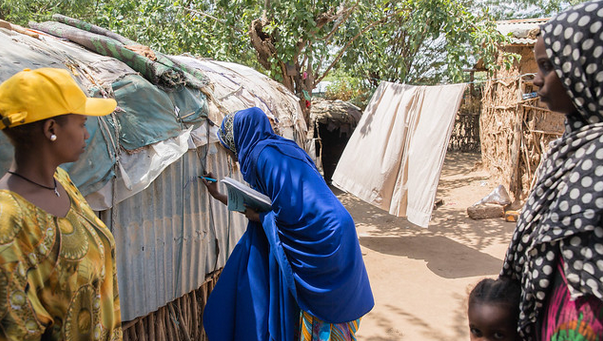
Global Public Health, DOI:10.1080/17441692.2022.2099930. Image caption/credit: Health worker marks the house to show how many children were reached with the polio vaccine during the campaign. ©UNICEF Ethiopia/2015/Meklit Mersha via Flickr (CC BY-NC-ND 2.0)
- Log in to post comments