










































Keeping up the Pressure: Enhancing the Sustainability of Protest Movements
CIVICUS
"With formal spaces for participation closing across the globe, citizens are more likely to take to the streets to have their voices heard and press for change. This study shows that the international community and national stakeholders must foster a safer and more enabling environment for people to engage in public protests. - Tor Hodenfield, Policy and Research Analyst at CIVICUS
Protest movements around the world are finding themselves on the frontlines of a global attack on democracy and human rights, according to this report by CIVICUS, the global civil society alliance. The report explores structural, national-level, and external factors that contribute to or undermine the sustainability of contemporary protest movements, defined here as continuous public and physical gatherings of a group of individuals committed to using non-violent tactics to effect some political, social, cultural, or economic change that diverges from mainstream or extant political positions or practices. CIVICUS's research assessed ongoing protest movements in Bahrain, Chile, and Uganda, using an interview and survey-based qualitative research methodology. The report seeks to build on our existing understanding of protest movements by providing perspectives from those leading and actively involved in protests, with the aim of contributing to the growing academic, civil society, and intergovernmental literature on the causes, consequences, and efficacy of contemporary protest campaigns.
"The space for civil society, determined by the realisation of the three fundamental civil society rights, of the freedom of association, freedom of peaceful assembly and freedom of expression, is under attack around the world." In 2016, the CIVICUS Monitor, an online platform that rates the quality of the space for civil society in countries around the world, reported that 3.2 billion people live in countries where their space to organise, speak out and take action is severely impaired. The global attack on the space for civil society is closing off institutional avenues through which citizens can raise their legitimate political and socio-economic concerns. As CIVICUS has documented in recent State of Civil Society Reports, recent years have seen the world swept by new waves of citizen protest. In countries around the world, large numbers of people have marched, demonstrated, occupied, and blockaded to call attention to governance failures, demand democracy, stand against autocracy, claim human rights, and urge that their fundamental needs are met. While the triggers of protests vary, the new protest movements that have sprung to life in many parts of the globe in have much in common, including the imaginative and creative tactics they employ, their ability to connect local and immediate issues to larger and longer-term concerns, and their determination to sustain action over time.
All the movements selected for the empirical research began during or after 2011, which meant that protest organisers in the 3 different countries were potentially able to apply similar tactics and technologies. (All 3 protest movements make heavy use of social media as a means of mobilising citizens, and all report that they have a strategy for using the media to spread their message. No protest movement leaders believe that citizens are unwilling to join protest movements because of a lack of clear messaging.) While these movements are each driven by a determination to tackle distinct problems, of democratic deficits, inequitable education polices, and state corruption, they are all grounded in an attempt to advance human rights, democracy, and good governance. In brief:
- Bahrain - As of February 2017, the CIVICUS Monitor indicates that, in this country, "there is complete closure - in law and in practice - of civic space." The contemporary protest movement in Bahrain began in earnest in February 2011 as part of the wave of protests that swept through the Middle East and North Africa from December 2010, commonly referred to at the time as the "Arab Spring". Protesters sought to overcome the absolute authority of the Bahraini monarchy, led by Hamad bin Isa Al Khalifa, and to institute pro-democracy reforms.
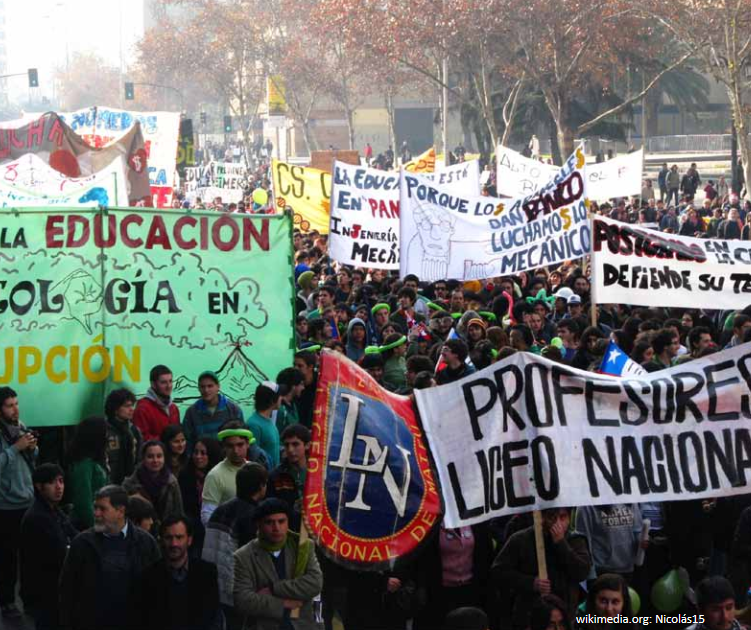
- Chile - The CIVICUS Monitor describes Chile's civic space as narrowed. Chile's contemporary student protest movement began in May 2011. The protests, largely known as the Chilean Winter, were comprised primarily of secondary and tertiary students advocating against the privatisation of education and increased tuition fees at universities and colleges. The movement later evolved to include a broader constituency, including labour unions, and embraced a broader set of socio-economic issues.
- Uganda - The CIVICUS Monitor determines that the space for civil society in Uganda is repressed. In November 2012, civil society leaders and concerned citizens launched the Black Monday Campaign to raise public awareness about the misuse of public funds by political figures and political officials.
These movements have achieved various levels of success in securing their objectives, and all remain active to some degree. The research found that all 3 states are failing to facilitate the right to peaceful assembly. All 3 protest movements, irrespective of their state's overall level of respect for core civil society freedoms, experience a range of unwarranted legal and extra-legal restrictions. The major ways in which states undermine the sustainability of protest movements are the excessive use of force, the arbitrary arrest of protesters, and the imposition of legal restrictions on the freedom of assembly.
Protest movements benefit from national-level connections and cooperation. Networking with allies, including with unions, faith groups and other civil society groups, is assessed as important for enhancing the sustainability of protest movements in each country. Most protest movement leaders in all 3 countries report that their movement engages with domestic CSOs in planning and holding protests. However, protest movement leaders in each country believe that domestic CSOs should play a larger role in mobilising support for protest movements. All agree that protest movements would benefit from greater coordination with a diverse range of national actors and allies.
In the face of restrictions on democratic dissent at the national level, CIVICUS observes, there is little support for protest movements from international stakeholders, including other protest movements, foreign states, United Nations (UN) bodies, and international civil society organisations (CSOs). This study concludes that such support is important to uphold the international human rights framework, of which the right to peacefully express democratic dissent is a key component. It is suggested here that the sustainability of protest movements would be enhanced if legal and extra-legal restrictions on the right to the freedom of assembly were removed or eased.
Protest movement leaders believe they and their movements have capacity development needs that are currently not being met. In particular, protest movements leaders in all 3 countries identify support for strategic planning and thinking, and organising, as their most important capacity development needs. Support for fundraising is identified as their least important need.
Notwithstanding constraints, leaders of all 3 movements are on the whole optimistic: They believe that public support for their cause will increase over the next year, and their movements will be sustained until their core demands are achieved. Furthermore: "CIVICUS will continue to build on our findings, based on the needs articulated by the protest leaders who contributed to this analysis. We urge all potential stakeholders, including civil society, states and intergovernmental bodies, to incorporate and apply our learning in their work to ensure that adequate support and solidarity is provided to protesters and protest movement leaders to ensure that they can effectively and safely exercise their right to peaceful assembly."
"Critical need to support right to protest, says new report", April 28 2017 media release - sourced from: e-CIVICUS 820: A Free and Diverse Media is Essential to Protecting Democracy in the 21st Century, May 4 2017, and e-CIVICUS website - both accessed on May 16 2017. Image credit: wikimedia.org: Nicolás15
- Log in to post comments