










































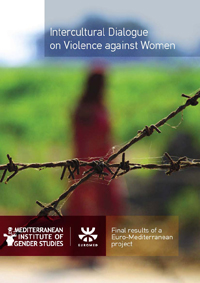
Intercultural Dialogue on Violence against Women: Final Results of a Euro-Mediterranean Project

This 101-page document summarises the final results of the 2007 project and study carried out by the Mediterranean Institute of Gender Studies (MIGS) to enhance the participation of women in intercultural dialogue about violence against women (VAW), as well as to develop strategies for overcoming discrimination and VAW in the Euro-Mediterranean (Euro-Med) region. MIGS, based in Cyprus, and 4 co-participating organisations from the region - Egypt (Alliance for Arab Women [AAW]), Greece (ANTIGONE - Information Centre on Racism, Ecology, Peace and Non Violence), Morocco (ISIS Center for Women and Development), and Spain (Association HEURA) - identified 25 women from diverse backgrounds to discuss VAW at a 2-day workshop. Funding for the collaboration came from the Anna Lindh Foundation for the Dialogue between Cultures.
The document includes a synthesis of the reports on VAW from the 5 partner countries, information from the workshop and training sessions conducted in Cyprus, and the short-listed photographs from the project’s photo competition and photo exhibition. It also summarises ways and means for further cooperation among the participants in the area of eliminating VAW, as well as ways of sharing and disseminating the results of the project activities to relevant stakeholders in the partner countries and in the Euro-Med region.
For the photo competition, candidates were asked to take their own camera and capture powerful images representing the issue of VAW from a gender-sensitive perspective. The competition was designed to allow for the assembling of an exhibition for public display. The short-listed winners from the 5-countries were invited to the workshop and training.
The workshop in November of 2007 included non-governmental organisation (NGO) activists, journalists, and women from minority groups. Organisers aimed for it to serve as a platform for discussion and identification of areas of common concern, exchange of experiences, and to strengthen ties between women and organisations working on VAW in the Euro-Med region. The representative NGOs made presentations on such topics as: trafficking in women for sexual exploitation - including a Greek project “Vocational Training and Awareness for the Police about Trafficking Issues”; date rape cases among young women; honour-related violence; advocacy and lobbying campaigns; and gender violence prevention in education. The AAW showed its short film-spots on "Honour Killing & Rape", produced in 2004 and shown on national television in Egypt.
Working groups discussed the following strategies:
- The creation of a Euro-Mediterranean Observatory on VAW that would monitor and evaluate national action plans and the implementation of legislation and other policy measures on VAW across the Mediterranean region.
- Identifying possible allies and partners in the government, engaging faith organisations and community centres, and using the media as an advocacy tool in Egypt to raise awareness and help address the problem of sexual harassment.
- The distribution of postcards in key locations, as well as television advertisements designed for a broad audience, for an awareness campaign on VAW, focussing on victims of violence and how women can better access support and protection services.
- The creation of networks of journalists in the region sensitive to the issue of VAW, engaging the media wherever possible in activities addressing VAW, and using alternative media sources such as internet blogs.
- The hosting of the photo exhibition by each partner organisation in their respective home countries as an awareness raising measure for VAW.
- The formation of an online group as a method of communication and possibly creating a larger network for information sharing among young women and NGOs working on VAW in the region. As a starting point, an email list was created.
From the country reports, recommendations by country for fighting VAW include the following:
- Morocco
- Policy and legislative response to the problem of domestic violence, with attention to the barriers that currently prevent women and girls in Morocco from lodging complaints in relation to domestic violence.
- Spain
- The creation of “Violence against Women Courts” which are staffed by professionals trained in gender violence.
- Education, with a clear focus on the prevention of violence.
- Increased material and human resources for the implementation of the Organic Act on Integrated Protection Measures against Gender Violence, enacted in December of 2004. Expansion of the reach of the law is needed, especially in health, education, care systems, police interventions, and judicial responses.
- Egypt
- A holistic approach and a comprehensive law against gender-based violence, based on a clear definition that specifies all forms, are needed. In addition, a 'legal mechanism' that provides protection for the victim from the aggressor would encourage more women and girls to file complaints.
- Select projects that stress socio-economic empowerment and education as human rights tools and find choose from them best practices that can be replicated.
- Strategies that focus on the social aspect of female genital mutilation (FGM), by focus on whole communities, rather than individual families.
- Greece
- Start the understanding and acceptance of the equality of the two sexes within the family and continue in education and in training of teachers, students, and professionals.
- Increase provision of support services.
- Increase confrontation of the problem at a legislative level.
- Cyprus
- Systematic research on the extent of these crimes needs to be conducted to inform policy and support and prevention campaigns.
- A gender perspective needs to be incorporated in all legislation, policy measures, and support and prevention campaigns.
- Other forms of violence against women urgently need to be addressed in Cyprus, such as sexual harassment, rape, and honour-related violence.
- A systematic plan of action for the prevention of VAW should be introduced and monitored as to its implementation, regularity, intended group, and evaluation.
- Awareness campaigns should be conducted, using all means available, particularly the media, to sensitise the public and empower women to seek assistance and support.
- Measures should be adopted for better coordination and communication between services.
- Education regarding sexual rights, communications skills, human rights, non-violent behaviour, etc., should be incorporated into the school curriculum.
- Log in to post comments