










































Increasing Full Child Immunization Rates by Government Using an Innovative Computerized Immunization Due List in Rural India
SHARE INDIA (Ganguly, R. P. Reddy, Balasubramanian, P. S. Reddy); Bhoruka Charitable Trust (Gupta); University of Washington (Widge); University of Pittsburgh (P. S. Reddy)
This study explores the use of computerised databases for achieving enhanced immunisation rates in India. Science Health Allied Research Education (SHARE) INDIA, a non-governmental organisation (NGO) from Andhra Pradesh, India, developed a strategy called Rural Effective Affordable Comprehensive Health Care (REACH), with the primary objective of promoting antenatal care (ANC), child immunisation, and family planning. Bhoruka Charitable Trust (BCT), which operated the Integrated Child Development Services (ICDS) Scheme in partnership with the government for 18 years in Rajgarh block of Rajasthan, India, provided researchers with the opportunity to test the REACH strategy without recruiting additional NGO health workers. In brief: "The success of the REACH strategy in both Andhra Pradesh and Rajasthan suggests that it could be successfully adopted as a model to enhance vaccination coverage dramatically in other areas of rural India."
Immunization coverage rates reported by National Family Health Survey (NFHS)-3 (2005-2006) were as follows: all India 44.0% (rural 39.0%), Andhra Pradesh 46.0% (rural 43.0%), and Rajasthan 26.5% (rural 22.1%). Various reasons for high partial/nonimmunisation rates in the study area have been reported in literature. According to one investigation carried out in the study area in 2007-2008 (the same year as REACH baseline survey), these reasons include: inadequate information about complete immunisation schedule (64.7%), thinking immunisation was not required (4.2%), no faith in immunisation (1.4%), lack of time to take children to immunisation sessions (2.8%), and sick child (1.4%). A United Nations Children's Fund (UNICEF) report exploring the same reasons, based on interviews with over 10,000 mothers, categorised them into demand-side and supply-side problems.
In this context, the REACH model, which was implemented in all 40 villages in Medchal mandal of Andhra Pradesh in 1994, managed to achieve full immunisation coverage of 96% among children aged 12 to 23 months in 2007. Furthermore, the model appears to have self-sustained there for over 20 years; rural Medchal mandal continued to sustain a high full immunisation rate (92.1%) until 2014.
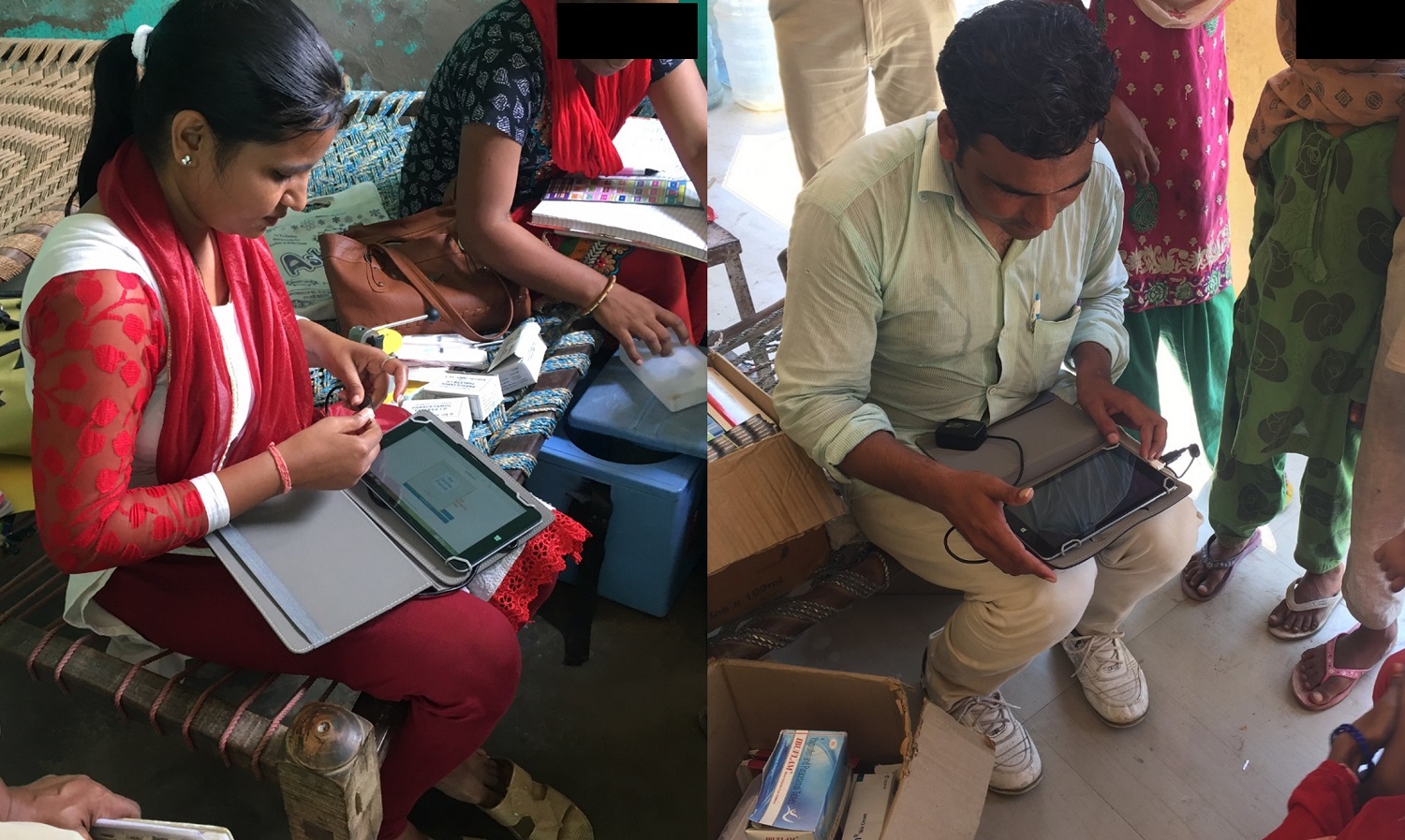
The REACH strategy comprised a 3-tier system where each village was mapped by global positioning system (GPS) and surveyed, along with enumeration of all persons in the household. Health information was gathered by trained community health volunteers (CHVs), 1 per 200 households, whose work was closely supervised by 4 health supervisors and 2 field coordinators. Villagers' demographic profiles and health data, including data on pregnant women, were tracked by a computer database. This was used to generate timely information for health care interventions and weekly reports of unimmunised children (using pregnancy and delivery tracking) in each village. This information was shared with government health functionaries; if government workers failed to immunise all identified children, the REACH health supervisors provided appropriate immunisations. Despite the success of REACH, the concern was that it might not be affordable to implement the strategy in other regions, as the original pilot required hiring NGO health workers in parallel with government functionaries. To render this strategy widely applicable, it was felt necessary to test its efficacy without deploying NGO health workers.
In 2008, BCT engaged the services of Indian Institute of Health Management Research (IIHMR), Jaipur, Rajasthan, to carry out an independent baseline evaluation of ICDS services in the Rajgarh block by conducting a 30-cluster survey, which showed a full immunisation rate of 64.7% among 12- to 23-month-old children of Rajgarh block. The same survey also found that 32.4% children were partially immunised, and 2.9% did not receive any immunisation. These results constituted the benchmark for evaluating the effectiveness of the REACH strategy in augmenting immunisation coverage in the study area.
To implement and test the REACH strategy, BCT provided data management staff consisting of 1 field supervisor, 1 data manager, and 5 data entry operators, along with a computer server with 5 nodes and a printer. Data entry staff and data manager were trained by internationally certified trainers from SHARE INDIA, who also designed the software and piloted its implementation in Andhra Pradesh. Reportedly, the software performed well with very few technical problems that were easily absolved by the data manager.
The report describes how the system worked, including the roles of the child development project officer (CDPO), lady health supervisors (LHSs), auxiliary nurse midwives (ANMs), anganwadi workers (AWWs), and accredited social health activists (ASHAs). In brief, household surveys were conducted by ASHAs in the REACH format, and the survey findings were used to create a computerised database. Information from the women's questionnaire was used to identify the pregnant women and immunisation status of children in the villages. Monthly reports were generated and provided to the LHSs 2 weeks ahead of the monthly sector meetings for distribution to the ASHAs. The ASHAs were asked to ensure the immunisation of unimmunised children in the list with the help of ANMs. ASHAs submitted reports of immunisations conducted and additional information regarding new pregnancies and live births in their service areas. At monthly sector meetings, the field coordinator received these updated reports from ASHAs through the LHSs. LHSs were expected to verify completeness and accuracy of collected data before submitting it to the field coordinator. Data were entered into the computer to maintain a prospective database in time for making available revised immunisation lists to LHSs and ASHAs within 2 weeks.
The use of computerised data was initiated in October 2008. All pertinent data as of December 31 2009 relating to immunisation services during this period were analysed. About 14 months after initiation of the REACH strategy, full immunisation coverage increased dramatically to 88.7%, partial immunisation declined to 10.3%, and only 1.0% did not receive any immunisation, compared with the results of the benchmark IIHMR survey (2008) to represent the preintervention rates.
There were, however, challenges faced while implementing the model in Rajgarh villages. The researchers identified poor follow-up and communication by government staff as the prime reason for high partial/nonimmunisation and dropouts, although access was fairly moderate, with 72.1% villages in Churu district having access to a subcenter within 3 kilometres and 75% of the primary health centres (PHCs) functioning 24 hours per day. The listing of beneficiaries helped to mitigate this problem, as the time spent on house-to-house surveys for identification of unvaccinated children was saved for other activities and lessened the stress on the burdened health workers. This model particularly helped to track dropouts in multidose vaccines. The government functionaries also feared the additional reporting burden imposed to support implementation and data updating, but their apprehensions were allayed with short orientation training, where it was explained that they were not to collect additional data but, rather, to improve data collection quality on existing parameters. The researchers also felt the need for periodic reorientation for boosting the dwindling motivation levels of health functionaries. They suggest that additional interfaces for better communication with beneficiaries may be provided to help prevent resistance and improve coverage rates. Community participation and engagement strategies have been shown to boost immunisation coverage rates in other, similar-performing regions.
According to the researchers, it is possible that government health functionaries can implement the REACH strategy without partnering with an NGO; they recommend that this possibility be field-tested in some selected areas. Although the database has been most successful with immunisation programmes, it may be helpful in other areas of public health as well. For example, REACH in Rajasthan has also been used to track ANC visits and delivery sites for pregnant women and has yielded data on family planning practices and trends.
Inquiry. Volume 55: 1-8. doi: 10.1177/0046958017751292. Image credit: Johns Hopkins Medicine
- Log in to post comments