










































Human-Centred Design Tools for Care Groups in Zimbabwe
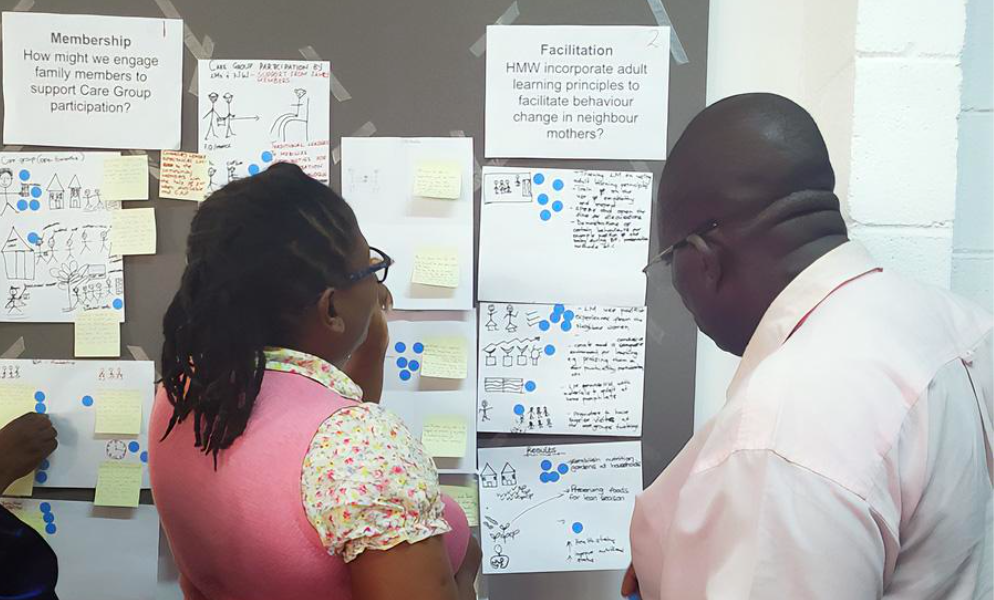
"Care group participants defined a quality group as one that is united, peaceful, and contributes to relevant, visible changes in their homes and communities."
This set of tools was created as part of a human-centred design (HCD) process and to test transferable solutions to improve the quality of peer support groups in Zimbabwe. They were developed by Amalima Loko, an initiative that works to improve food security in five districts of Zimbabwe's Matabeleland North region through increased food access and sustainable watershed management. Amalima Loko is a partner of USAID Advancing Nutrition, the United States Agency for International Development's (USAID) flagship multi-sectoral nutrition project.
Under Amalima Loko, care groups are used as the peer-to-peer support group model to improve the health and nutrition of the communities they work with. Care groups consist, on average, of up to 10 caregivers of children under five led by a volunteer lead mother. This group meets regularly - typically twice a month - and receives household-level counselling from a lead mother.
The tools were developed as part of an HCD research process to improve programme implementation and success. As explained by USAID Advancing Nutrition, HCD "is increasingly applied to global health challenges to help program or service providers think differently about problems and collaboratively generate solutions with intended users or program participants. The process engages diverse stakeholders to frame challenges and co-create solutions, puts program participant needs, desires, and contexts in the center of solutions, and uses cycles of creative and iterative solution development, testing, and monitoring."
This set of tools was developed to support the care groups and is based on feedback from neighbour mothers and caregivers, lead mothers, and promoters of care groups. The tools are meant to be reflective of the challenges and opportunities to support behaviour change they described and prioritised in individual interviews and district-level workshops. These challenges and opportunities included, for example:
- an interest in modular content beyond breastfeeding and hygiene among neighbour mothers;
- recognition that in some groups, neighbour mothers are not bringing challenges to the group for problem-solving or discussion;
- the fact that neighbour mothers enjoy performing dramas and expressed interest in developing their own dramas;
- a desire among lead mothers to receive training or mentoring from promoters;
- the existence of interpersonal challenges between some care group participants;
- a desire among lead mothers to teach others and build their reputations as leaders;
- an interest among lead mothers to receive additional capacitation of soft skills; and
- some neighbour mothers' lack of sufficient time or relevant skills to promote reflection.
Based on these challenges and opportunities, the four tools or solutions identified and tested by the group were designed to strengthen dialogic facilitation and community recognition by including reflection and interactive, fun activities and by increasing social support for participation through commitments. In their current form, the tools are ready for local adaptation and use by programmes that seek to strengthen care groups or other peer-to-peer support groups through dialogic facilitation and social support, which, it is hoped, will lead to improved participation and adoption of key practices.
The tools are as follows (click on hyperlinked headings to access the tools online in English, Tonga, and isiNdebele):
- Look and Learn Guide Guide for Care Group Leaders - This guide shares tips for preparing lead mothers and facilitating look-and-learn sessions. During these care group meetings, a hosting lead mother and promoter invite visiting lead mothers to observe a care group session. After the meeting, the lead mothers and the promoter debrief to share recommendations and reflections on the session. The guide was designed to be used by a hosting lead mother and/or a promoter.
- Drama Development Guide - This guide provides two adaptable templates for facilitating the development and optional performance of an original drama based on care group member experiences and priorities. The dramas could reflect a range of experiences. Creating them will require implementing adult learning principles (such as drawing on past experiences to create the dramas and applying their skills to a relevant problem) and soft skills (such as communication, interpersonal relating, time management, and teamwork).
- Simple Job Aid for Reflections Session - This job aid has been designed to support care group participants in reflecting on the modules they've completed and the behaviours they have practiced and tried to adopt. Reflecting on the modules and receiving feedback from care group participants is one of many ways that lead mothers can support their care group members in adopting recommended behaviours. The template includes welcome exercises, illustrative discussion prompts, and facilitation tips.
- Commitment Card Guidance and Monitoring Form and Example Commitment Card - This guide has been designed to support care group participants in making commitments to practice a recommended behaviour. The guide, which is meant to be used by lead mothers during care group meetings and home visits, is accompanied by an example commitment card that reflects the recommended behaviours they would like to promote. To use the card, caregivers invite a member of their household to be their commitment partner.
Publishers
USAID Advancing Nutrition website on March 20 2024. Image credit: Riley Auer/USAID Advancing Nutrition
- Log in to post comments